Yosemite from 36,000 Feet

Whenever I fly home to San Diego from Sacramento I try to sit in a window seat on the left side of the plane. When the weather is clear, and the route of the plane is just right, I have a phenomenal view of Yosemite Valley. Such was the case when I came home last Friday:

Yosemite from Plane 1

As always, please click on the image and get a larger view. For those of you that don’t recognize the two giant landmarks in Yosemite, I have pointed them out in the image below.

Yosemite from Plane 2

It takes just a few minutes to fly over this most splendid part of our state, and if you don’t know what you’re looking for, you can miss it entirely. However, I have spent many hours looking up from the base of the valley on El Capitan, a sheer wall of thousands of feet. Climbers spend many days scaling this vertical wall.

A year ago I hiked up Half Dome. It was a fantastic hike and a great adventure which I described in the post behind this link.

I am fascinated by different perspectives we humans get to have. Being on such a massive mountain, being totally at the mercy of our gear and our training, we feel like ants in the grandiose splendor of nature. Yet, hours later, for a small amount of money, we can be on an airliner cruising over these massive mountains at 36,000 feet, making them look like tiny anthills themselves.

This is how we will feel a few hundred years hence when we have figured out how to make starships, when we leave the solar system and we look back on that pale blue dot that is the entire earth.

It’s at times like this when I feel fortunate to be alive in an age where I have both the opportunity to climb a mountain like Half Dome in the wilderness, and then fly over it as if I were a god.

Another Attempt at Sill Hill Waterfall

Early this morning I made another attempt – after several more over the last ten years – to find the elusive Sill Hill Waterfall. I didn’t reach the fall, and there were a lot of things “wrong” with this hike.

I was at the waterfall once and only once in the early 1990s, I don’t remember exactly what year. Then I had used Jerry Schad’s 1986 edition of Afield and Afoot in San Diego County – now very battered but still treasured.

Map Sill Hill
Map of Hike – click to enlarge

I started on the right side of the map, at a sharp angle of highway 79 just south of Lake Cuyamaca. There is a little parking area there in the bend which is impossible to miss. I got as far as the blue arrow on the map, which was 2.4 miles of hiking, moderately uphill, and then downhill for a while. The waterfall is located approximately where the red arrow points. There is no trail to the fall – never has been. That’s partly why it’s such a treasured destination. It’s just about impossible to find – or to reach. But let’s start at the beginning.

Milk Ranch Road
On Milk Ranch Road

Milk Ranch Road is a pretty well developed dirt road up the hill. There is no vehicle traffic since it is closed off by a locked gate down by the road. I left early in the morning, around 7:30.

Hail
Who is Waving At Me?

As I hiked up the road, suddenly I had this distinct feeling “somebody” was looking at me. There was a burned tree trunk to the right up the hill that looked a lot like a Hitler soldier saluting. I must add that the fires in the early 2000s devastated what used to be a forest up here, and dead trees are everywhere, as you can see in these pictures.

Six Way Intersection
The Six Way Intersection

After about two miles going steadily uphill I reached the 6-way intersection at a saddle. Here I am facing south toward the Azelea Spring Fire Road, which connects to the trail I took on July 4, 2012, described here.

Impenetrable Underbrush
Impenetrable Underbrush – Cuyamaca Peak in the Background

Zooming the camera looking south, I could see Cuyamaca Peak, the second highest point in San Diego County, in the background. The mountain is covered by dead burned forest. The undergrowth is as tall as two men or more, and completely impenetrable.

Toward Cuyamaca
New Growth Covers Floor

Here is a more panoramic view, with thick brush visible in the foreground. Some young fir trees are poking through, and a few old ones survived, but it may take another century before these woods are covered by forest again like they were in the 1990s.

Vast Meadows
Vast Meadows

Turning north, there are vast meadows of dry grass, some of it chest high. You cannot see the ground through the brush.

Supposed to Go This Way
This Way – Really?

As I reached the point where it was necessary to leave the road and head through the brush to find the waterfall, I looked west and contemplated entering the bush. When I first found the waterfall 20 years earlier, this was dense forest with not much coverage on the ground, good for reasonable walking, avoiding poison oak here and there. Now, I found it impossible.

Or That Way
Or That Way?

Here is another view west, the direction I was supposed to go. There was no way I would be able to cover half a mile downhill in this terrain.

I carried a GPS, so I was sure I would find my way back, but first I’d have to get through this. It’s not like I brought a machete.

And then I got scared. All of a sudden I realized that there were a lot of things wrong with my situation.

I was more than two miles away from the nearest human beings (at the road) and all alone. It was the middle of July, and at 8:30 it was already hot, with flies buzzing around my face. Cuyamaca is mountain lion territory. It’s not wise to be alone, defenseless except for my hiking poles – which were strapped to my backpack – in mountain lion terrain. I am sure I was making plenty of clumsy noises, and I was smelling of fear, now that I realized how exposed I was. Then I looked down and noticed I could not see the trail through the thick grass. The summer heat would have rattlesnakes very active, and hidden perfectly under the brown and yellow shrubs, invisible to me. I had actually SEEN rattlesnakes on this trail previously.

Invisible rattle snakes, invisible cougars, and me all alone – I was freaking out.

Sorry, Sill Hill Waterfall, to conquer you I must:

  1. Come in the winter, when rattle snakes are slow, and flies are rare
  2. Come with several more people, two minimum
  3. Bring a machete
  4. Scare away mountain lions by the sheer ruckus our group makes

What was I thinking?

Sign Mountain Lion
Sign at the Parking Lot

I hightailed out of there, watching carefully where I was stepping, and turning around and looking for furtive eyes stalking me in the brush from all directions. I was relieved when I safely reached the parking lot an hour later.

And then I saw this sign.

Hiking Mt. Baldy

On Saturday, May 25, I finished what I didn’t complete on May 4, conquering Mt. Baldy.

This time I approached it differently. Starting from the same parking lot, I went up the ski lift road to Baldy Notch, then up towards north-west to the Devil’s Backbone, and along the ridge, all they way to the peak at waypoint 24. Then I came down the way I wanted to go up, waypoint 25 and 27. I checked out the camping spots Kyle had pointed out at waypoint 26, went down to the Sierra Club hut and the creek, waypoint 28, and finally back down the same route I had taken last time. It was a long 9 hours and 11.5 miles, with some of the steepest trails I have seen in Southern California.

Map Baldy Hike 05-25-13
[click to enlarge]
Starting out, the trail is really a truck road from the base to the top of the ski lift.

Ski Lift

Here is a view looking down with a lift tower crossing the road. The first 3.2 miles of this hike is basically on road like this, climbing moderately up to 8,200 feet.

Looking Down on Clouds

Here is a view from the same spot looking in the other direction, south. The marine layer is still over the Los Angeles valley far below.

Going Here

Looking west, I can see the peak of Mt. Baldy for the first time (red arrow). This is where I am headed.

Top of Lift

It is somewhat disconcerting to hike 90 minutes uphill a dirt road in the deep mountains and then find – cars – on the top. This is the top of the ski lift. There are some side lifts going into several other directions from this point. I have never actually been up here skiing, but I thought I should try it sometime and see the mountain from a whole different perspective.

North to Mohave

Just a few steps from the skiing area is the precipitous drop to the north. Here I had a good view down into the Mojave Desert with a thick white band of clouds covering the base of the mountain.

Devil's Backbone

After another ten minutes of hiking west from the ski area up an access road, the Devil’s Backbone starts. This is a narrow ride with steep declines in both direction, in some places several thousand feet down. There are spots where the ridge is literally three feet wide, with drops on both sides. I could not take pictures there. I have to fix my eyes on the trail and put one step in front of the other, lest I get dizzy and – I don’t want to think about it. There are also sections where the trail is a mere foot wide across loose scree fields, where I find it very important to make sure to place every step carefully. Twisting an ankle or stumbling could be very hazardous. The slopes are steep enough that it would be impossible to arrest a fall, should one occur. I always wondered what it would be like up on the Devil’s Backbone during gusty winds.

Summit Ridge

Finally the summit is in view. It’s still a long way up, about 1,000 feet in altitude from where I took this picture.

Summit Ridge Zoom

Here is a zoomed view. Looking carefully, it’s possible to see the trail winding up the ridge and there are even some hikers visible on the trail. The top is the summit of Mt. Baldy.

On Summit

And here I am standing on the summit at 10,068 feet (3,069 m). It took four hours and ten minutes to get here, hiking 6.8 miles.

Busy Place

The summit is a large area. There must have been a hundred people on top when I was there at 11:40am.

Broad Expanse

The peak is vast, this view facing west. On clear days, the Pacific would be visible from here. I am always amazed when I am on the top of a mountain. There is no way to go any higher.

View East

Looking east from the same spot, the two other iconic mountains of Southern California are visible. On the left (red arrow) is the huge bulk of Mt. San Gorgonio, with 11,499 feet (3,505 m) the highest mountain in Southern California. A bit to the right is Mt. San Jacinto, at 10,833 feet (3,302 m) still 800 feet higher than where I was standing at 10,068 feet.

Rugged Life

Plant life is rugged up here.

Found It

I took the way down toward the Sierra Club Hut and found the spot where I had intended to camp on my last trip. It’s a beautiful, quiet place. I sat down and had lunch here.

Coming down the one mile to this spot from the summit was very steep and slippery due to loose gravel at times. I was glad I was making it downhill, not the other way with a full pack.

Need to Go There

From this point, I could see where I had yet to go, the valley (red arrow).

Devil's Backbone from other Side

In the other direction, I could see the ridge of the Devil’s Backbone, the way I had gone up a few hours before.

Trail Down

The trail down is quite rugged at times.

Mystery Plant

I saw some of these mushroom-like plants, about six to ten inches tall. I don’t know what they are.

I Was There

Just before getting down to the parking lot, I looked back up to where I just had been, the summit of Mt. Baldy (red arrow).

San Antonio Falls

At 0.7 miles into the hike, there is a good view of San Antonio Falls. There are always people frolicking at the bottom of the falls.

At this point, having hiked over 11 miles, I could think of nothing but getting back to the car.

It was a good day.

The Day I Didn’t Hike Mt. Baldy

Mt. Baldy, sometimes called Mt. San Antonio, is the peak of the huge mountain range just south of Pasadena. It’s 10,064 feet high. The trail head is at 6,100 feet, so it’s a 3,900 foot and very steep climb. I got the idea from Kyle blogging at Hiking Angeles Forest. He was there the weekend before me and pointed out a ridge with a number of flat spots very suitable for spending the night. You might read his account yourself. It drew me right in. On Saturday, May 4th, I made my attempt.

I had been on the top of Baldy several times before, but each time I had taken the route via Baldy Notch and Devil’s Backbone, which is much less step. Also, each time before I did day hikes, carrying a day pack only.

This was a two-day trip, however, and I wanted to break in my new pack. Fully loaded, at the parking lot, it looked like this:

Backpack

Can you spell “TOO HEAVY” ???

My  plan was to hike to Kyle’s Ridge (here you go, I gave it a name) on the first day. I brought five quart bottles for water, only two of them full. I figured I’d need no more than two to reach the creek at the Sierra Club Hut (see below).

Once at the ridge, I’d build my camp, then hike down again to the hut and the creek, fill up all five water bottles, and hike back to the ridge, this time carrying only water.

Five bottles of water should be enough to remain hydrated through the night, provide for breakfast cereal, then keep me in water for the ascent to the peak the next day, and finally all the way back down via the Devil’s Backbone.

Good plan.

Here is the map of my trip, showing my actual hike.

Map
[click to enlarge]
You can see the trail head and the start of my hike at the red arrow. The first 0.7 miles is a fairly steep paved road ending at a major switchback with a great view of San Antonio Falls. Then the road becomes dirt. Following it leads up to Baldy Notch and it was to be my way back down. After 0.3 miles exactly at way point 022 on my map, there is a little side trail that may be easy to miss, climbing up the slope on the left of the road.

The green arrow points to the hut, at way point 023, 1.7 miles from the trail head. The blue arrow points to the approximate location of Kyle’s Ridge.

The word steep is no kidding here. This is definitely as steep as “the wall” on Vivian Creek Trial on Mt. San Gorgonio. I labored up weighed down by my pack and I found myself surprised how hard it was for me. I blame some of it on my new pack, but most of it on my lack of practice. It had been almost two years that I had done an overnight trip carrying a full pack. I was glad I was alone, lest I embarrass myself by my slow pace.

At 1.2 miles, the view opened up and I saw my destination:

Where I am Going
[click to enlarge]
The blue arrow points to the peak of Mt. Baldy, where I wanted to be the morning of the next day. The red arrow points to the Sierra Club’s San Antonio Ski Hut, which was built in 1935, burned in 1936 and rebuilt in 1937. If you enlarge the picture you can see a little white dot, which is a reflection off the hut – I know, not much to see from a distance of 1.7 miles.

And a long, long, long 1.7 miles seemingly straight up the mountain it was.

Trail

Here is a typical stretch of trail.

Hut

Just about three hours and 2.7 miles after leaving the parking lot I arrived at the hut at 8,200 feet altitude. The hut was occupied by a group of at least 20 or more rambunctious boys and a few men, all in identical T-shirts, maybe a church group or scouts. It was a noisy lot, so I had my lunch break outside on a bench.

Looking down

Looking down from my spot, I had a nice view of the valley from where I came.

Peak

Looking north-east in the other direction, the top of the ridge in the background is the peak of Mt. Baldy, another 1.4 or so miles of trail and 1,800 vertical feet away. But now I faced the crux of the problem.

Destination

This picture shows Kyle’s Ridge from the hut, basically where I needed to go now, and then back here to fetch water, and then back up again. This is the blue section of trail I painted in the map between the green and blue arrows. With three and a half hours of daylight left, and my legs already weak from the climb up, I didn’t think I could do it. The altitude, the exhaustion, the weight of the pack, the time of day, all told me NOT TO DO THIS.

I considered for a minute to fill up all five bottles and make the trip only once, but even that seemed dangerous in my weak condition, adding six or seven pounds of more water to my already heavy load.

Finally, I considered spending the night near the hut. I decided that the trip up to the ridge under a full pack the next day would still be a challenge, and the presence noisy boys topped it off.

I finished my apple and hiked back down the trail the same way I came. I had a wonderful day hike carrying a full pack. When I got back to the parking lot two long hours later, my quads were jello from the constant braking downhill, and I was glad for having made the decision that ensured my safety.

My resolution is to come back to this spot with a day pack early one morning, go up via Devil’s backbone and come down to Kyle’s ridge, then the hut and complete the circle counterclockwise.

Meanwhile – I’d better train up carrying my pack.

Rattlesnake Threats

RattlesnakeI am a hiker and a climber. I am comfortable with my skills and I know my limitations. I know how to navigate, schedule my strength, time my outings, and pace my progress. I have done it for decades.

But I have always been worried about getting bitten by a rattlesnake. Climbing is dangerous when you reach up for a ledge over which you can’t yet see. You really don’t know if you’re going to face a snake there at any time. Every step over every rock or log can be the mistake of a lifetime. Such are the risks we take.

Here is the account of Justin Schwartz, who was bitten by a rattlesnake in 2002 when he was 13 years old. Click on the link on the bottom of his page for this pictures.

WARNING: These pictures are extremely graphic. If you cannot deal with very graphic medical “gore” you might opt to forego the pictures.


Hiking North Clevenger

After hiking the South Clevenger Trail last year on July 6, it was time for North Clevenger yesterday afternoon. I hiked alone.

Here is the map posted at the trailhead:

map

Here is the actual trail I hiked:

trail

First I might note that you can see the South Clevenger hike of July 6 on the bottom of the map (red arrow). The trailhead for the north section is off Highway 78, just a quarter-mile past the well-marked turnout by the south trailhead. There is good, safe parking for about 8 to 10 vehicles with plenty of overflow parking along the highway.

When comparing the map posted (top image) and my own trail, you can see that I didn’t go all the way. When I got to the end of my trail, I took a waypoint to make sure I’d find my way back, because the trail was lost to me at that point. It has completely fizzled out. The map shows it going on for another mile or two, but if it was there, I didn’t find it.

Going off trail was somewhat hazardous, because I noticed ticks. Sure enough, there was one crawling on my leg already. I decided to call it a hike and turn around at that point. But before I did, I took off boots and socks and examined my legs all the way up and down to make sure I had no nasty stow-aways.

elevation

As you can see from the chart, the trail starts at an elevation of about 700 feet and descends steeply into the bed of the Santa Ysabel Creek, before rising on the other side. The picture below shows a section of trail right next to the creek at about 500 feet elevation.

creek

From there, the climb is steady and consistent, with steep switchbacks at times, up to the top of the ridge seen in the picture below.

overview

Once I crossed over the ridge I hiked on the level for a while before the trail fizzled out at about 1880 feet elevation.

typical trail

Above is a typical view of the trail. Highway 78 is visible in the far distance below. The peak just left of the center of the picture is Cuyamaca, the (almost) highest peak in San Diego County.

boulders

Massive boulders spot the hillside, waiting for that inevitable earthquake to shake them loose and give them a few frantic seconds of tumbling before another rest of millennia.

parking lot

Here is a look from a little ways up, down to the parking lot from where I came. The red arrow points to my car.

The whole round trip took two hours and 45 minutes. It was sunny but not too hot, with a great cool breeze coming in from the distant ocean.

New Palm Grove 2010 – 2013

I have taken to hiking Palm Canyon in the Anza Borrego Desert every year right after New Year. I skipped 2011, and in 2013 I didn’t go in January, but on March 10.

On January 3, 2010, I noticed a brand new stand of palm trees developing. I took a picture and marked the spot (click to enlarge):

New Palm Grove 2010

When I came back on January 7, 2012, here is the identical view:

New Palm Grove 2012

Then I came back on March 10, 2013. Here is the view now:

Final 03-10-2013
New Palm Grove 2013

And here, for scale, with proud daddy:

Proud Dad 03-10-2013

Attempt to Hike Indianhead – Take Three

After a reader’s very helpful comments on my first post on the attempts of climbing Indianhead (thank you Charity), and after my trials in take two, I went out last Sunday to check out the suggested route.

The approach starts directly at mile 1.0 from the parking lot, about half a mile before reaching the first palm grove. The route leads straight up the mountain along a white gully.

I didn’t go very far. There is no cell phone reception. This makes at least one climbing buddy critical. Two would be better. The terrain is very difficult. There is no trail, and there are many opportunities to hurt ankles or much worse.

Just to give you a feel for what it’s like, here is a shot looking up to where I am going. The camera is pointed upwards. It’s very difficult to get a sense of scale. The ocotillo plants on the right are about twice the height of a man.

Gully1

As always, click on the images to enlarge.

Looking back to where I came from, pointing the camera down, I had this view:

Gully2

The scale of the terrain is difficult to show in pictures when there is no human being to photograph. So  I did you a favor and drew myself into the picture in front of the boulder, just so you get a sense of the size of things:

Gully3

Here is the funny thing:

Today, late morning, the office shook from the sharp jolt of a non-minor earthquake. I remember thinking that I didn’t want to be right there during an earthquake. It turns out, the earthquake happened 24 hours after I was there and it was centered in Anza, right where I was. I guess I just missed it.

I am now looking forward to January 2014 – hopefully time to bag Indianhead once and for all.

On Potato Chip Rock

Hiking Mt. Woodson on Monday, I could not resist posing on top of the famous Potato Chip Rock at the peak.

Norbert on Potato Chip Rock, Feb 25, 2013

Hiking El Cajon Mountain

“Hiking El Cajon Mountain is brutal and strenuous,” said Devin, who has spent more time on mountains and trails in the last year alone than most people do in a whole lifetime.

All the reviews say it’s “uphill both ways.” How can that be? Let’s look at the elevation profile:

El Cajon Elevation

While, on most mountains, you walk uphill on the way up, and downhill on the way down, that is not the case here. Every time we gained some elevation, we had to go downhill again, just to get forward. That’s a welcome break on the way up. Coming home, however, having to climb back uphill just to get back, is most unwelcome.

We uttered many four letter words on this hike.

Altogether, it took 6.5 hours to cover the eleven miles of this brutal trail. Devin could have gone much faster, I am sure, if he had not had to wait for the old man.

We also had issues with the trail itself.

El Cajon Map

It does not have many switchbacks. The trail itself appears to be an ancient logging or fire road that was originally bulldozed into the mountain, straight up and down. Now it is terribly eroded in most places, but the grade is very steep, making for very strenuous hiking uphill, with much huffing and puffing and resting, and knee-crushing, slow downhill slipping. It even took us a bit longer to return from the peak than it took going up.

Here is an example of the dreadful trail.

El Cajon Trail

This is looking down about a 30% grade, very steep. There is nothing special about this section. This is what most of this trail looked like, up, down, up, down, up and down.

At one point, fairly high up, we found this old mining truck, that must have been sitting here since the 1940ies.

El Cajon Truck

There is a reward for every climb, even the most ugly one, the most brutal one. The last half mile was a real, light trial, straight up the western flank of El Cajon Mountain. Even a little  scrambling around boulders was necessary. Here are father and son at the top:

El Cajon Peak

The downtown of San Diego is in the very distance on the left side of the picture, not really visible in this photograph. Devin hopped over to the actual peak to get a picture taken:

El Cajon Real Top

Here is a look back at our trail. The red arrow marks the furthest point from whence we came, after we had ascended the first major ridge from the road:

El Cajon From Whence

No matter how brutal the hike, how much we complain, it’s always rewarding to get down and look back up to where we just were. The red arrow points to the peak:

El Cajon Looking Back

The trailhead for this hike is off Wildcat Canyon Road, as you drive north, a mile or so past the entrance of Stelzer County Park. The parking lot for the trail is clean, maintained and well-marked with a brown sign for El Cajon Mountain Trail, right next to the road. There are even bathrooms at the beginning of the trail proper, about a third of a mile up from the parking lot.

Hiking Mt. Marcy – Take Two

A couple of years ago I hiked Mt. Marcy in July. Here is a small excerpt from that post:

When I finally got within a half a mile of the top, the weather became outright inclement. I had read about people dying on Mt Washington in Maine (6,288 feet high) during freak snowstorms in the summer and I could never understand how that can happen at such comparatively low altitude, as judged by a Californian. On Mt. Marcy I got my enlightenment. Even though I wore every stitch of clothing I had brought (my T-shirt, my long-sleeve hiking shirt and my windbreaker, I was whipped by an icy storm. Frozen raindrops pelted me sideways from the west. I had to face away from the wind so my hood didn’t get blown off and I could see. And through this I was picking my way up sheer rock slabs, slippery from the water, steep and sometimes without any good footholds.

Then, just recently, I came across this horrific blog entry that shows what can happen to a lone hiker. He got lost near the peak, but it was in winter. I cannot even imagine the panic he felt, and the fear for his life.

I always carry a GPS now. If I ever lost my way, I would notice it quickly and I would be able to determine where I missed my turn. It could quickly backtrack. This saved me a couple of times when hiking up on Half Dome and getting lost in the darkness of the early morning.

Movie Review: 1 Revolution

Chris Waddell is a paraplegic who lost the use of both legs when he broke is back in a skiing accident when he was a young man. He proceeded to train as a paraplegic ski racer and general athlete, becoming an advocate and inspiration for the disabled community.

He decided to “climb” Mount Kilimanjaro, the highest point in Africa at 5895 meters, and the world’s tallest free-standing mountain by using a hand-cycle. The bike is an off-road four-wheeler that he cranks by hand.

OneRevKili

The movie 1 Revolution is a documentary of Chris’ planning and execution of the climb. It is hugely inspiring for everyone, and I am sure more for “disabled” people. I am putting the word “disabled” in quotes because after watching this documentary, it’s pretty hard to get up and tell yourself that there is something that you cannot do.

I was personally particularly inspired by this film because, being a hiker and climber myself, I have had a lifelong dream of climbing Kilimanjaro that I have never taken the time to realize. I have only experienced it vicariously by books, and now by the documentary film 1 Revolution.

You can check out Chris’ website for much more information about him, his quest, his mission and his enormous adventure as the first paraplegic to scale Mt. Kilimanjaro under his own power.

Rating: ***


El Capitan Yearnings

Twenty years ago I did some rock climbing. However, I never did lead climbing. I never did multi-pitch climbing. The truth is, I am scared of heights. In my rock climbing endeavors, both in the climbing gym and outdoors, I learned that when your shoes are 10 feet above “the deck” – which is the floor, and you fall, you can very easily die. You don’t need to be 100 or 500 feet up. 10 feet is enough.

So climbing up 100 feet on a top-rope to an anchor I had built myself taught me many lessons. Some of those are:

1. As soon as your feet are more than 10 feet off the ground, and you mess up, or your gear fails, you die.

2. Never climb with – and be belayed by – somebody whose skills you do not know and who you don’t trust with your life.

3. When you’re on the wall, gross-national-product land is gone. Worries about career, money, family, kids and health are gone. That next hand-hold is EVERYTHING.

4. Rock climbing is an excellent way to overcome all kinds of fears.

But I had a career, responsibilities, children to raise, and very little time. My climbing faded further and further behind, and it’s been years since I tied my last figure-eight knot.

Still, it’s in my yearning and my blood, and when I recently visited Yosemite, where El Capitan, the holy grail of big wall climbing in America, overpowers all other mountains and natural features, I can’t help but stop the car, get the camera out, get the binoculars and look at the majestic mountain.

Above is a picture of El Capitan, or El Cap, as climbers lovingly call it. I took this picture from the road in Yosemite Valley. It’s a sheer wall of vertical, rock, 3000 feet tall; that’s more than half a mile.

[Go click on the picture to enlarge it and display it on a large monitor, if you can. Do that to all the pictures in this post, to get the most out of them.]

Here is El Cap from another angle, from the right of the picture above. I am a bit closer to the wall now. Do you notice anything? No?

Well, let’s go exploring together. Click on the image below. It’s the same picture as the one above, but I have pointed something out:

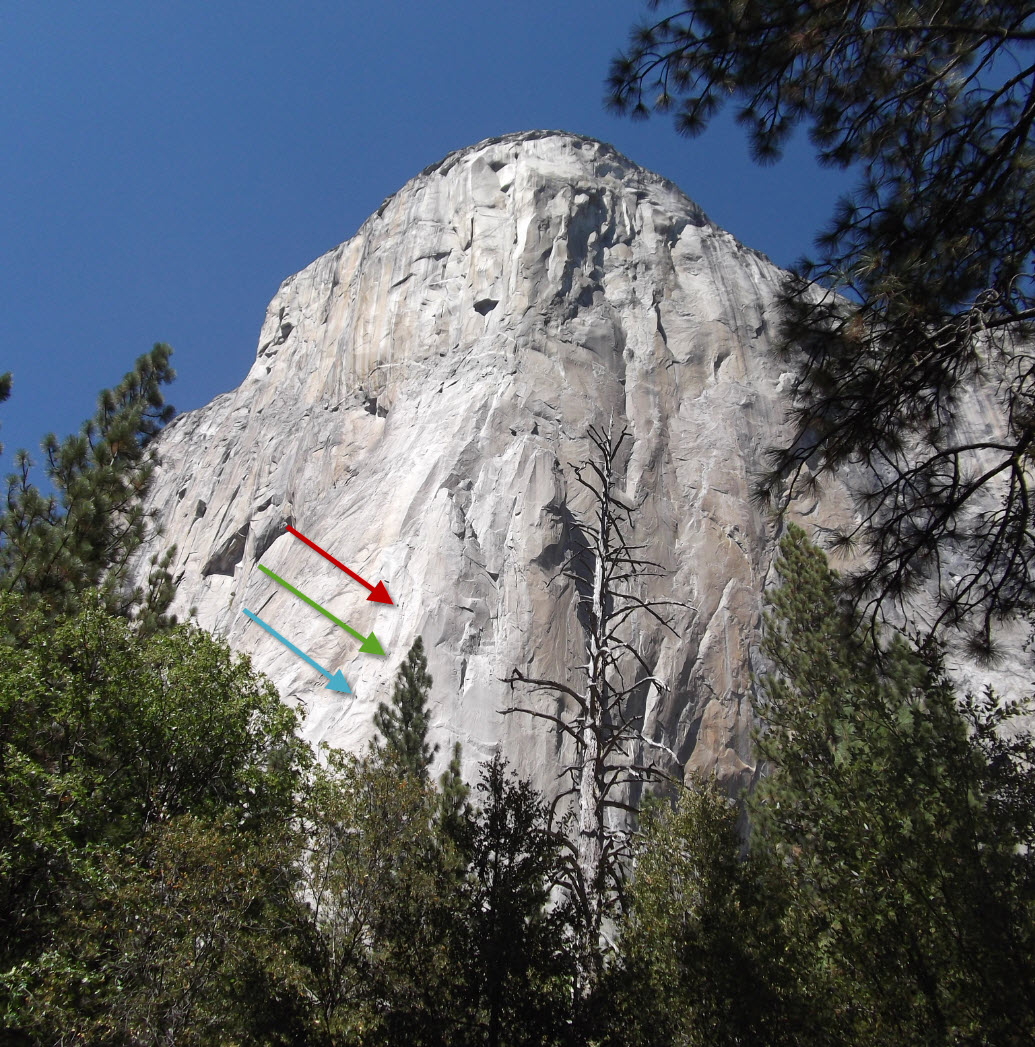
At the red arrow, there is a lead climber. At the green arrow is the team’s haul-bag. A haul-bag is where they keep all their gear for multiple days on the wall, jackets, sleeping bags, bivouac, food and all the water they will need. At the blue arrow is the belayer, who follows the lead climber up and removes the protection devices as he climbs up.

Can you see them? No? I agree, they are too small to see. To actually see them, you need to look at the zoomed picture below. This is the same image, just closer.

Ah, now you can see a man at the red arrow and some gear hanging to his right. About 30 feet below him, at the green arrow, you see the haul bag, with a yellow bottom. And another 30 feet below that, at the blue arrow, his partner, getting ready to follow him up.  It might be fun to click on the original picture above and try to see them without the arrows. You can use the tree in the foreground as a guidance of where to look.

After spotting them there, I wanted to get closer. So we hiked up to the base of the wall:

Here I am at the base. At El Cap, you can actually walk from the road to the base of the 3000 foot El Capitan wall in about 10 minutes through the trees. I am standing on flat gravel, approximately where these climbers started their climb, possibly early that day. Where is that first step, that first hand-hold?

Being at the base of El Capitan, I can now look straight up at the mountain. This is difficult to do, since I have to crane my neck to an impossible degree. So I just lay down on a flat boulder on the ground and looked up. This is what I saw from that spot:

The branch sticking down is from a dead tree further away from the wall than my spot. I am looking up the wall of El Cap to the very top, approximately in the center of the picture. Can you see our climbing boys from this perspective?

I didn’t think you could, so I marked them for you with arrows:

Can you see them now?

I didn’t think you could, so I zoomed in again, and now here they are:

There again is the haul bag at the green arrow with the yellow bottom, and the two climbers in their respective positions. Look at the dark black spot on the left upper side of the picture. That’s an overhang, or a “roof” as climbers call it. Does it not look, from this angle, as if the climbers were right under the roof? It does, doesn’t it?

Now, just for kicks, go back to the first picture with the arrows pointing to the tiny climber specks and look for the dark spot of the roof. It is way, way, way above them.

This is one of the interesting phenomena with rock climbing. When you’re on the rock, distances and heights get distorted. Looking down looks endlessly far, even though you my have just left “the deck.” Looking up does not look that far to go, and sometimes it’s very deceiving. It can be difficult to tell how high you actually are.

Here is a parting shot of me with binoculars with another spotter, searching for yet other parties on the wall.

Then I got in the car and drove away, full of El Capitan Yearnings.

Hiking Half Dome – Conquered

Half Dome was the physically hardest hike since summiting Mt. Whitney some 20 years ago when I was a much younger man. Ascending the infamous Half Dome cables was also the scariest thing I have ever done, worse than technical rock climbing and skydiving. This hike is listed in Backpacker Magazine as one of America’s 10 most dangerous hikes.

[click on any images in this blog post to enlarge]

The hike from the parking lot at the trailhead and back was 18.3 miles, starting at an elevation of 4,000 feet and topping out at 8,840 feet, a huge elevation change for a day hike. We started at 4:00 am in total darkness, and I came limping and dragging back to the parking lot at 6:00 pm. “Younger people” can usually do it in about 8 – 12 hours. We are not “younger people” anymore.

It is not my intent for this post to be a guide for other hikers, but rather a narrative of my own experience. “Mr. Half Dome”, Rick Deutsch, does a much better job, both with his website, blog, videos and his book Yosemite’s Half Dome. I highly recommend all if you are seriously planning hiking Half Dome.

When entering Yosemite through the main tunnel, the vista is breathtaking. Yosemite is one of the most spectacular and awe-inspiring natural places in this country.

On the left you can see the famous El Capitan, a 3,000 foot sheer rock wall. In the background, overtowering the valley and everything around it is Half Dome, our final destination. The north face of half dome is a 2,000 foot wall of vertical rock.

The weather looks good for a climb on September 11th.

Here is where we’re planning on going, zooming the camera in from the valley floor. It’s really 4,800 vertical feet above where we’re standing. Hikers come up from behind the dome, from this viewpoint.

In recent years it has gotten so crowded on this trail that now permits are issued and strictly enforced by an armed ranger. Since there are many more applications than slots, a lottery is used. Trisha applied in April and promptly won us slots for her birthday bucket-list hike on September 11th. I didn’t even know this was on my bucket list. Half Dome is listed as “strenuous” or “very strenuous” in every description.

It was pitch black when we got on the trail at 4:00 am. We turned the lights off and I took this flash picture. The reflectiveness of the sign turned Trisha into a ghost.

With headlights we only saw the next 10 or 20 feet in front of us. Turning off the lights left us in complete blackness, with the stars as bright as I have ever seen them overhead, accompanied by a sliver of a moon and Venus nearby.

For two hours we hiked up the famous mist trail past Vernal Falls, one of the most scenic hikes in America, and saw nothing at all. We even lost the trail a couple of times and needed to use to GPS to find our way back. Sometimes it’s hard to find the trail in daylight. Try total darkness sometimes. It’s a very uncomfortable feeling to be lost in dark woods next to thunderous waterfalls and sheer drops of hundreds of feet all around.

Around 6:00 am we finally got some light. By now we had passed through the most scenic part of the hike in darkness. At least we saw Nevada Fall right here. You can see some of the rough-hewn steps here. There were hundreds and hundreds of those leading up the cliffs.

Now we are in “Little Yosemite Valley.” There is a nice campground by the Merced River, and this is the last source of water. About halfway up. The top of Half Dome, from the back, still 3,000 vertical feet up and four miles away, is looming.

At 9:45 am we were at about 6.5 miles and 7,200 feet altitude. It was time to take inventory. Our non-negotiable turn-around time was to be at the cables by 11:00 am. Any later would jeopardize the hike and the ascent could get too dangerous, due to crowding, as well as weather. Thunderstorms or rain on the dome has been fatal to many a hiker and climber over the years. Trisha decided at that point that she did not have the strength to continue up the slope, with only an hour to go, let alone deal with the dome itself. The only responsible thing to do was to start the descent. I need to add here that many people somewhere along the way decide they have to turn around. I don’t know what the statistics are, but I assure you, the hike is much harder than most people anticipate.

We split up; I got into high gear and powered on.

After another 20 minutes up endless switchbacks, there is a flat ridge at about 7,800 feet altitude. Half Dome sat majestically, with the famous subdome in front of it. You can see the red arrow pointing to the cables on Half Dome and the blue arrow to the top of the subdome. Climbing the subdome is almost as scary as Half Dome itself, going up hundreds of rough, single file stone steps, some a foot high or higher. Toward the upper part of the subdome, the steps peter out and all that is left is steep, grey slab of granite to walk on.

Click on the image above to enlarge. You will see I have boxed in the cables section in green, and a section of the subdome in blue. There are people all over those two boxes, you just can’t see them unless I point them out.

So the image just below here is a zoomed copy of the blue box from the picture above:

I know it’s hard to see, but there are people all over these pictures on the wall. I have pointed out six of them with red arrows. You can now click again on the large picture above and pick out more people on the subdome, now that you know what you’re looking for.

Similarly, I have enlarged the green box here:

When you now see the people on these zoomed pictures, it puts the original picture into perspective.

Now I am on top of the subdome, which is marked by the blue arrow in the picture with the boxes above. Climbing the subdome was extremely exhausting. I would take 10 steps, stop and pant, try not to look down behind me the seemingly vertical wall. Another 10 steps. Don’t look down. Don’t look up. Focus on each step. Don’t slip. Don’t get dizzy.

Finally, on top of the subdome, shown here, there is nothing left to do but put on the gloves, gulp down some water, eat a quick power bar, and get on the cables.

I did not take any pictures while on the cables. I can only tell you about it now.

It took all my courage and resolve to walk up and get started. The slope is about 45 degrees, a bit steeper in the middle, less on both ends. The altitude is over 425 vertical feet to the top. Looking up, it looks straight up. Looking down brings on vertigo. I resolved to do neither. There are 68 posts, about 10 feet between posts, and 2 x 4 wooden slats at each post. So you pull yourself up using both arms on a steel cable thicker than my thumb. Strong gloves are absolutely required. Hands could not take it and skin would be gone in minutes. Feet solidly on the ground, walking up while pulling up. I could only do one post at a time and I needed to stand there and rest, breathe, relax the arms and hands. I could not have gone faster, since the traffic jam of people going up and going down slowed things considerably. There were some people, less than half my age, in complete panic and almost frozen with fear, clinging to a post, refusing to move.

I wished I had brought my climbing harness to clip in. Without a harness, slipping and falling for any reason would be deadly. Slipping could be induced by somebody above losing control or dropping something. When the rock gets wet, it’s like a sheet of ice, and the only thing left is upper body strength and hand strength.

Somewhere half way up, standing calmly and resting on a post, I realized how utterly exposed I was, along with 30 other people on the cables with me at the time.

Lesson to self: Next time, bring a harness and clip in. It’s the difference between sheer panic and peace of mind.

Now that you have a sense for what it was like, you will understand why I didn’t pull out a camera and took pictures while on the cables. I would have had to look up, look down, look around, let go of the cable, and take incalculable risks.

Sorry, no pictures.

40 minutes on the cables, and now I am standing on top of Half Dome:

To the right you see a couple of guys standing on the famous overhang. I cannot go near the abyss myself. I am happy just staying away from the edge.

Here is another angle of the overhang. People step out and look down, 4,800 feet to the valley floor below. A giant void unlike anything I have ever experienced before. I could not let myself get closer to the edge than this (about six feet or so).

Here is a view into the west. The top of Half Dome is said to be as big as 17 football fields. People have played frisbee up here, but don’t leap after it if it goes over the edge.

Clouds were coming in, making me scared. And knowing that I’d still have to go down the cables, which is a whole other experience, I could not relax sufficiently to enjoy much of my stay.

Here is the view from the top of the cables, before they curve down into the void.

Just as on the way up, I resolved to take it one post at a time. Don’t look down, don’t look around, since the void curves away in all directions. Try not to burn the gloves. Try not to slip. Carefully navigate around any people frozen in their fear, up or down.

Finally, 30 minutes later, I stepped off the cables, and told myself that I was glad that I had done it and that I would never, ever want to do THIS again.

One look back, now relaxed and satisfied. Been there, done that. Never mind that I had to get back down the subdome, and the other eight endless miles to the valley. Slowly, surely, I’d get there, about six long hours later of relentlessly pounding of the knees and feet.

The next morning, I point up to where I just was. See, it can be done.

And about never again: We decided that this was just a practice hike. We’re already planning to apply for Sept 11, 2013. We’re getting permits for a party of four.

Any takers for the extra two? I now know how to train you up.