Hiking Half Dome – Conquered

Half Dome was the physically hardest hike since summiting Mt. Whitney some 20 years ago when I was a much younger man. Ascending the infamous Half Dome cables was also the scariest thing I have ever done, worse than technical rock climbing and skydiving. This hike is listed in Backpacker Magazine as one of America’s 10 most dangerous hikes.

[click on any images in this blog post to enlarge]

The hike from the parking lot at the trailhead and back was 18.3 miles, starting at an elevation of 4,000 feet and topping out at 8,840 feet, a huge elevation change for a day hike. We started at 4:00 am in total darkness, and I came limping and dragging back to the parking lot at 6:00 pm. “Younger people” can usually do it in about 8 – 12 hours. We are not “younger people” anymore.

It is not my intent for this post to be a guide for other hikers, but rather a narrative of my own experience. “Mr. Half Dome”, Rick Deutsch, does a much better job, both with his website, blog, videos and his book Yosemite’s Half Dome. I highly recommend all if you are seriously planning hiking Half Dome.

When entering Yosemite through the main tunnel, the vista is breathtaking. Yosemite is one of the most spectacular and awe-inspiring natural places in this country.

On the left you can see the famous El Capitan, a 3,000 foot sheer rock wall. In the background, overtowering the valley and everything around it is Half Dome, our final destination. The north face of half dome is a 2,000 foot wall of vertical rock.

The weather looks good for a climb on September 11th.

Here is where we’re planning on going, zooming the camera in from the valley floor. It’s really 4,800 vertical feet above where we’re standing. Hikers come up from behind the dome, from this viewpoint.

In recent years it has gotten so crowded on this trail that now permits are issued and strictly enforced by an armed ranger. Since there are many more applications than slots, a lottery is used. Trisha applied in April and promptly won us slots for her birthday bucket-list hike on September 11th. I didn’t even know this was on my bucket list. Half Dome is listed as “strenuous” or “very strenuous” in every description.

It was pitch black when we got on the trail at 4:00 am. We turned the lights off and I took this flash picture. The reflectiveness of the sign turned Trisha into a ghost.

With headlights we only saw the next 10 or 20 feet in front of us. Turning off the lights left us in complete blackness, with the stars as bright as I have ever seen them overhead, accompanied by a sliver of a moon and Venus nearby.

For two hours we hiked up the famous mist trail past Vernal Falls, one of the most scenic hikes in America, and saw nothing at all. We even lost the trail a couple of times and needed to use to GPS to find our way back. Sometimes it’s hard to find the trail in daylight. Try total darkness sometimes. It’s a very uncomfortable feeling to be lost in dark woods next to thunderous waterfalls and sheer drops of hundreds of feet all around.

Around 6:00 am we finally got some light. By now we had passed through the most scenic part of the hike in darkness. At least we saw Nevada Fall right here. You can see some of the rough-hewn steps here. There were hundreds and hundreds of those leading up the cliffs.

Now we are in “Little Yosemite Valley.” There is a nice campground by the Merced River, and this is the last source of water. About halfway up. The top of Half Dome, from the back, still 3,000 vertical feet up and four miles away, is looming.

At 9:45 am we were at about 6.5 miles and 7,200 feet altitude. It was time to take inventory. Our non-negotiable turn-around time was to be at the cables by 11:00 am. Any later would jeopardize the hike and the ascent could get too dangerous, due to crowding, as well as weather. Thunderstorms or rain on the dome has been fatal to many a hiker and climber over the years. Trisha decided at that point that she did not have the strength to continue up the slope, with only an hour to go, let alone deal with the dome itself. The only responsible thing to do was to start the descent. I need to add here that many people somewhere along the way decide they have to turn around. I don’t know what the statistics are, but I assure you, the hike is much harder than most people anticipate.

We split up; I got into high gear and powered on.

After another 20 minutes up endless switchbacks, there is a flat ridge at about 7,800 feet altitude. Half Dome sat majestically, with the famous subdome in front of it. You can see the red arrow pointing to the cables on Half Dome and the blue arrow to the top of the subdome. Climbing the subdome is almost as scary as Half Dome itself, going up hundreds of rough, single file stone steps, some a foot high or higher. Toward the upper part of the subdome, the steps peter out and all that is left is steep, grey slab of granite to walk on.

Click on the image above to enlarge. You will see I have boxed in the cables section in green, and a section of the subdome in blue. There are people all over those two boxes, you just can’t see them unless I point them out.

So the image just below here is a zoomed copy of the blue box from the picture above:

I know it’s hard to see, but there are people all over these pictures on the wall. I have pointed out six of them with red arrows. You can now click again on the large picture above and pick out more people on the subdome, now that you know what you’re looking for.

Similarly, I have enlarged the green box here:

When you now see the people on these zoomed pictures, it puts the original picture into perspective.

Now I am on top of the subdome, which is marked by the blue arrow in the picture with the boxes above. Climbing the subdome was extremely exhausting. I would take 10 steps, stop and pant, try not to look down behind me the seemingly vertical wall. Another 10 steps. Don’t look down. Don’t look up. Focus on each step. Don’t slip. Don’t get dizzy.

Finally, on top of the subdome, shown here, there is nothing left to do but put on the gloves, gulp down some water, eat a quick power bar, and get on the cables.

I did not take any pictures while on the cables. I can only tell you about it now.

It took all my courage and resolve to walk up and get started. The slope is about 45 degrees, a bit steeper in the middle, less on both ends. The altitude is over 425 vertical feet to the top. Looking up, it looks straight up. Looking down brings on vertigo. I resolved to do neither. There are 68 posts, about 10 feet between posts, and 2 x 4 wooden slats at each post. So you pull yourself up using both arms on a steel cable thicker than my thumb. Strong gloves are absolutely required. Hands could not take it and skin would be gone in minutes. Feet solidly on the ground, walking up while pulling up. I could only do one post at a time and I needed to stand there and rest, breathe, relax the arms and hands. I could not have gone faster, since the traffic jam of people going up and going down slowed things considerably. There were some people, less than half my age, in complete panic and almost frozen with fear, clinging to a post, refusing to move.

I wished I had brought my climbing harness to clip in. Without a harness, slipping and falling for any reason would be deadly. Slipping could be induced by somebody above losing control or dropping something. When the rock gets wet, it’s like a sheet of ice, and the only thing left is upper body strength and hand strength.

Somewhere half way up, standing calmly and resting on a post, I realized how utterly exposed I was, along with 30 other people on the cables with me at the time.

Lesson to self: Next time, bring a harness and clip in. It’s the difference between sheer panic and peace of mind.

Now that you have a sense for what it was like, you will understand why I didn’t pull out a camera and took pictures while on the cables. I would have had to look up, look down, look around, let go of the cable, and take incalculable risks.

Sorry, no pictures.

40 minutes on the cables, and now I am standing on top of Half Dome:

To the right you see a couple of guys standing on the famous overhang. I cannot go near the abyss myself. I am happy just staying away from the edge.

Here is another angle of the overhang. People step out and look down, 4,800 feet to the valley floor below. A giant void unlike anything I have ever experienced before. I could not let myself get closer to the edge than this (about six feet or so).

Here is a view into the west. The top of Half Dome is said to be as big as 17 football fields. People have played frisbee up here, but don’t leap after it if it goes over the edge.

Clouds were coming in, making me scared. And knowing that I’d still have to go down the cables, which is a whole other experience, I could not relax sufficiently to enjoy much of my stay.

Here is the view from the top of the cables, before they curve down into the void.

Just as on the way up, I resolved to take it one post at a time. Don’t look down, don’t look around, since the void curves away in all directions. Try not to burn the gloves. Try not to slip. Carefully navigate around any people frozen in their fear, up or down.

Finally, 30 minutes later, I stepped off the cables, and told myself that I was glad that I had done it and that I would never, ever want to do THIS again.

One look back, now relaxed and satisfied. Been there, done that. Never mind that I had to get back down the subdome, and the other eight endless miles to the valley. Slowly, surely, I’d get there, about six long hours later of relentlessly pounding of the knees and feet.

The next morning, I point up to where I just was. See, it can be done.

And about never again: We decided that this was just a practice hike. We’re already planning to apply for Sept 11, 2013. We’re getting permits for a party of four.

Any takers for the extra two? I now know how to train you up.

Hiking San Gorgonio

In our quest for hiking Half Dome on Sept 11, San Gorgonio yesterday was the dress rehearsal. The round trip at Half Dome will be 15.5 miles, with an elevation profile of a 4,600 foot climb, from 4,000 foot to 8,600 foot. In comparison, San Gorgonio is a 18 mile round trip, with an elevation profile of a 5,300 climb, from 6,200 to 11,500 foot.

So all in all, San Gorgonio is a longer, harder and higher climb than Half Dome – except for the frightening cable part, and a great candidate for a dress rehearsal. And rehearse we did.

Here I am when we started at 6:30am, still relaxed and full of energy.

Things change quickly on the Vivien Creek trail, however. After hiking up a Jeep road for a half a mile, and crossing Mill Creek, the infamous Vivien Creek wall looms. This is a brutally steep stretch of switchbacks seemingly straight up, for about half a mile. It sure changes the mood.

[click on map to enlarge]

After the wall, the trail meanders along the creek for what seems miles and miles, occasionally broken up by a few switchbacks, it but climbs steadily. The terrain is wild, the cliffs huge, and as a human being I feel like but an ant in a gigantic world. Here is Trisha demonstrating just that point.

At 5.8 miles is High Creek Camp [waypoint flag 11], at about 9,200 feet elevation. Getting here is a brutal hike. It is the last creek crossing and therefore the last water on the trail. This is also a perfect place to spend the night for an assault on the peak in a day hike the next day. I did this a few years ago.

Trisha decided to turn around at waypoint 12, when it started looking very stormy. I still had some energy, so I went on, setting myself a goal of turning around at 1:30pm.

On the way I got a great shot of San Jacinto, which we hiked a few weeks ago:

As I labored up the massive switchbacks to the next ridge, I realized that I had not done a day hike of San Gorgonio since my thirties. Being 56, this was a stretch. Sure enough, my progress was slower, particularly with a fairly heavy pack. I was breaking in a new full pack and I was carrying a lot of extra weight.

I finally it was 1:30pm, and I reached the end of my road, about 1 mile away from the peak in distance, and about 1,000 vertical feet below the peak. I looked up west and the storm was brewing. Hiking that ridge would still be still ahead of me. I estimated it would take me at least one more hour up, and one more hour down to this point. That was not an option.

Here is a final shot (the green arrow on the map above shows the direction of my photograph) of the peak of San Gorgonio, still a mile away, which I did not reach on this trip:

San Gorgonio Peak

One more look at my turn around spot:

And now came the inevitable hike back down, 7.8 miles, downhill in rough terrain, hell on the knees, killer on the feet, and brutal on the spirit. Will this trail ever end?

It turned out that Trisha got rained on hard on her way down. The thunderstorms were brewing well below me. The valley was all misted in and lightening was flashing under me. I stayed dry all the way down, somehow avoiding the pockets of storms.

When I arrived at the parking lot at 7:15, I had hiked 15.5 miles, climbed up and down 4,300 feet. I was a wreck. Everything hurt. I was exhausted. To get to the peak of San Gorgonio ever again, I need to carry a full overnight pack to High Creek, camp the night and rest, then attack the peak, come back, camp another night, and head down.

Yesterday was also the day of the Perseid Meteor Shower. Another thing I have always wanted to do is to carry the full pack to the peak (in two days), spend the night of the meteor shower on the peak, and then hike down (in two days). The problem here is: How do I carry a full pack plus enough water for overnight to the peak?

I need to bring a mule named Devin for that.

Hiking San Jacinto – July 19, 2012

San Jacinto Peak seems to be a hike I need to do every few years. Here is a view from the valley:

San Jacinto Peak from Valley

Last time on June 21, 2008 with Devin. This time on July 19, 2012 with Trisha. It’s always a good hike. It took five hours up and three hours back down, for a total of 11 miles on the trail.

I love the views from the top. There are not many places in the country, or the world, where you can look down from 10,800 feet into a valley floor at 500 feet, so close that you feel you could reach down and touch it. That’s the hallmark of San Jacinto Peak.

View from San Jacinto Peak

The peak is very rugged, covered with huge boulders and no paths or trails. The last 200 feet of climb is basically clambering over boulders the size small cars or even bigger. In the distance is the broad back of San Gorgonio mountain, sometimes called greyback, the highest peak in Southern California, at about 11,500. That’s next to climb to do in August.

Stone Hut at San Jacinto Peak

Just 200 feet below the peak, there is the famous stone hut, built mostly from stones and wood from location. It contains four rugged bunk beds and a variety of supplies that people left. There is also an emergency supplies cabinet, safely latched to keep the mice (and other critters) out. I am sure this hut supplies good shelter for hikers caught in a storm, rain, thunder or snow, at the peak. Although I wonder about its safety in thunderstorms. Accidents at the stone hut on the peak of Mount Whitney in thunderstorm come to mind.

The arrow points to the location of the top station of the Aerial Tramway from where we started hiking, 5.5 trail miles away and 2,200 feet lower than the peak.

At the Peak

Made it to the very peak.

Climbing Hopkins Mountain – or rather Getting Lost Trying

It was time for my annual Adirondack hike. I picked the Mossy Cascade Trail to Hopkins Mountain from Keene Valley. From the book Adirondack Trails, High Peaks Region, it looked like a good solid day hike that should not give me too much trouble.

It started out just fine.

I arrived at the trailhead, just as described in the book, right before a steel bridge off Highway 73, 2 miles south of Keene Valley. I got there at 8:00am, and there was not another car to be seen. Clearly, I was going to be the only one on this trail.

A nice footpath started, and the trail was marked by red blazes. It climbed steadily, just as the book said, up to a place where there is a “camp” at about 1.0 mile.

Here is the cabin. It was obviously not occupied. I loved it though. I could live there a good part of the year. This was as close as I got. I didn’t dare risk getting shot or attacked by some dog.

Then here are the instructions going forward from the camp:

I underlined the critical section. Cross the brook (I did) and start climbing. I saw the yellow blazed property line. I went another hundred yards or so, and suddenly the trail fizzled out. Completely fizzled out. I was sure I had missed it, so I double-backed to the brook and tried again. No success. The trail was gone. Here is what things looked like there:

Can you see any trail?

How about here:

I found myself scrambling over logs and through brambles. The going was very tough and against all hope, I never found another trail. Here is the map of me scrambling about, finding the trail:

You can kind of see the panic, can’t you?

But I thought I could possibly do it. The GPS showed the trail (fat dotted line) and I know I was right around it. So I thought I might just be in a bad spot, and if I just kept going, the trail would clear up again and I could walk on without strugging through the bushes. Here are my efforts:

Near marker 10 the trail stopped. You can see this section in the map above. Marker 8 is the end of the road for me, where I turned around. You can see, I kept roughly on the trail, but it took enormous energy. I kept having to hike with the GPS right in my hand, turning constantly to stay on “the trail” that was not there. You can see me rambling back and forth.

When I got to marker 8, at 1.7 miles, I rested and got to thinking:

  • Going was very slow and very laborious, since I was climbing clear through the woods. Without a GPS I would already be lost and if it weren’t for the creek I could hear within earshot, I’d have no sense of direction anymore.
  • If my GPS failed for any reason, I’d be toast right there. It would already be tricky to find my way back.
  • If I broke a leg or incapacitated myself any other way, I’d be toast, too. Nobody knew where exactly I was. I had no cell phone reception at all. Since there was no trail anymore, nobody would find me, even if they looked. Since the trail was gone due to lack of use, clearly, nobody just comes around here.

This would have been different had I been with a buddy, and with a backup GPS. We could have slugged on and up, even though it was very slow and rough going. Being alone, the risks were way too high – so I decided to do the only right thing, and turn around.

After some meandering back – you see that on the map above, I found the original trail and just retraced my steps back.

When I look at the full map of my trip, I notice an odd thing. See the red and blue arrows? I went up and down this trail on a footpath no more than two feet wide. I retraced my steps exactly. How then is the GPS showing the two lines apart as far as they are? Something obviously got it offset and confused at the top. It goes to show me, even the GPS is not bullet proof. The distance between the two lines, which I know are identical, are at least 50 or more feet in the real world. Enough to get lost.

All in all, I  was out for about 140 minutes and hiked a total of 3.4 miles. I didn’t get anywhere near Hopkins Mountain, and probably never will.

Hiker be warned. Trip 51 in the High Peaks Region book, 13th Edition, the Mossy Cascade Trail, describes a trail that is simply no longer there.

So – having extra time on my hands – I cheated – and drove to the top of Whiteface Mountain. But that’s another blog entry.

Getting Psyched for Half Dome

Half Dome is, on a scale from 1 to 10 in difficulty, an 11. This just shows the last half hour of a grueling 8 hours up.

Of course, on the sobering side, guys like Alex Honnold, climb the face of this without a rope. Watch this video and tremble.

Hiking the South Clevenger Trail

Last Saturday, looking for a quick practice hike, we decided for the Clevenger trail off of Highway 78 on the way to Ramona. Here is a post with a lot more pictures than I took, so it may help. The trailhead is off the first main pullout off 78 heading east, a few miles after the San Diego Zoo Safari Park.

Clevenger Hike

The whole hike from trail head to peak is 2.3 miles and can be done in a little more than an hour. It was a hot day, and we started at about 10:00 am, with the sun beating down. For a moment there I wondered if it was wise. But we made it just fine. At the point where I have the red arrow in the map above, there is a surprise:

Clevenger Chairs

Somebody mounted two steel chairs, cemented on top of a large boulder, and built a wooden staircase in the back of the boulder to reach the chairs. The chairs rock gently, and all that is missing is a small refrigerator with a couple of cold ones, and it would truly be paradise. The view into the valley is spectacular, the breeze nice and refreshing. I could have rested there for a long time.

However, facing to the right, I saw this vista of the peak or endpoint of the Clevenger Canyon South hike:

Clevenger Point

So I hiked the 0.3 miles over to the nubby

Norbert on Top of Clevenger

From there, I and took a picture of the valley from which we started:

Clevenger View

The red arrow points to my car!

The Clevenger trail is a nice 3 or 4 hour excursion from Escondido, including driving up and back, and hiking. I’d recommend spring or fall, and not July 1. In July, be sure to bring a cooler with a couple of beers for the glorious chairs.

4th of July – Hiking Cuyamaca Peak

Jerry Schad’s books list the hike to Cuyamaca Peak, the second highest peak in San Diego County at 6512 feet,  as a hike up and down the Lookout Road, a paved road straight up the mountain. I have done that hike many times over the years. Up the road 2.75 miles, then down again. On the way down it always seems steeper and longer than going up – endless.

Hiking Cuyamaca Peak

This time we took a different route, starting out from the same beginning, the Paso Picacho Campground. The campground is about 11 miles south of Julian off Hwy 79 on the right. The entry fee is $8 per vehicle, and there is a large, safe parking lot. We first took the Azelea Glen Loop Trail, then joined the Fern Flat Fire Road at the Azelea Spring, heading even further north, before joining the Conejos Trail heading south. This trail intersects Lookout Road, so we took the last half mile loop up Cuyamaca on the Lookout Road. This took 5.25 miles, about 2 hours of 10 minutes of walking, plus another hour or so of rests and breathing stops. At the end, we took the Lookout Road all the way down to the campground again, making the entire trip exactly 8 miles long.

Hike Profile

The profile shows that it was a very steep climb most of the way, followed by an incredibly steep and steady descent down the paved Lookout Road from the peak.

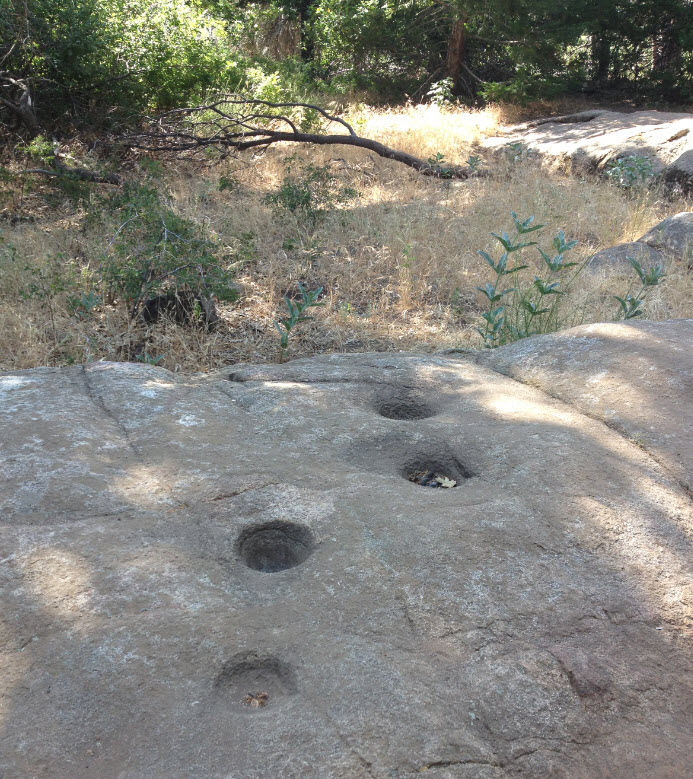
Not far from the beginning of the hike, still near the campground, we found some morteros, grinding bowls carved into large boulders along the trail by the Kumeyaay Indians. These Native Americans used the circular morteros over 2,000 years ago to grind local nuts and seeds into meals.

I recently wrote about being in awe when standing in rooms and buildings where the Founding Fathers first signed the Declaration of Independence, to the day exactly 236 years ago. I had a feeling of no less awe today, when I took the above picture, and imagined generations of women sitting there 2000 years ago, grinding their nuts, acorns and seeds. What would they have thought if they had seen me standing there as a ghost from the future, taking a picture of this place of theirs.

Near the campground, when we were still fresh and chipper – Trisha, the happy hiker.

Due to the fires in October 2003, all terrain on this mountain is now changed for decades to come. The forest, once thick with cedar, fir, pine and oak, is gone. Dark shady slopes of dense woods are now completely exposed to the sun. Ten years of recovery without forest has allowed the underbrush to burgeon; it is now impenetrable. The picture above shows a typical section along the Azalea Glen Trail. There are signs that the forest will recover, but it will take decades.

Seedlings

The picture above shows a group of seedlings of pines that have all grown since the fires. There are hundreds of those in some areas, where they will clearly recover.

Leopard Lilies

The Leopard Lilies were in bloom everywhere. These are beautiful large orange blossoms that grow in clusters.

Cuyamaca Peak

Here is a picture taken from the start of the Conejos Trail. We basically hiked straight up this ridge.

View from the Top of Cuyamaca Peak Looking West

Once at the top, the views sometimes reach all the way to Mexico in the south, to the Pacific in the west, the deserts in the east, and Palomar Mountain in the north. Today it was hazy. This is looking from the peak southwest toward where downtown San Diego would be visible on a clearer day.

Burned Wasteland with Underbrush

The underbrush reaches up to the endless forest of burned trees, fir and oak alike, which line all trails and roads all over the Cuyamacas.

Hiking Cuyamaca Peak was a perfect endeavor for this year’s Fourth of July. It was hot, sunny, with a good breeze that helped keep us cool when we needed it. It was an excellent practice hike for the big prize of Half Dome scheduled for September 11th this year.

Hiking Mount San Miguel

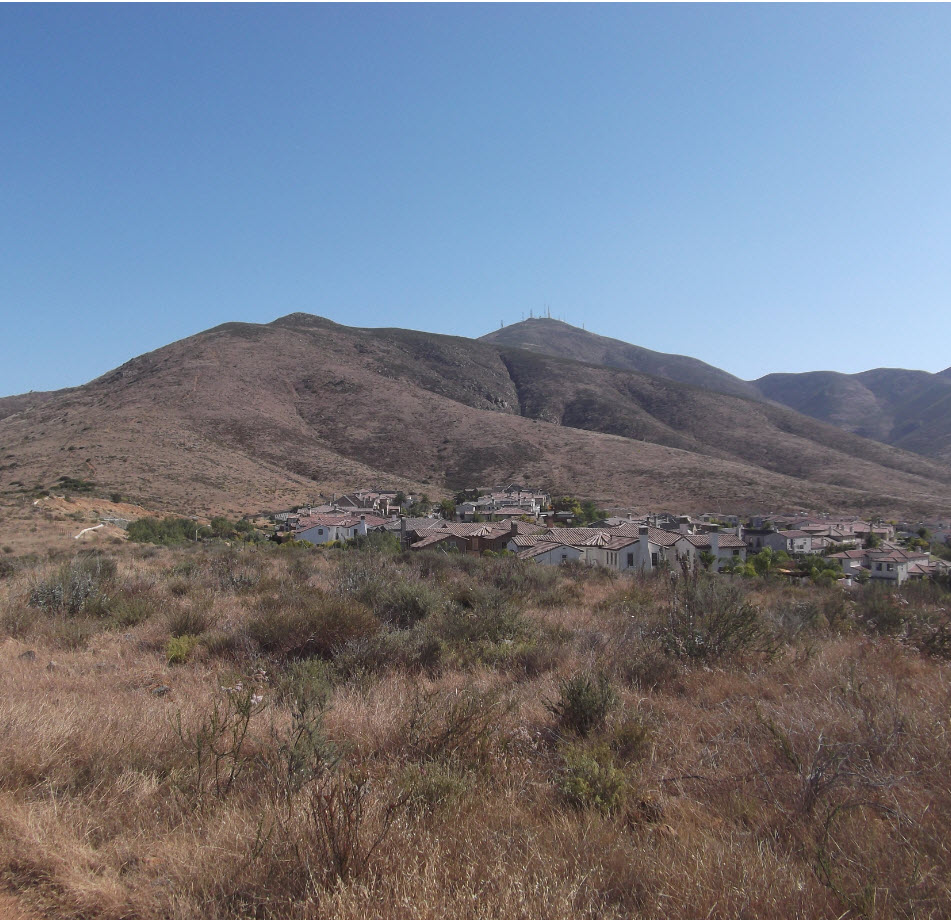
Mount San Miguel is the prominent mountain in the approach path for airliners into San Diego. It is the mountain with all the antennas on top, seemingly close within reach as the planes bank to the right for the final approach to downtown. Sometimes the planes fly so close to the mountain, it’s almost scary. After flying into San Diego for more than 25 years, I have always wanted to hike that mountain. And today we did.

This was not trivial. We had one false start last weekend just finding the right place to start. This is not a hike in Jerry Schad’s books, and while there is a decent, if rough, trail, there is very little hiker traffic. It’s one of those hikes you have to really want to do.

The peak is the mountain in the very back with the antennas. This picture was taken within 5 minutes of starting the hike. It is surrounded by suburbia and upscale housing developments, gold courses and reservoirs.

There is no trailhead and no proper place to park your car. You have to park in a residential neighborhood. There are two different places to park, one on Duncan Ranch Road, just north of the intersection with Proctor Valley Road. You walk down Proctor Valley Road about a quarter of a mile. There is a field to the left where a narrow trail starts that eventually leads to the ridge behind the homes and up. This start makes the hike three-quarters of a mile longer than it needs to be.

We  took the alternate route and parked in a neighborhood just beyond that intersection.

Parking for Hiking Mt. San Miguel

Park on Iron Gates Lane in the bend (red arrow). The main gate to the gated community to the north is right there.  There is a concrete access road heading west which is locked with a steel gate to keep cars out, but a hiker can easily walk around it. Hike straight up to the power post on the ridge, then turn right. You are now on the main trail to the peak.

Trail Map for Mt. San Miguel

The red arrow points to the place to park the car. Once you start hiking up the access road,  and turn right, the trail meanders through shrubs and bushes along the main ridge. It is almost always exposed to the wind, which today was welcome and cool. This trail simply climbs straight up and does not have a lot of switchbacks. The trail itself is rough, rocky and just what you’d expect from a trail that is not very popular and does not get a lot of use. From an intermediate peak it descends 130 feet before it climbs the main cone for the final peak.

Mt. San Miguel Trail Profile

Here is the profile. In a length of 2.5 miles, we ascended 1,750 feet, for the most part relentlessly up, except for the one dip. The whole hike up, including a few water and breathing breaks, took two hours. We were back at the car five hours after leaving, with ample time lingering at the peak and at the flag.
Trisha Showing the Way

Here is Trisha, showing where we’re going, on the intermediate peak, just before the dip.

Just before the intermediate peak, since it’s the day before Memorial Day, we took a little side trip so I could pose next to the flag posted there. The location of the flag is on the map above at the blue arrow.

Ready for Memorial Day

Finally, the views from the top are endless. We could see Mexico and Tijuana in the distance in the south, downtown San Diego and the ocean beyond in the west, and of course endless mountains to the north and east.

At the Top of Mt. San Miguel

You can’t get to the exact top, since the array of antennas is fenced in with razor wire on top, but it was rewarding to stand there, after all these years looking down onto this mountain from airplanes.

Hiking Half Dome

Trisha applied for a permit for four people to hike Half Dome in Yosemite on her birthday on September 11 and won (there is a lottery). There are two of us. We have two more spare permits.

So here we go.

In the event that  you don’t know what that means, here is a good informational site.

And there are the “dreaded cables” near the top. After seven or more hours of grueling hiking – this:

Here is a great video by the park service.

Here is a great photograph.

We need to train up, which means hiking every chance we get from now until September. Next week Mount San Miguel. Then Cuyamaca. Then San Jacinto from the tram to peak, to get adjusted to altitude hiking. Then San Gorgonio in a day on the Vivien Creek trail. That’s a very hard and long hike, about as long and as much altitude change as Half Dome, but higher. So it’s a good dress rehearsal.

Care to come along?

Hiking Black Mountain

Last Sunday Trisha and I hiked Black Mountain, the prominent dark cone just east of Rancho Penasquitos with all the antennas on top. This was my first time hiking Black Mountain. On a good day, you can see the ocean, Point Loma, the islands off  the coast, downtown San Diego, Cuyamaca Mountain in the east, Palomar Mountain to the north and all of North County.

Sunday was fogged in completely. When we started, we could see no further than a few hundred feet. The mountain, we knew, was there, but we could not see anything. So we started hiking up the trail from the Hilltop Community Park (red arrow) at 735 feet elevation. It was 2.05 miles and took 48 minutes to get to the top (blue arrow) at 1552 feet.

Here is our trail:

From a distance, Black Mountain looks like a smooth cone with “grass” cover. Hiking up, here is Trisha with the “grass,” which is actually impenetrable shrubbery of all kinds, sprinkled with Manzanita everywhere.

When we got to the top, as expected, we had a 360 degree view of absolutely nothing:

Finally, on the way down it cleared up a bit, and we actually saw the mountain we were just on, kind of:

Overall, a great hike of two hours or so, a good workout. The trail is half trail, rough and rocky, and then toward the top it’s a truck road. Not a pretty hike, but very quick to get to and a good workout right in the heart of San Diego County.

Edward Abbey Doesn’t Sugarcoat

I am reading Desert Solitaire by Edward Abbey, first published in 1968. Abbey tells of his time as a ranger in the Arches National Park in Southern Utah in the 1960ies. One chapter is dedicated to water and how a desperate hiker can find it. There is a myth about getting water out of a barrel cactus. He tells that the best you can get is a few drops of bitter liquid out of the green pulp, but the labor and the exasperation would make you sweat and expended far more water.

He goes on:

When you reach this point you are doomed. Far better to have stayed at home with the TV and a case of beer. If the happy thought arrives too late, crawl into the shade and contemplate the lonely sky. See those big black scrawny wings far above, waiting? Comfort yourself with the reflection that within a few hours, if all goes as planned, your human flesh will be working its way through the gizzard of a buzzard, your essence transfigured into the fierce greedy eyes and unimaginable consciousness of a turkey vulture. Whereupon you, too, will soar on motionless wings high over the ruck and rack of human suffering. For most of us a promotion in grade, for some the realization of an ideal.

My advice to hikers: When you go into the desert, carry at least one gallon of water per day per person.

Potatochip Rock on Mt. Woodson

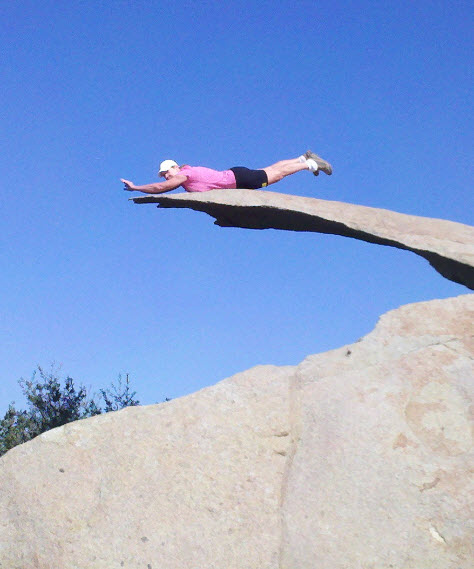
Today Trisha and I hiked Mt. Woodson. Near the top, at 2850 feet altitude, is the Potatochip Rock. Here is Trisha perched on top.

Ah, superwoman getting ready to take off:

There were other people there, loading it down. I kept waiting for it to snap. It goes hundreds of feet down the cliffs in the back.

Rescue on Half Dome

 Non-climbers,

If you complain when it’s cold in the room,

In the morning.

If you that forgot what it’s like to need help,

Really need help,

Read Rescue on Half Dome.

It will make all the difference.

Attempt to Hike Indianhead – Take Two

On January 7 and 8, 2012, Devin and I made another attempt at climbing Indianhead Peak in the Anza Borrego desert. We didn’t succeed in summiting.

Here is the map of our endeavor (click to enlarge). In 2010, we made an exploratory hike up Palm Canyon, which we documented here. We started at the same place, the parking lot shown on the lower right side of the map. The arrow at Palm Grove points to the first oasis. This is where the maintained trail ends and it is therefore the final destination of many dayhikers. A lot of people make it up there even with small kids. The waypoint marked by the blue flag just to the right, labeled 002, is the location of the New Palm Grove shown in this blog entry.

The arrow labeled “where we stopped in 2010” is just that. However, since I lost the GPS I used in 2010 on Kearsarge pass in August 2010, I didn’t have the exact waypoint with me, and I also didn’t have a good map. While I had planned to take the ridge directly after that spot, shown in the 2010 blog entry, we missed it this time and overshot by a good mile and a half, finally arriving at the arrow pointing to Our Camp. That’s where we spent the night. It was exactly five miles from the parking lot, and a very, very tough five miles.

After the first oasis, the trail ends, and hiking becomes very difficult. Making progress means climbing over immense boulders, crashing through thorny shrubs, crossing the creek many times and sliding along steep slippery rock faces. Many times we had to backtrack and find another way, on the other side of the creek. All this with a full overnight pack, which gets caught in branches and has a tendency to pull in unexpected directions, makes for a dangerous and often scary hike or climb. Five miles of this is utterly exhausting.

Here is our camp:

(Click image to enlarge). You can see the flat area where we had pitched our tents (red arrow).

Look at the palm grove in the background. It had burned some years before, and the trunks of the trees are all blackened, the old fronds burned off. However, when growth came back after the fire, new fronds developed, and the wilted ones are once again forming the characteristic yellow bushes below the living leaves – until the next fire.

We spent the night next to the creek, the full moon as bright as a reading light. We actually tested that and Devin was able to read. We made a fire in a little natural fire cave (green arrow), Devin cooked one of his gourmet wilderness dinners, and we turned in by 8:00, when the fire had died down, it got cold and there was nothing left to do but sleep.

The sun does not come up until 7:00am, so it was a long night in the tent. Since we had only planned for one night out, we knew we had to summit and come back to the camp by noon, to be able to make it back out by dark at 5:00pm. It was very obvious that we didn’t have enough time for a summit attempt again this time and we committed to an exploratory hike up the ridge (blue arrow).

You can see our attempt on the map where I made waypoints 003, 004, 005 and 006, carefully marking spots in the wilderness in order not to get lost on the way down. In the desert, it is very easy to get lost and end up on the wrong ridge, far from where you want to be at best, and possibly in a dangerous position with no way out. The light also changes the way things look. Waypoints are important for finding your way back.

We climbed up a steep and rugged ridge, of course no trails and maybe no human boots before us in years. After about 45 minutes we reached a natural turn-around point. We knew we didn’t have time to go further, and looking up looked forbidding. Here is Devin at the end point:

Looking down from our ridge into the valley where we came from, taken with a zoom, we can see our camp site (red arrow) where our stashed gear waits for us when we return.

When we finally got back to the camp after four more rough hours climbing and stumbling down the creek, when I fell twice with a full pack, once getting my head submerged in water, we were thoroughly exhausted.

We concluded that next time we’d attack the peak right from the parking lot, going on the black curved line on the right side of the map above, over the false peak and the saddle to the peak. I think this can be done in five hours up and another five down with a daypack, without having to trek all the way up the canyon first to come from behind.

A tough ridge is a tough ridge, no matter what side of the mountain we climb.

Next year, Indianhead, next year.