For most of the year 1977 I lived in Cologne. I was just 20 years old, and it was the very first place of my own. I was in the military, stationed at the Cologne/Bonn airport. I didn’t want to live in the barracks, so I found an apartment of my own at Taunusstraße 15. I moved out of there in November of 1977 and I have not been back to Cologne in the past 47 years, until today. For nostalgia’s sake, I just had to go back and check out the old neighborhood. Photocredit to Trisha who took all the pictures for me.
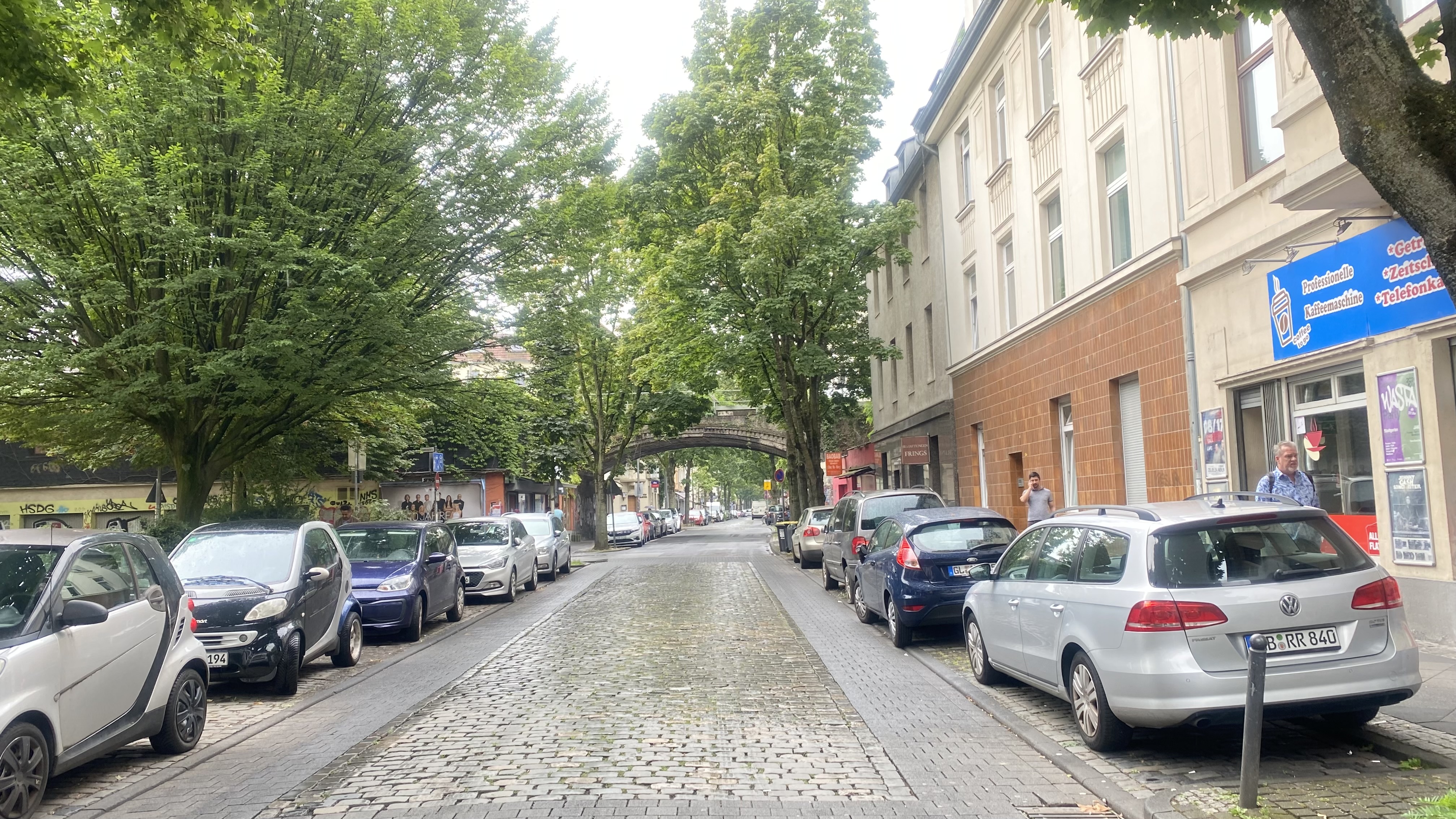
Here is a view from the Taunusplatz up the street a bit, a one-minute walk away.
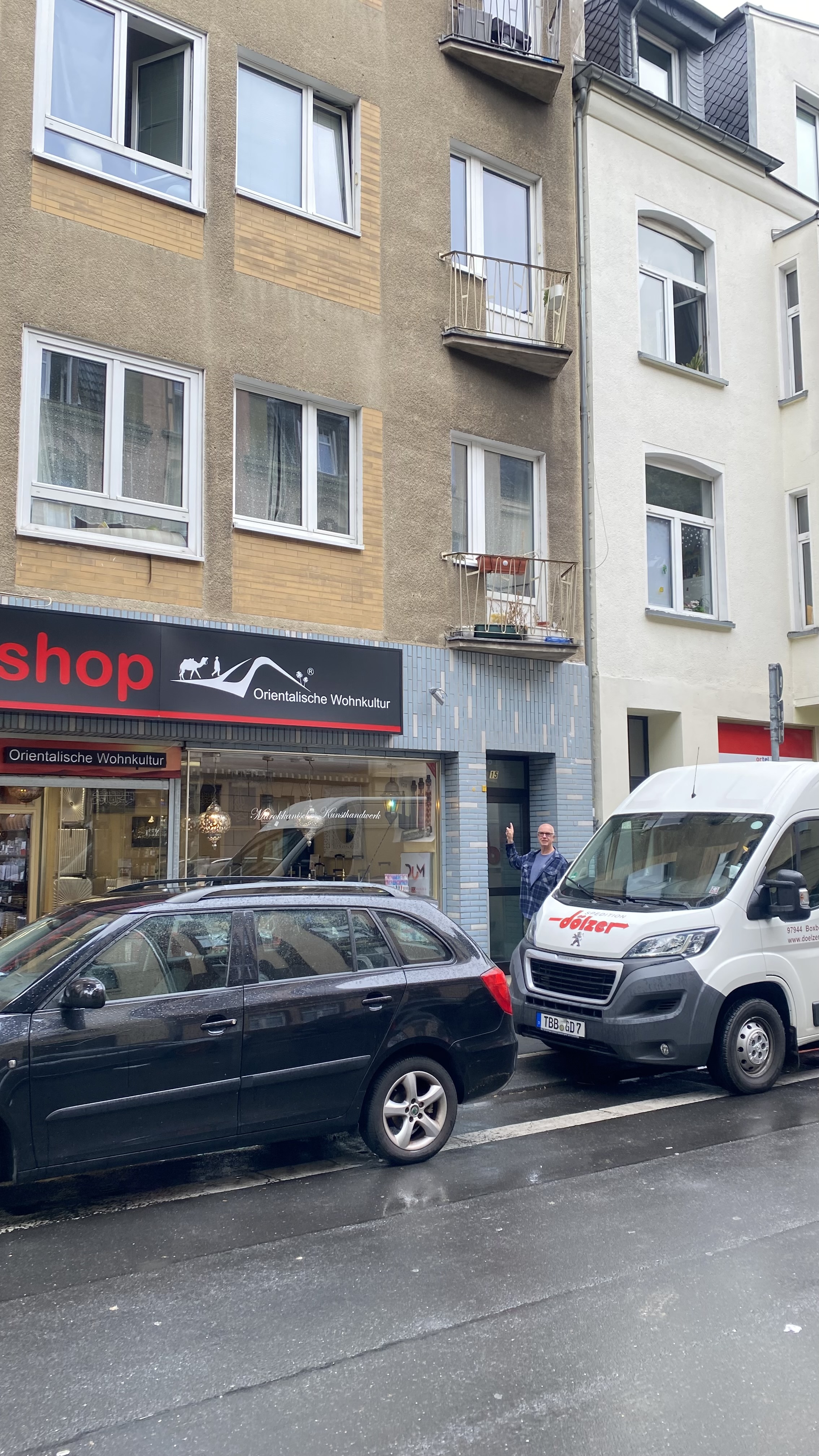
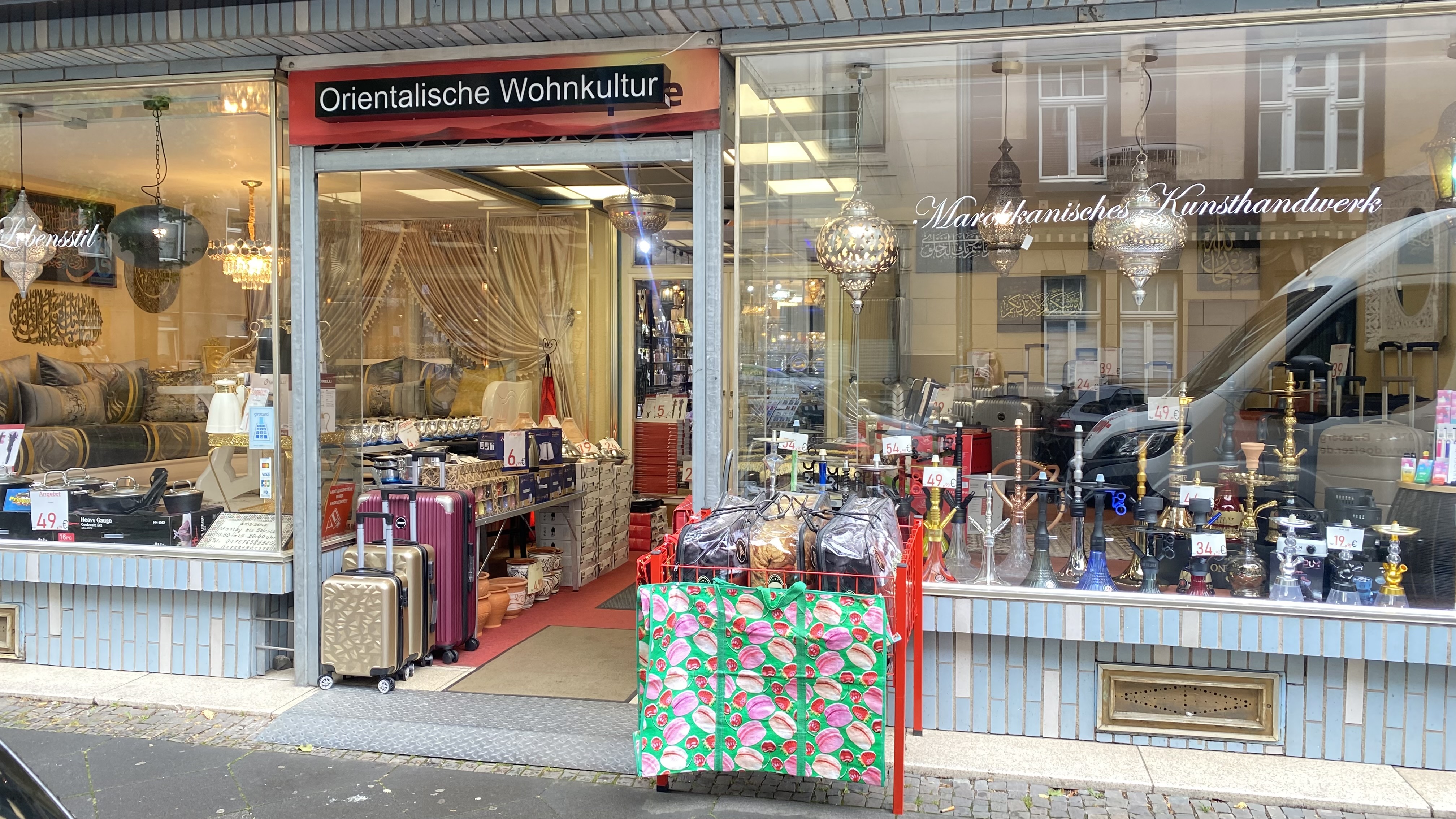
Here I am in front of the place. Unfortunately, there was a big van so we could not get any closer for a good photo of me at the door. I lived several stories up and in the back, overlooking the alley. But this was my entrance.
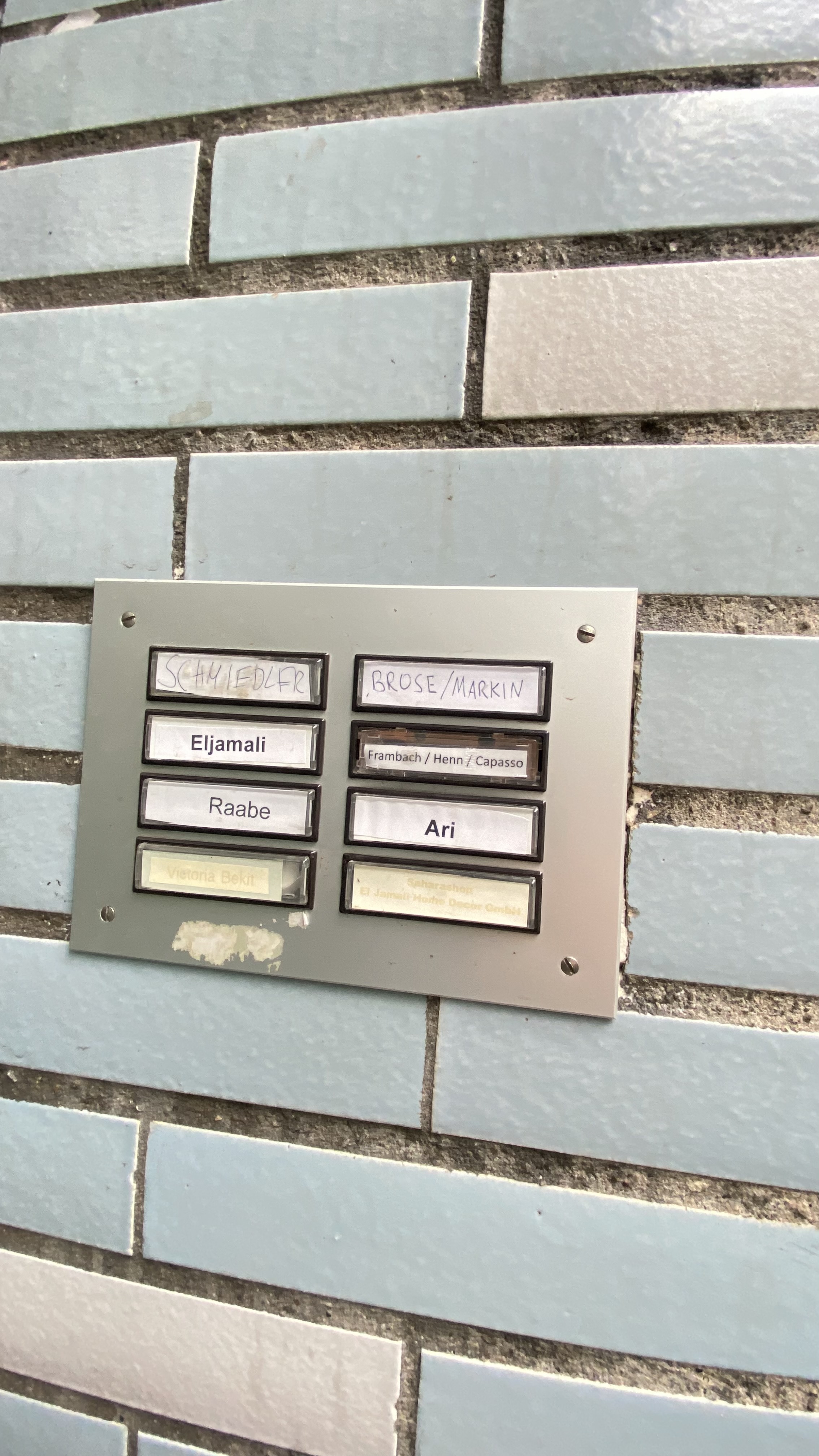
Here is the doorbell. My name was where Eljamali is now.
My landlord, Herr Wolf, lived on the second story, below me. He always let me borrow his vacuum cleaner. He was in his late 60ies, about my age now, and he owned and operated the store below, which was a haberdashery at the time, selling upscale conservative male clothing, nothing a young soldier could afford.
The neighborhood has changed. Now the store is a Turkish shop with all kinds of baubles and, of course, hookah pipes.
The neighborhood is very different now. All the stores and businesses are distinct middle eastern, with Turkey being the major presence. It used to be a German white middle class area. Now nobody even speaks native German. We went to a little cafe in the neighborhood, had a nice breakfast, bought some fresh fruit and then took an Uber back to the city.
I am sure I’ll never come this way again, but I had a nostalgic fix walking along the old street corners and awakening long forgotten memories.
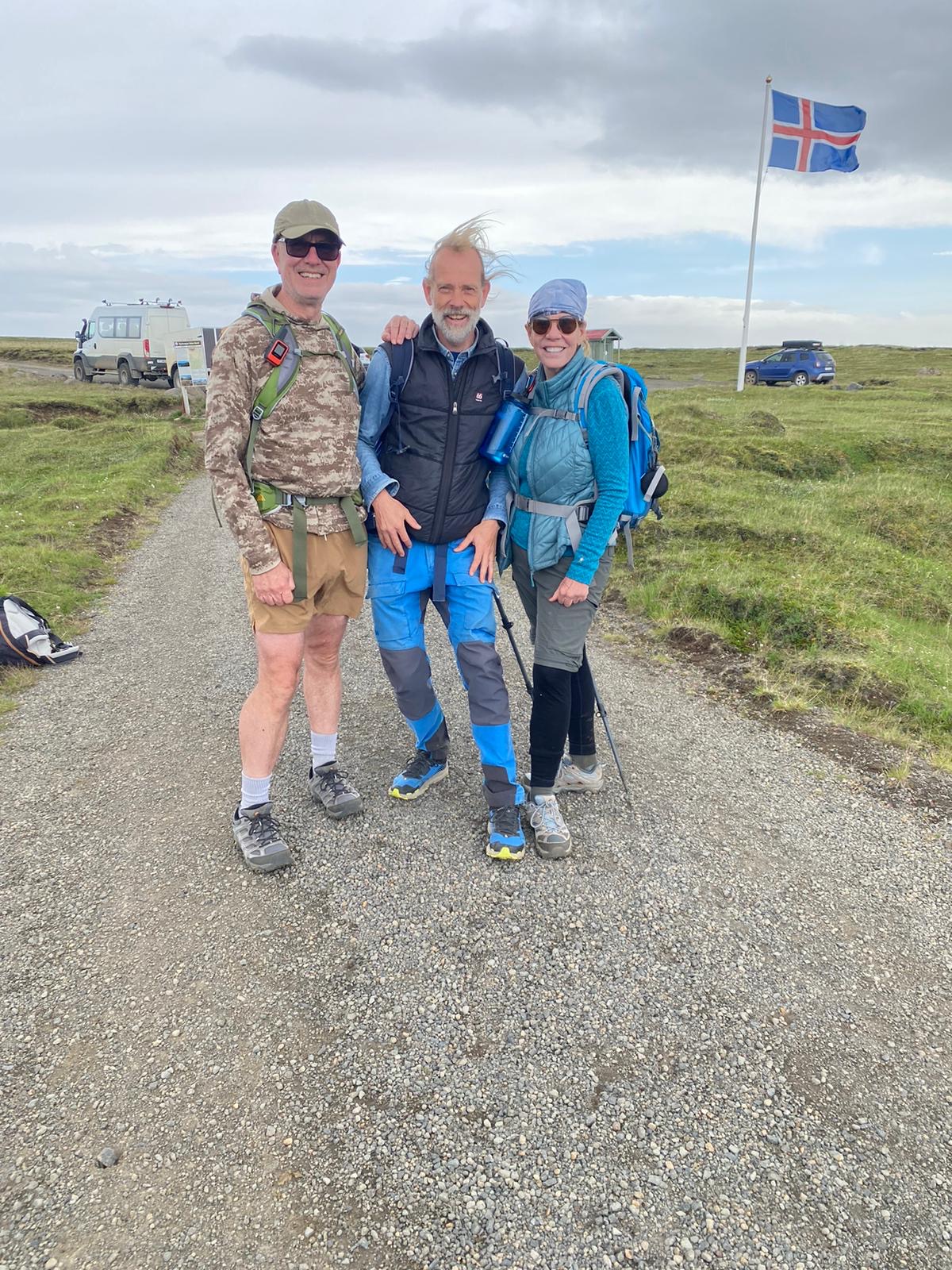
Iceland is a majestic place, with extremes, and a stark, striking beauty. After spending a week hiking the ancient trails on the highlands, I thought I’d show some pictures of fire and ice. Here are Trisha and I with our guide Jonas at the end of the last long hike, with the parking lot behind us.
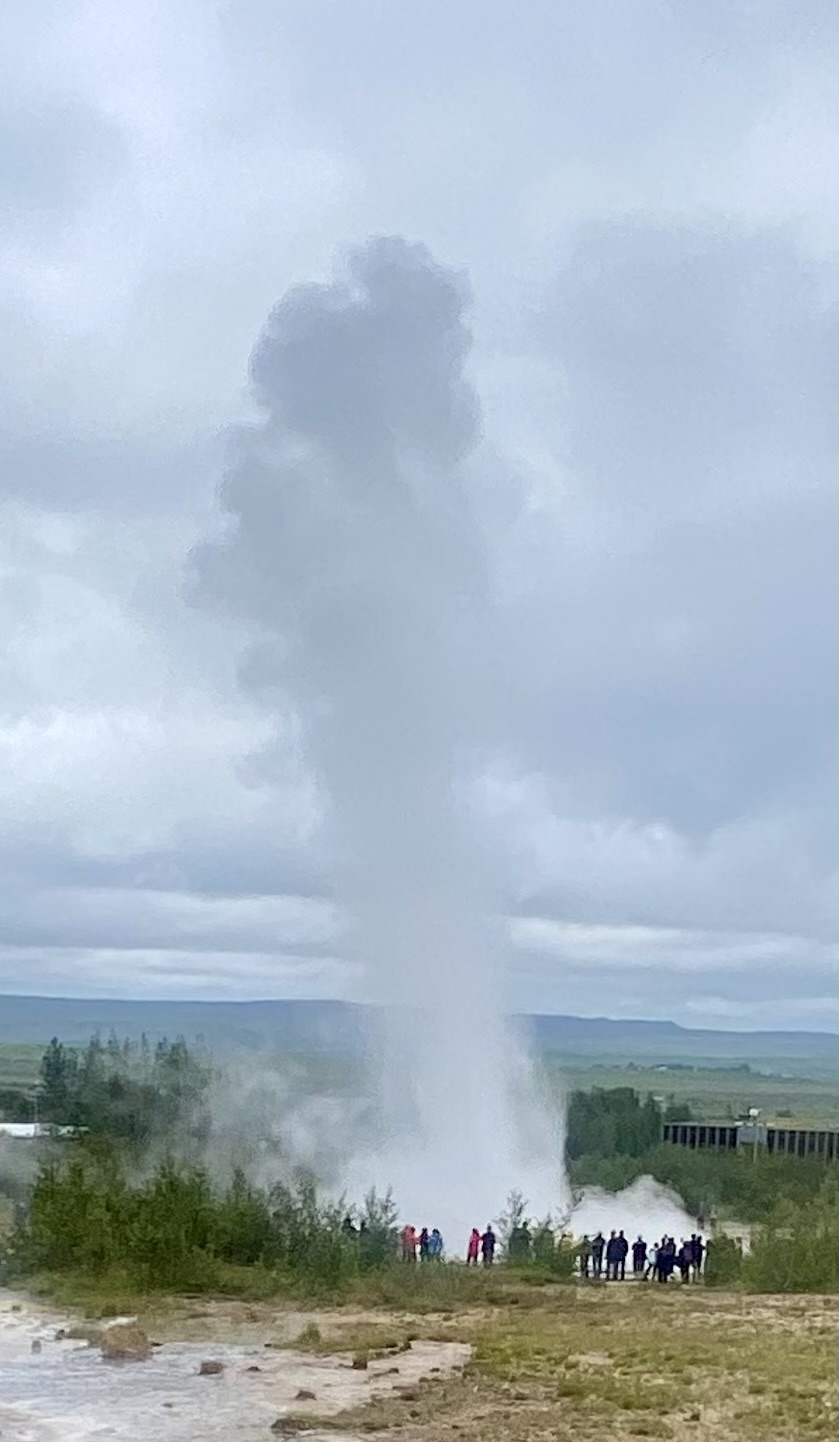
Here is a picture of the main geyser at the Geysir Hot Spring Area along the Biskupstungnabraut (well, highway 35) on the way to the highlands.
Here is a video of the same geyser, photo credit to Lou in our group:
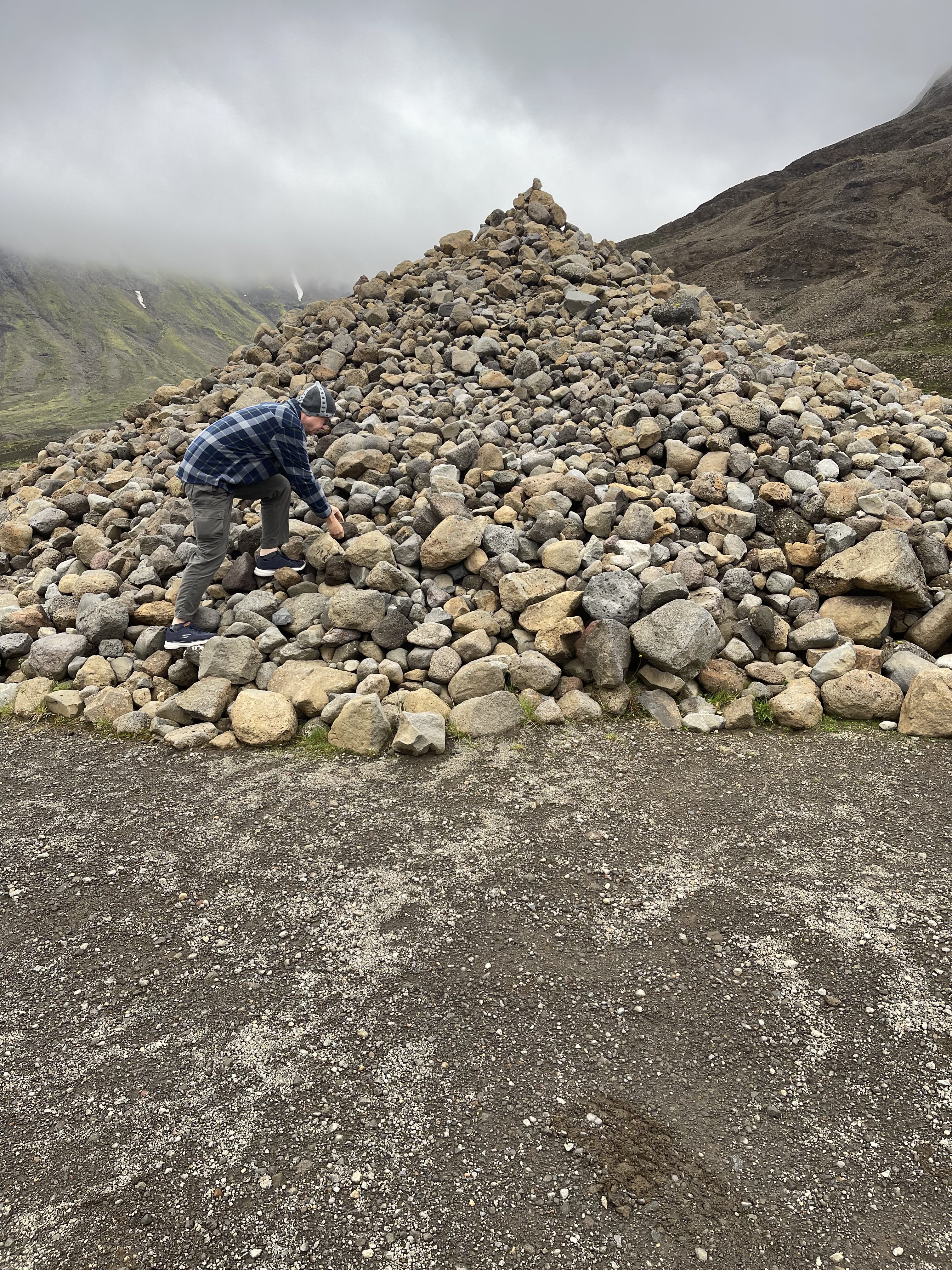
On our way out Jonas told us the story of his father, Valdimar, who in 1961 build a summer ski school way out in the mountains. He was one of the pioneers of developing sports in Iceland at the time. He had an old pair of rubber boots that apparently he didn’t need anymore. On his way out to the site where they were building a hut, he placed the boots on an open lot beside the road (a rough and rutted dirt road to this day) and put a rock into the boot for good luck while he was out there in the wilderness working. His sons, including Jonas, and friends started to take up the practice. They would stop by the boots on their way out and leave a rock for good luck and to fend off accidents and mishaps. This was kept up by the locals and recently the guides. Here you can see me, over 63 years after the practice started, laying down my rock for good luck. There is a pair of rubber boots somewhere under this pile. I came home unscathed from the land of fire and ice, which means that my rock worked.
Up in the Hveradalir Geothermal Area some of us hiked down a muddy ravine to a steaming hot spring. Sulfur was heavy in the air. My glasses immediately fogged up from the heavy steam and I had to take them off to see. And seeing was critical, since one little misstep and you can find yourself in a cauldron of boiling mud:
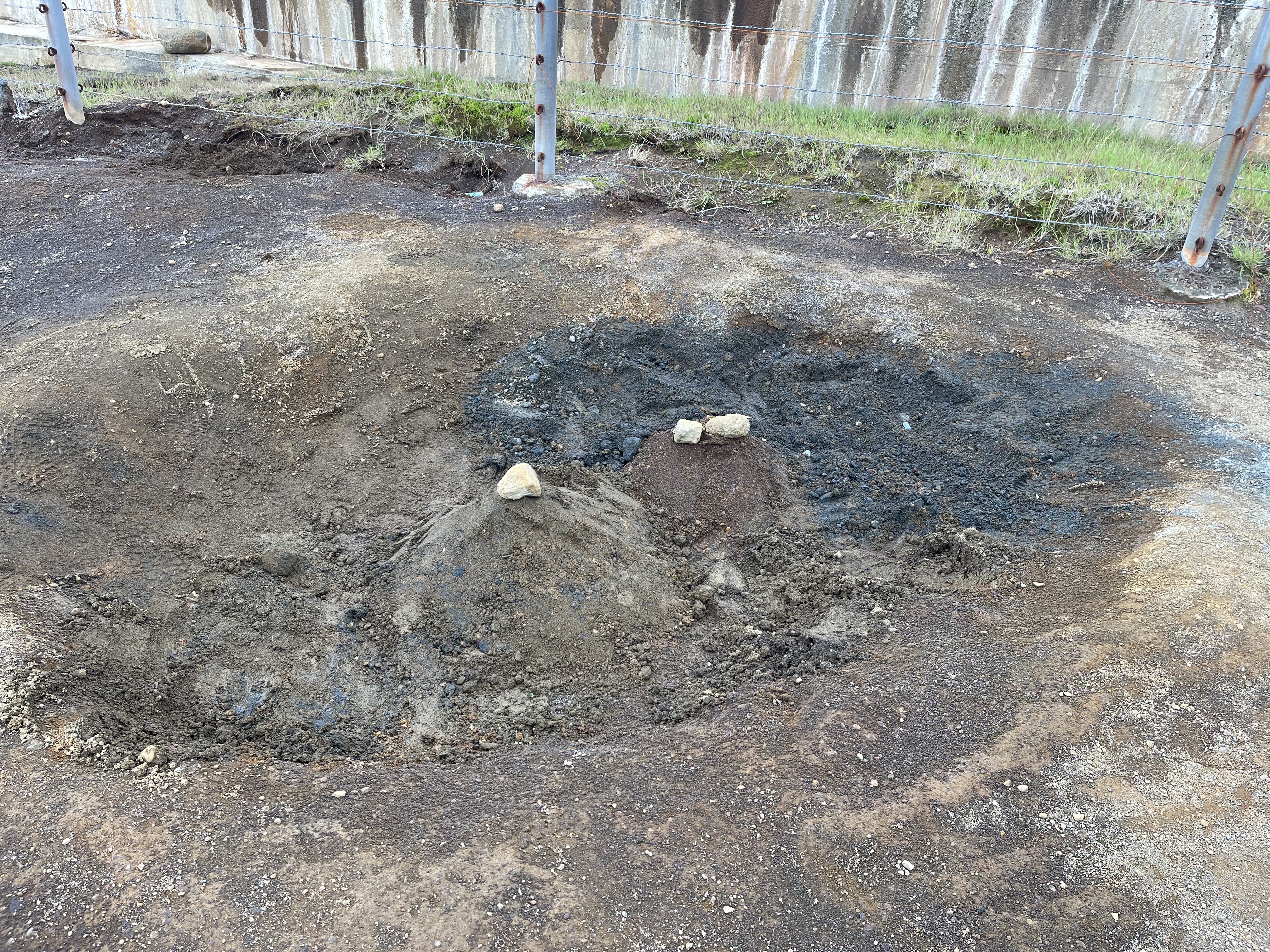
Speaking of boiling. There is an area where the locals bake their bread in boiling dirt. See the picture below with the little mounds with rocks on top of them? When I touched the dirt, it was hot. When I pushed my fingers into the dirt, is was very hot, boiling hot.
The locals bring shovels and special baking pots with their rye bread dough. They dig a hole in the hot dirt, put in the pot, cover the pot with a special cloth to keep the dirt out, and then cover the whole thing with dirt again making a mound. To mark it as an oven, they put a rock on top. You have to remember which one is your own rock and of course not disturb somebody else’s cooking mound. There are dozens of these mounds in this area. When you come back the next day, you dig up the pot, and your bread is done. I tasted their bread and loved it.
The cooking dirt is right next to a large lake which you can see in the video below. The lake water is normal cold temperature. I touched it to make sure. Just like any lake. But within just a few feet of the lake’s shore there are little hot spots with boiling water. You could boil an egg in this little spring.
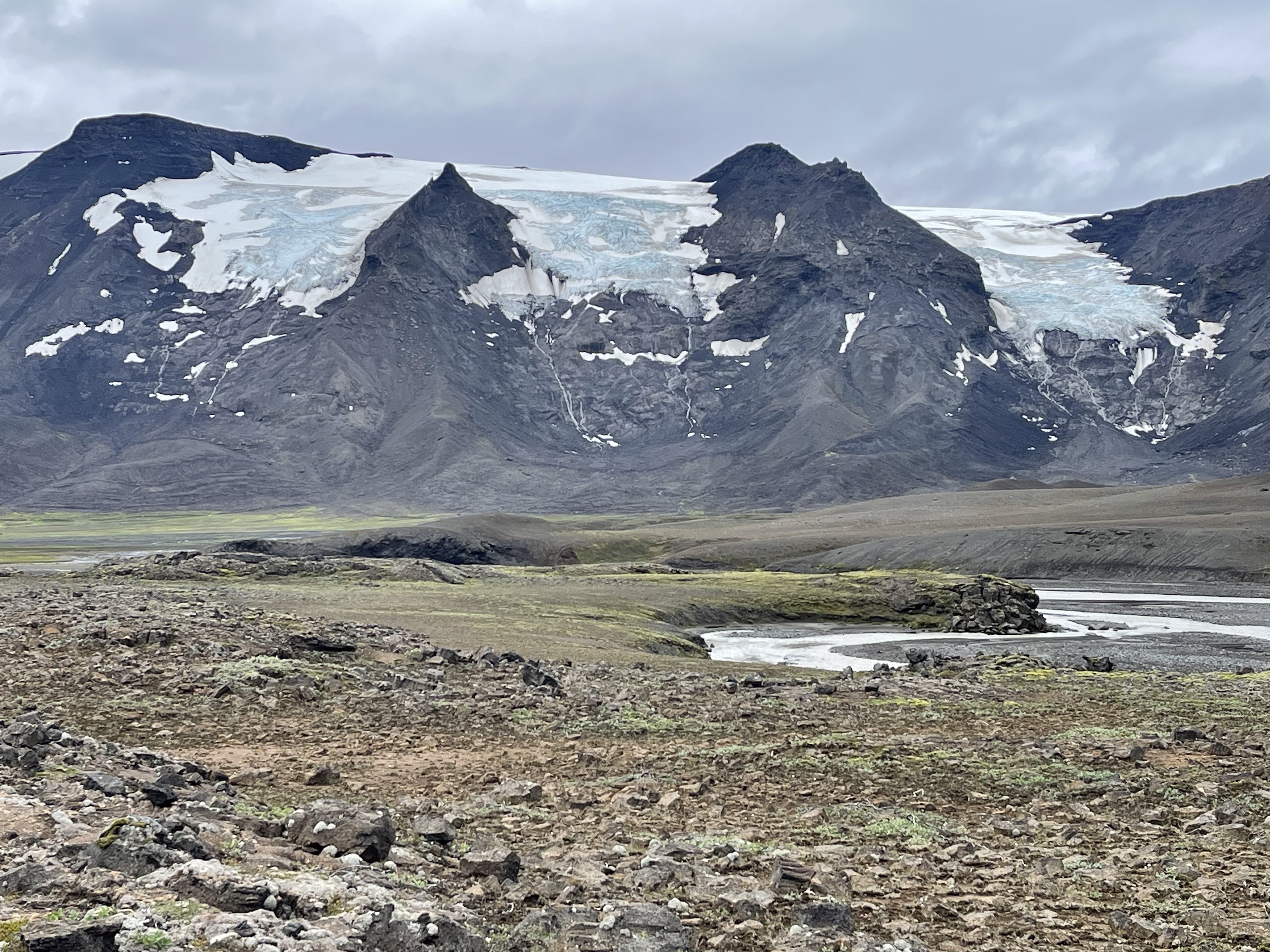
After fire, there is always ice. Here is a good view of the Langjökull glacier from our trail.
The Fagradalsfjall volcano, which had been dormant for 800 years, began erupting in March 2021. It had just just erupted again a few months ago, and we were warned that it was supposed to go off again within days of our visit. Fagradalsfjall is only about 10 miles from the Keflavik International Airport and close to the capital city Reykjavik. We did not have time to visit the volcano during our trip, but we did stop at the Lava Show in Reykjavik. In a theater-like setting, they are actually showing a live lava flow, and you can experience the intense heat of fresh hot lava and watch it cool off while a narrator describes what is going on. I highly recommend that show.
Iceland is a majestic, dramatic and extreme country with a hardy people and a glorious and very difficult language. I want to go back.
Here are maps, statistics and some pictures of the four main hikes we did in Iceland:
Hike 1
July 31, 2024 – 8:00 miles, 6:35 on the trail, including all rests and stops.
This hike was the most strenuous. We climbed up into the mountains and did a circle of vast hot springs area, known as the Hveradalir Geothermal Area. The wind was fierce and we needed all our layers to wear. It was basically in and out on the same trail.
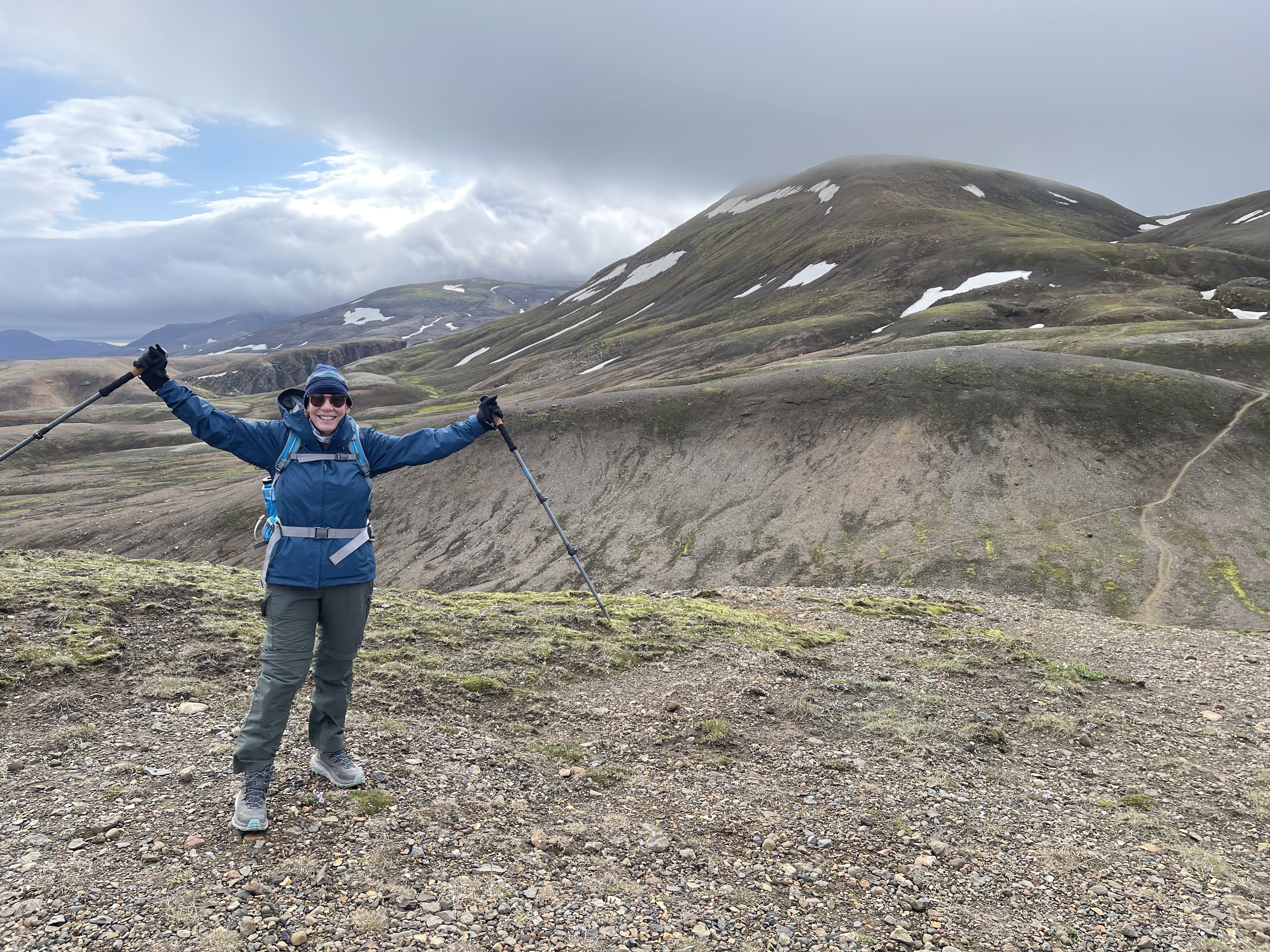
Here is Trisha on the trail after coming up a steep ridge.
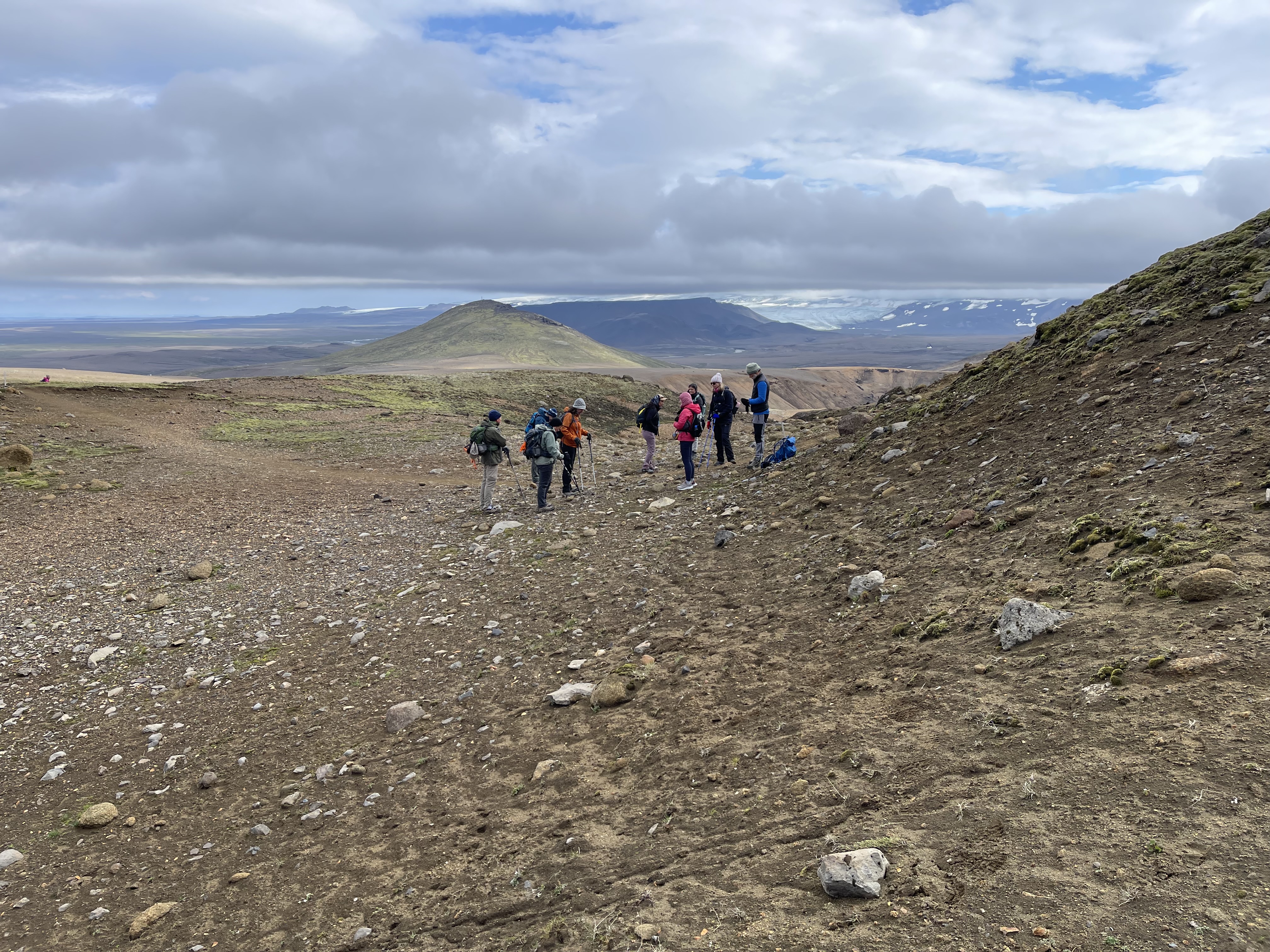
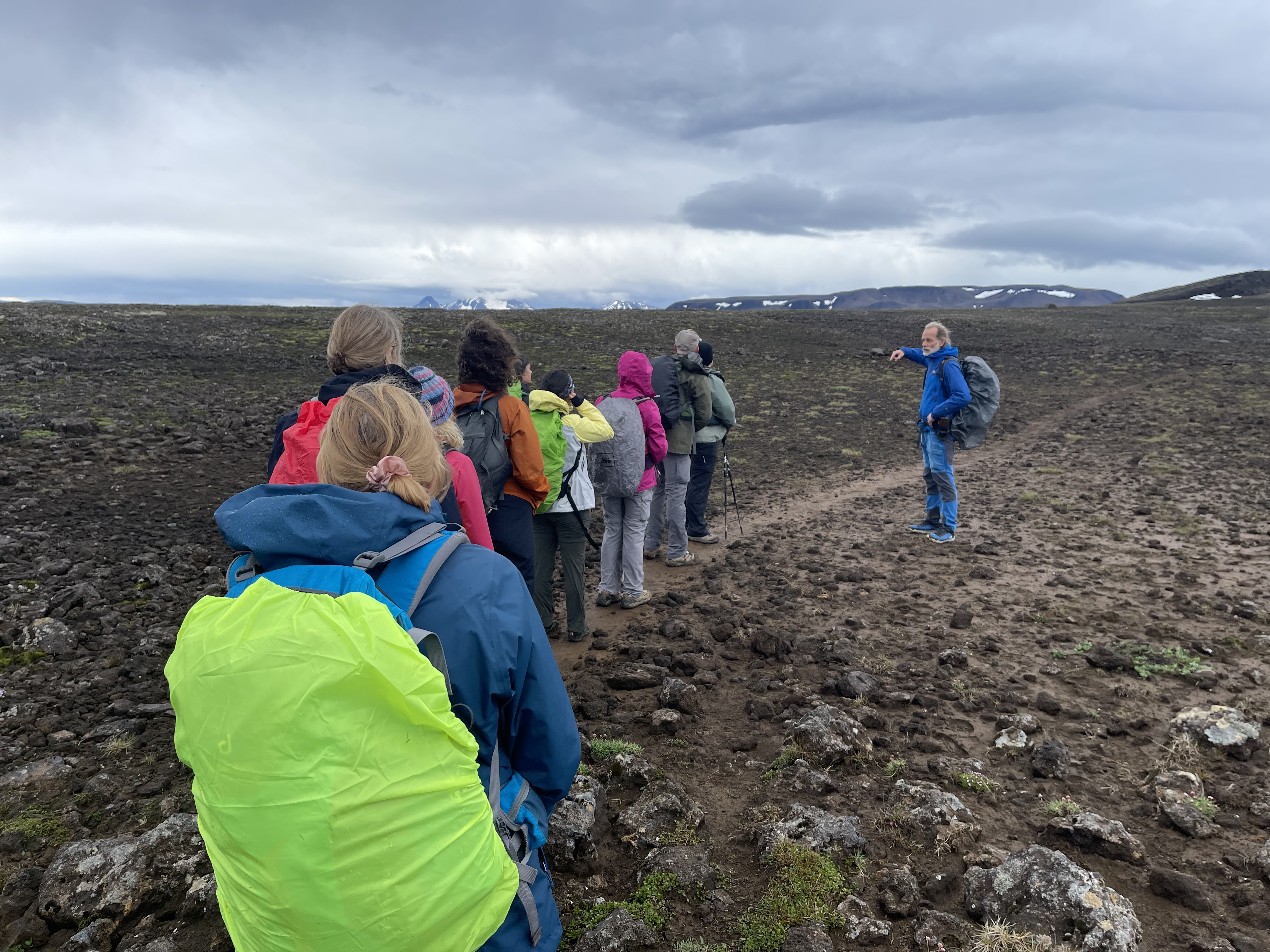
And here is our whole group, getting oriented by our guide Jonas on the right side. In the background just over Jonas’ head you can see a part of the Hofsjökull glacier, which is located in the center of the country.
Here is a better view of the Hofsjökull glacier:
Some of the terrain was quite steep, and there were rudimentary stairs installed. That’s me in the very back getting ready to come down.
The landscape at Hveradalir is in front of us, deep valleys with many colors, greens, red, yellow and lots of browns, ocres and whites. Plumes of steam and occasionally sulfur wafts around everywhere. You have to be careful where you step. There could be a very thin crust over boiling water.
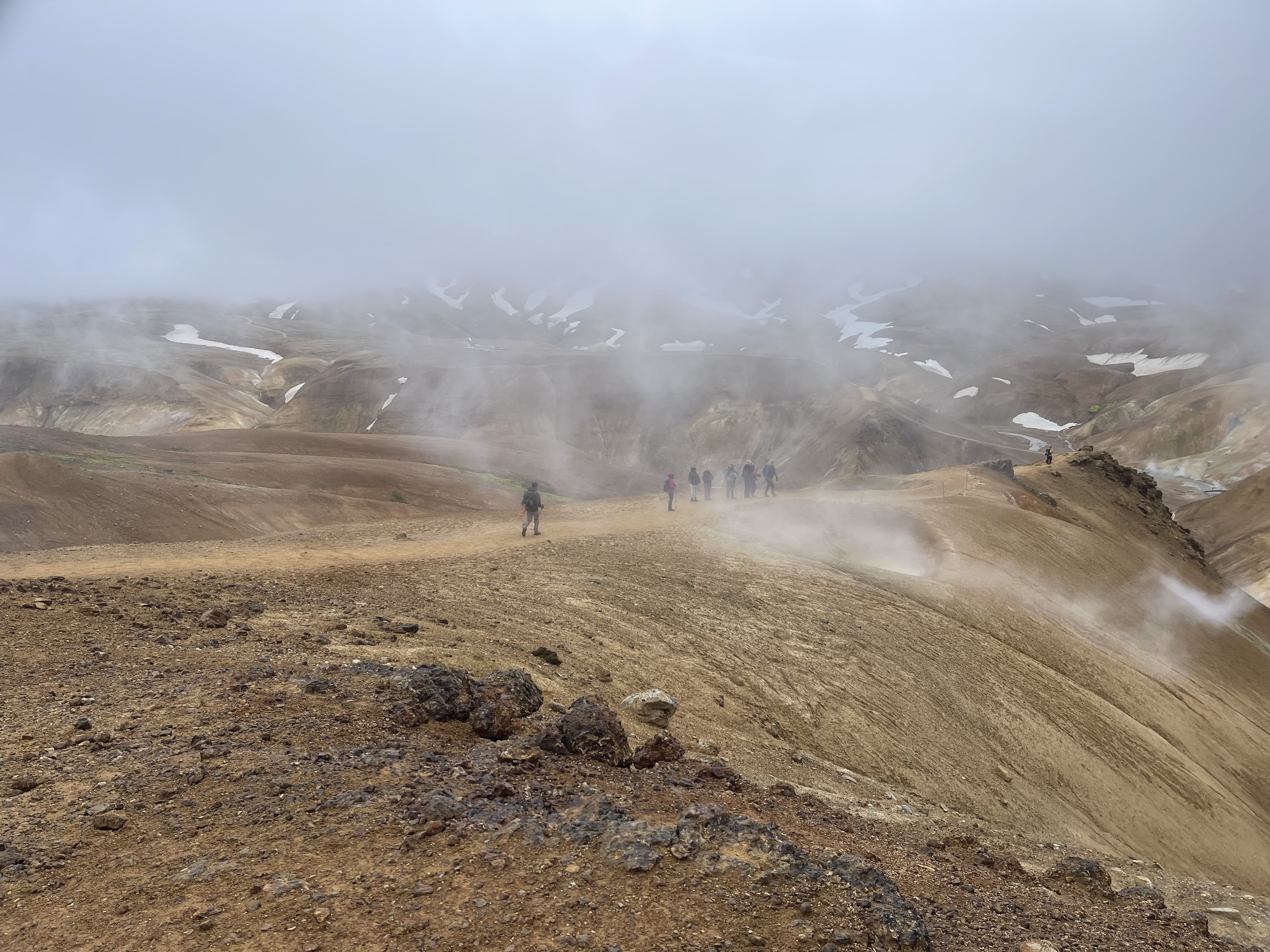
Our team makes it way along the ridges.
All colors of the rainbow abound. Note also the thick cloud cover that seems to reach down into the valleys. Occasionally when walking through a cloud of hot steam my glasses would fog up and I’d be instantly blind. This happened a number of times.
Here you can see what a 40 miles per hour wind will do with a steam plume.
There were also the occasional snow fields that we needed to cross.
In the end, this was a rewarding hike. There we are, happy campers.
Hike 2
August 1, 2024 – 9.68 miles, 6:30 on the trail.
Our guide improvised this hike. The first section was on a trail up to a crater. He had never been there himself. Some of us hiked around the crater rim. We had fantastic views from the top of the rim. A few of us went around the back way, where we met up again. Then the second half of the hike was across the open tundra. No trail. It was rough on the feet and legs, and we were all exhausted from the hike, the cold and the occasional rain by the time we got to the (very tiny) hut.
This was probably the roughest day for most of the group.
Near the hut where we spent the night was this historic building. We had dinner in it. It used to be a shelter for sheep herders. They’d spend the night in the hut, and brought in sheep to keep themselves warm.
One of the fascinating facts about Iceland is of course its harsh arctic climate. Without civilization, humans are basically helpless. During the endless winters this country is covered by snow and shrouded in darkness. You might notice in my pictures that there are no trees. There is literally nothing to burn. So even a hut like this one cannot be kept warm other than through body heat of humans or animals. How do you cook when there is nothing to burn?
Speaking of sheep – we saw many small groups of sheep, two or three together, never more – no herds – roaming the country.
Along the way, we crossed many ancient lava fields. Much of this hike reminded me of my hikes in Maui, Hawai’i, not too long ago. Except Maui is warm, and this is very cold.
We needed our rain gear on this hike. Everyone got wet.
Here we are inside the crater, with a good view of a small outlet section of the the Langjökull glacier in the distance to the west.
Dramatic lava formations form landmarks visible for dozens of miles.
Hike 3
August 2, 2024 – 8.99 miles, 5:31 on the trail.
This was a more leisurely hike, mostly flat.
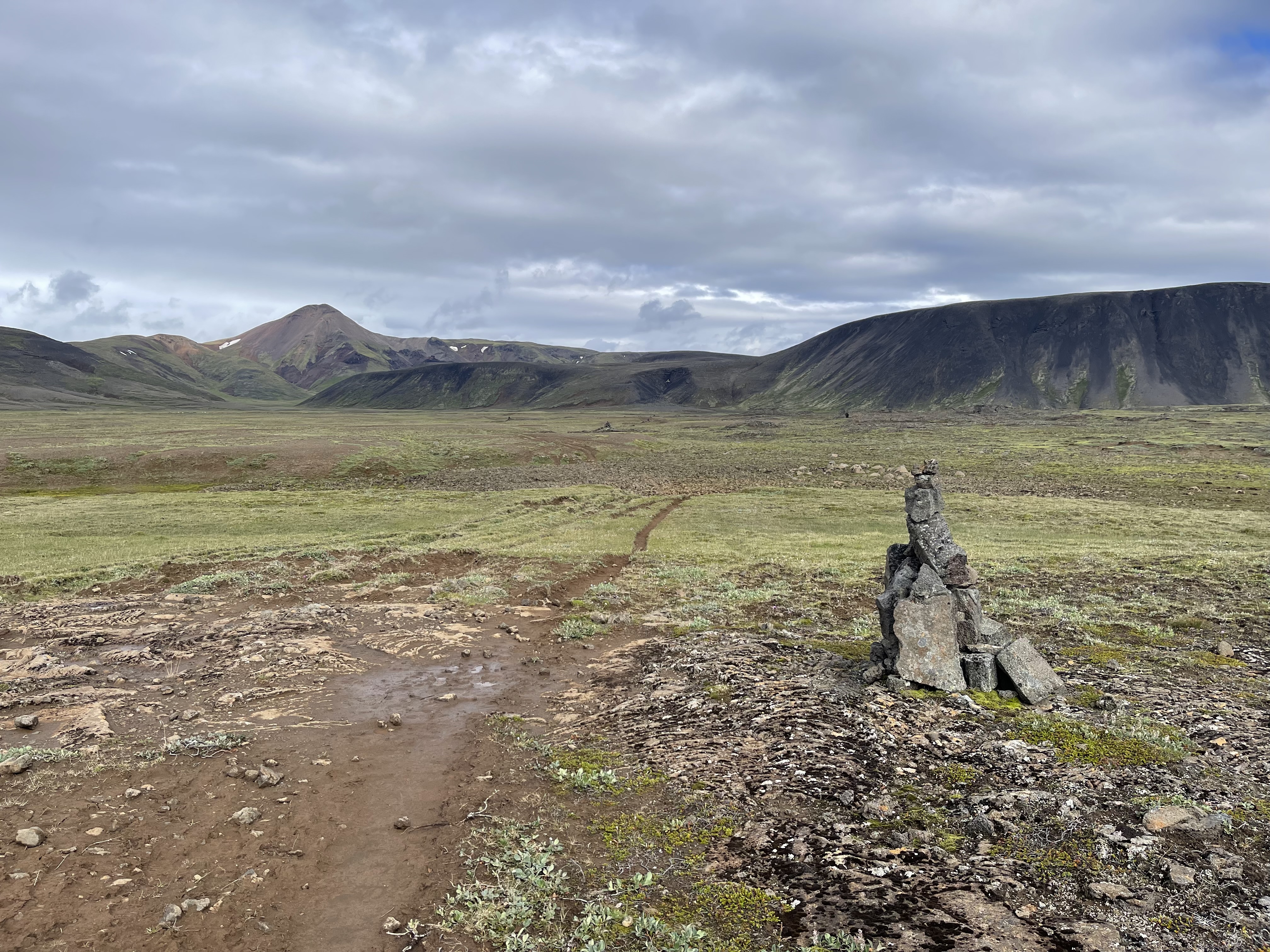
This part of the hike is on the famous Kjalvegur road. This path below is the “road.” No motor vehicle has ever driven on this road. On the right you see a cairn. These are marking the way, since the path sometimes completely disappears either in rock, water, grass or – of course – snow. The cairns are spaced apart just far enough so you can always see the next one, and hopefully the next two, so you have an indication of where to go.
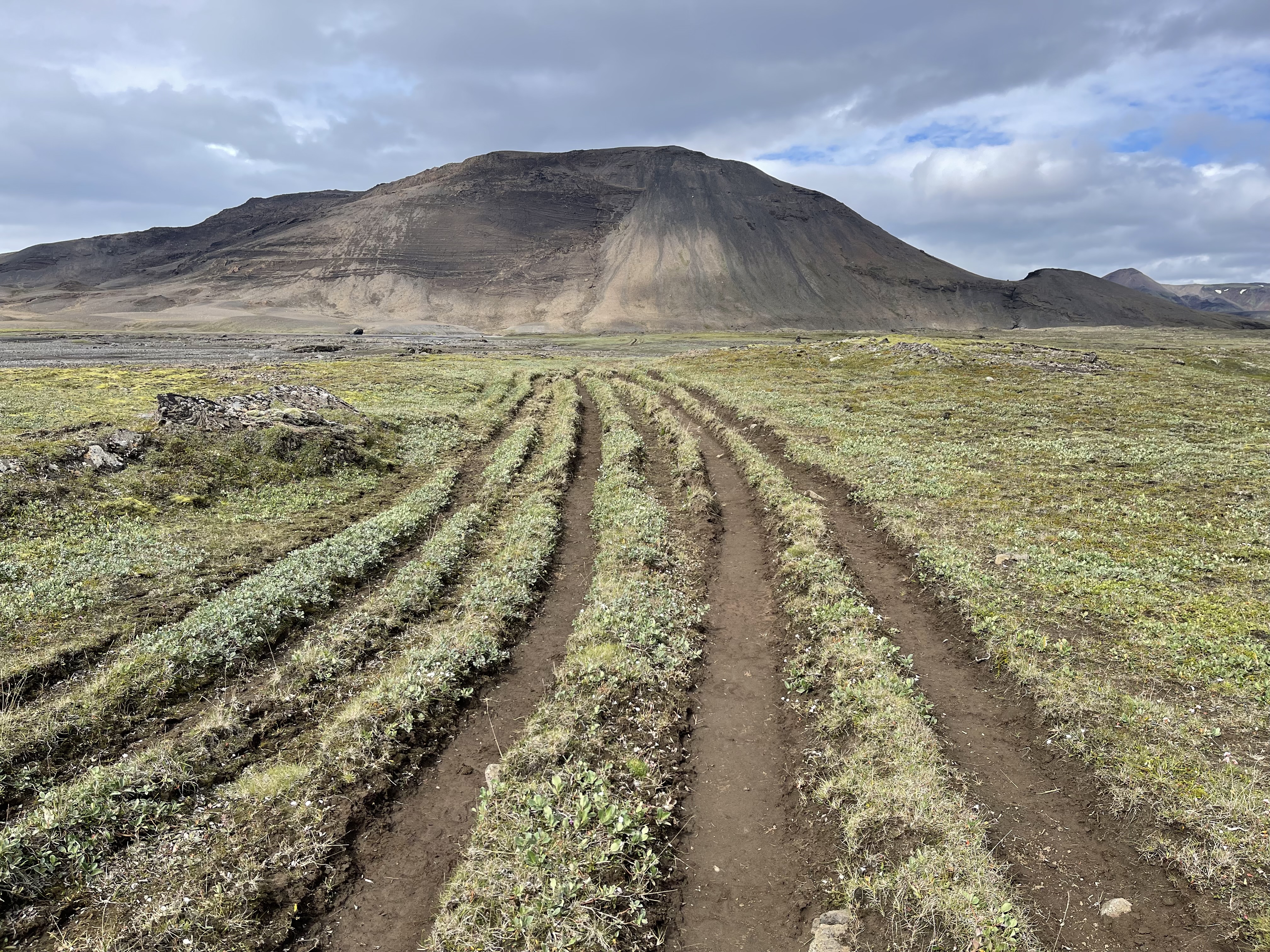
One interesting phenomenon is that the trail often is divided into many “lanes” like on a freeway. These are formed because when one of the grooves gets too deep, everyone goes to the side of it to a higher one. Also, when riding horses on these trails, a rider has to bring three horses, one to ride, and two to switch out. The other two horses usually walk alongside the rider, so three lanes of the trail get used up that way. Over the centuries, freeways like these start forming.
Here are nine of us, each in our own lane.
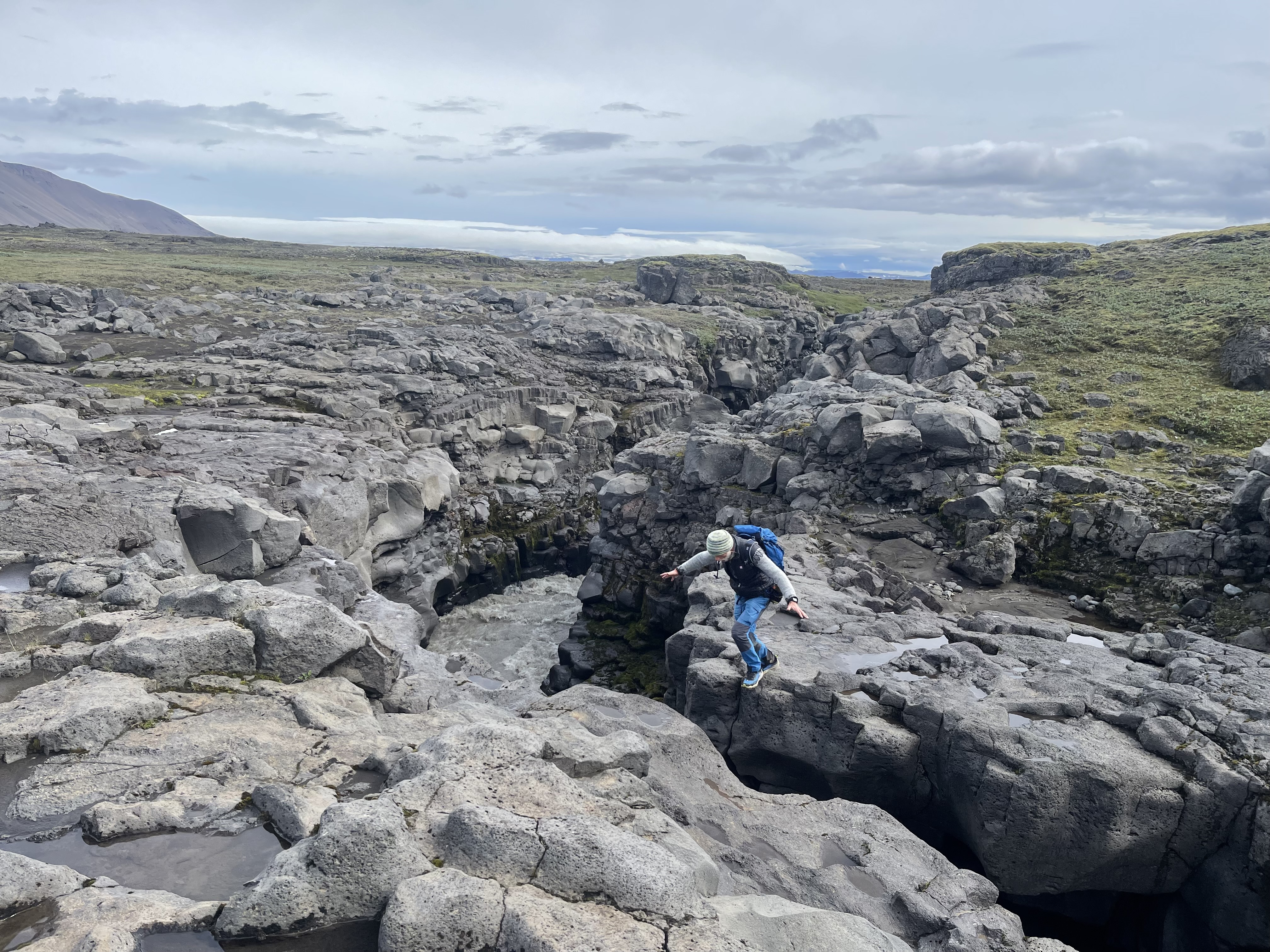
On this leg of the hike, there was a deep gorge from a river of glacier water from the Langjökull glacier. On this spot, it comes close enough together so a person can jump over it, although below there is a raging river. Here I caught our guide mid-jump.
A little further along is a little bridge which we needed to cross. Our guide told us that during the snowmelt season in the spring, the water comes up all the way to the bridge and it has been torn away from the rock before.
Here you can see some of our team crossing.
And a parting shot, where I am standing on the bridge, looking down. It’s hard to imagine that the water comes up to and actually above the bridge.
Finally, the hut at the end of the day.
Hike 4
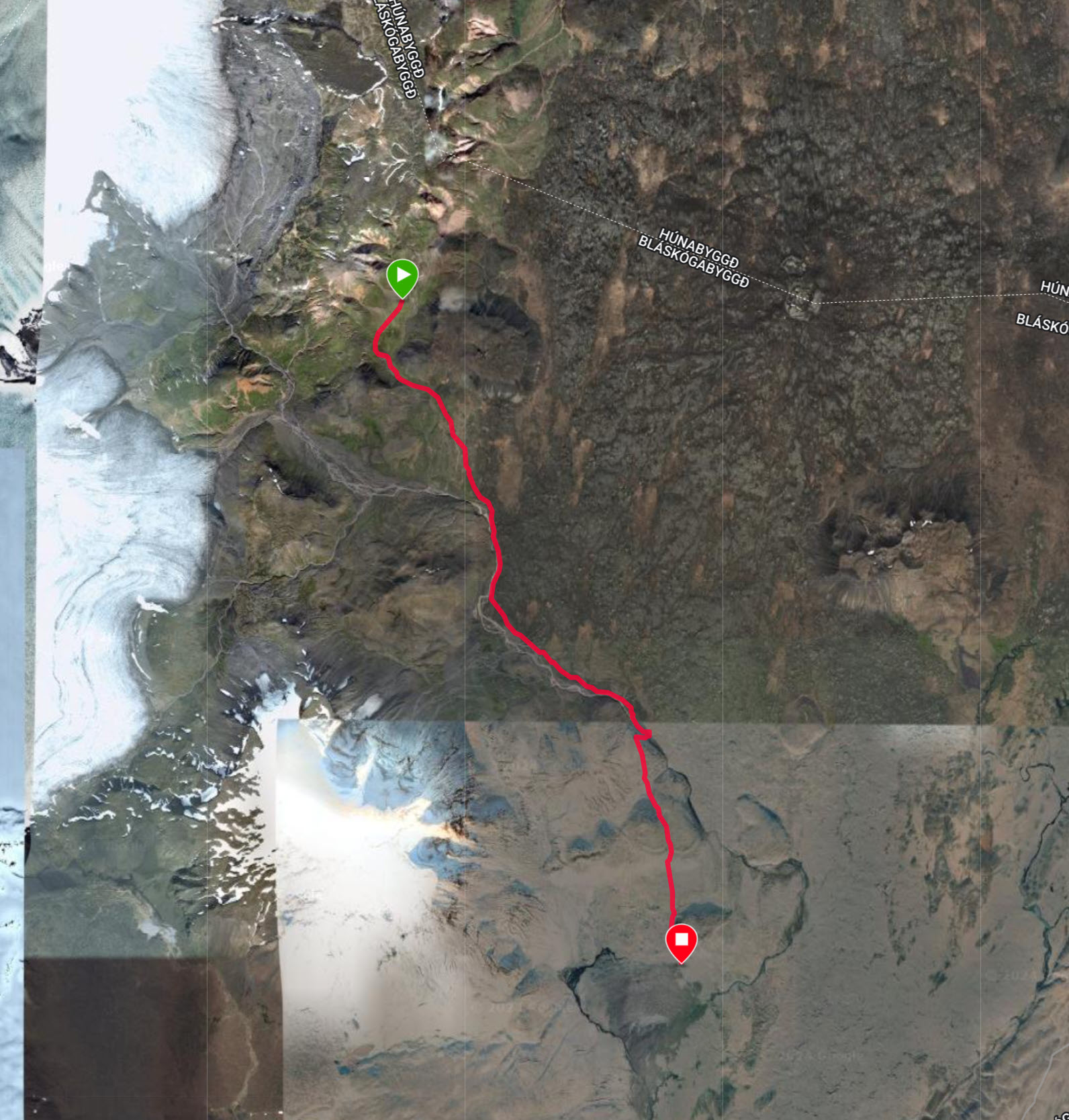
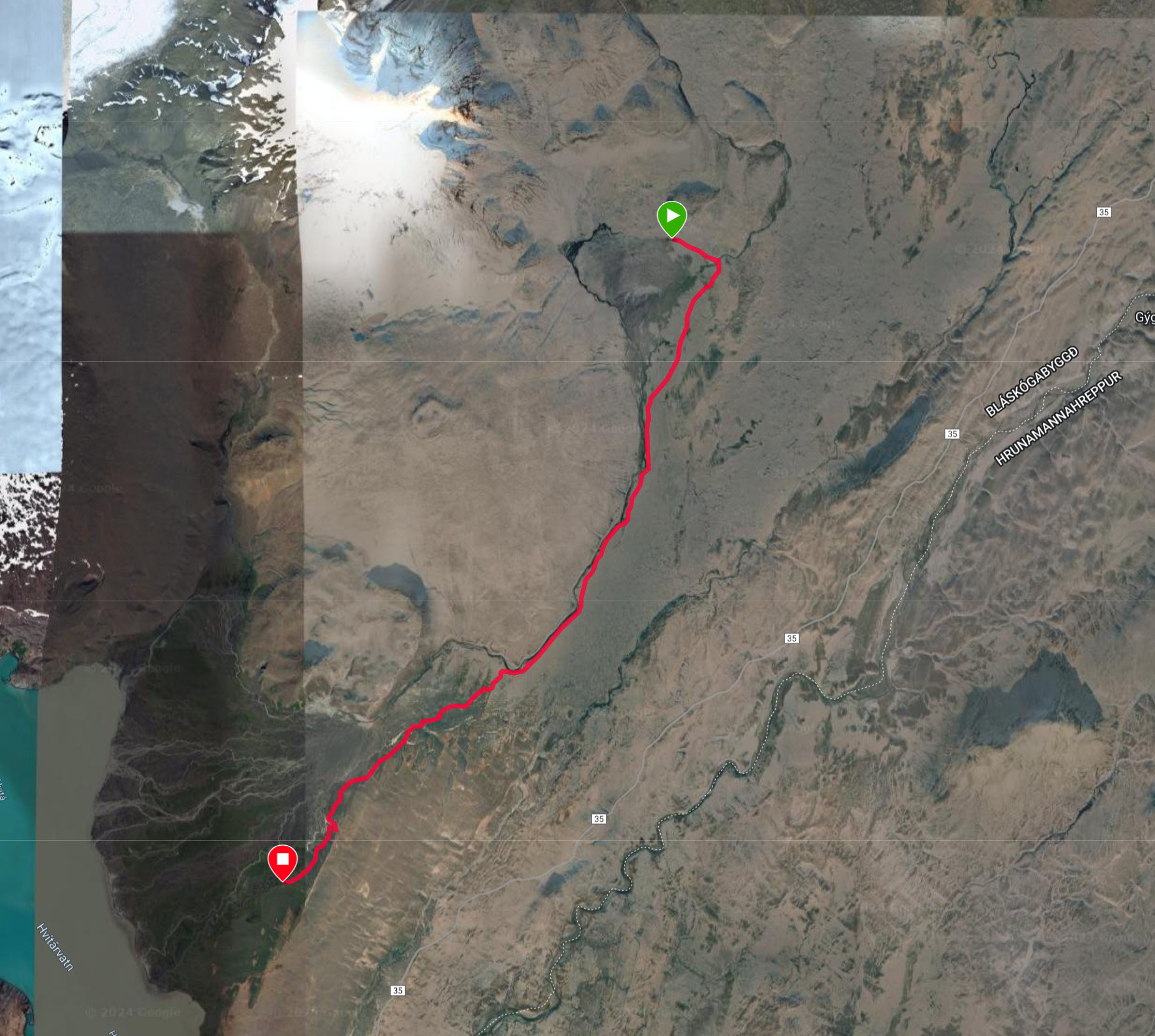
August 3, 2024 – 10:25 miles, 5:32 on the trail.
This was our longest hike of all, and it was also the warmest day. Eventually most of us hiked in shorts. The only nuisance were the midges. Iceland has two primary types of midges: one resembling a mosquito but not biting, and another smaller, fly-like creature that does bite. They do not carry diseases, like mosquitoes. They buzz around your face, and eyes, and get ingested when breathing. They are not around when it’s windy, and it was mostly windy all week, so they were not a major problem.
We had to cross over a few mountains. Here is our team huddling.
We found a peaceful spring. This entire creek in the video below just came out of the ground as a spring not further than 300 yards from this spot. The water is clean. You can drink water from a spring in Iceland without needing a filter. We drank right out of the creeks during our Iceland hikes, the freshwater creeks that is, not the glacier creeks.
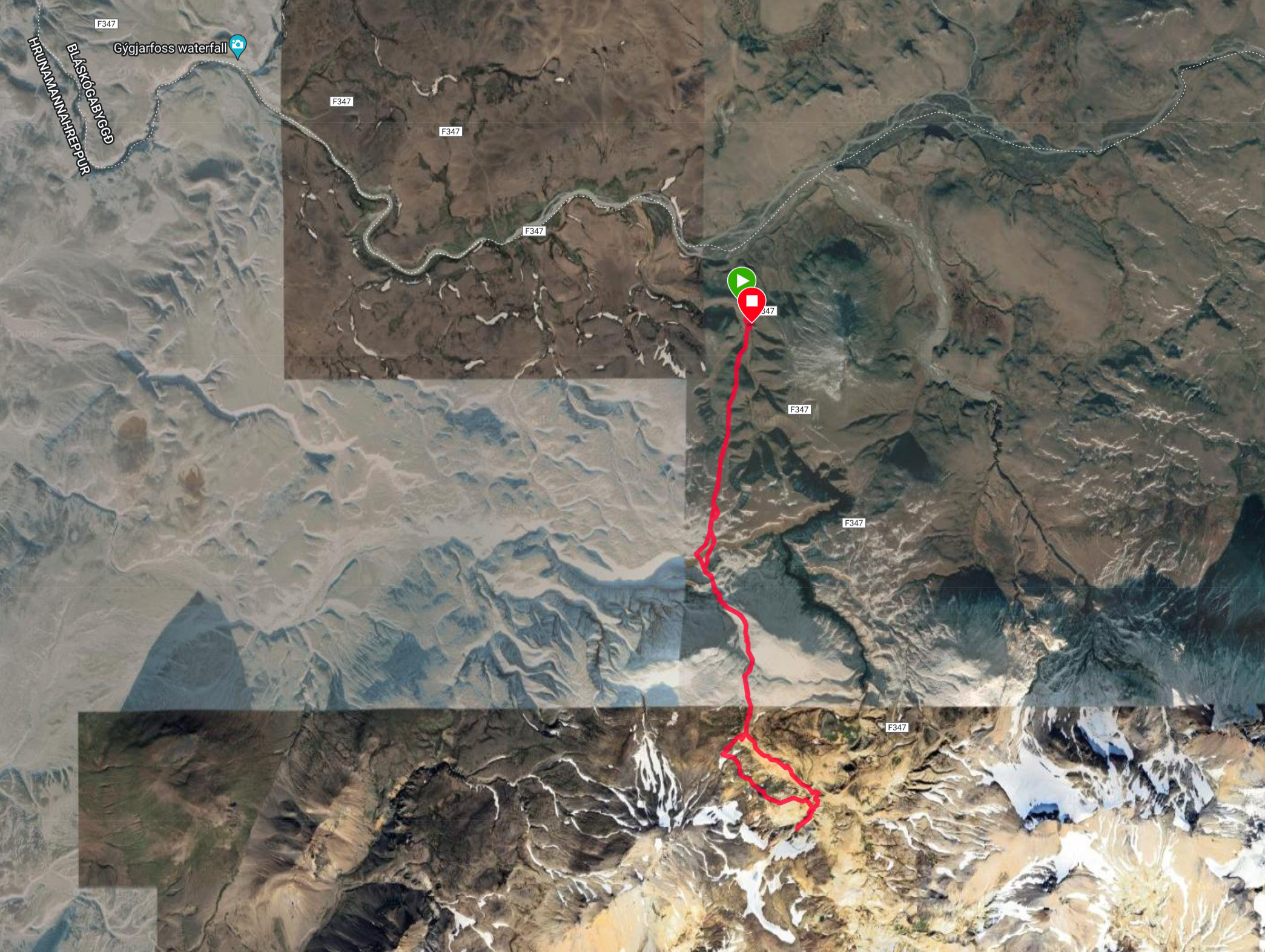
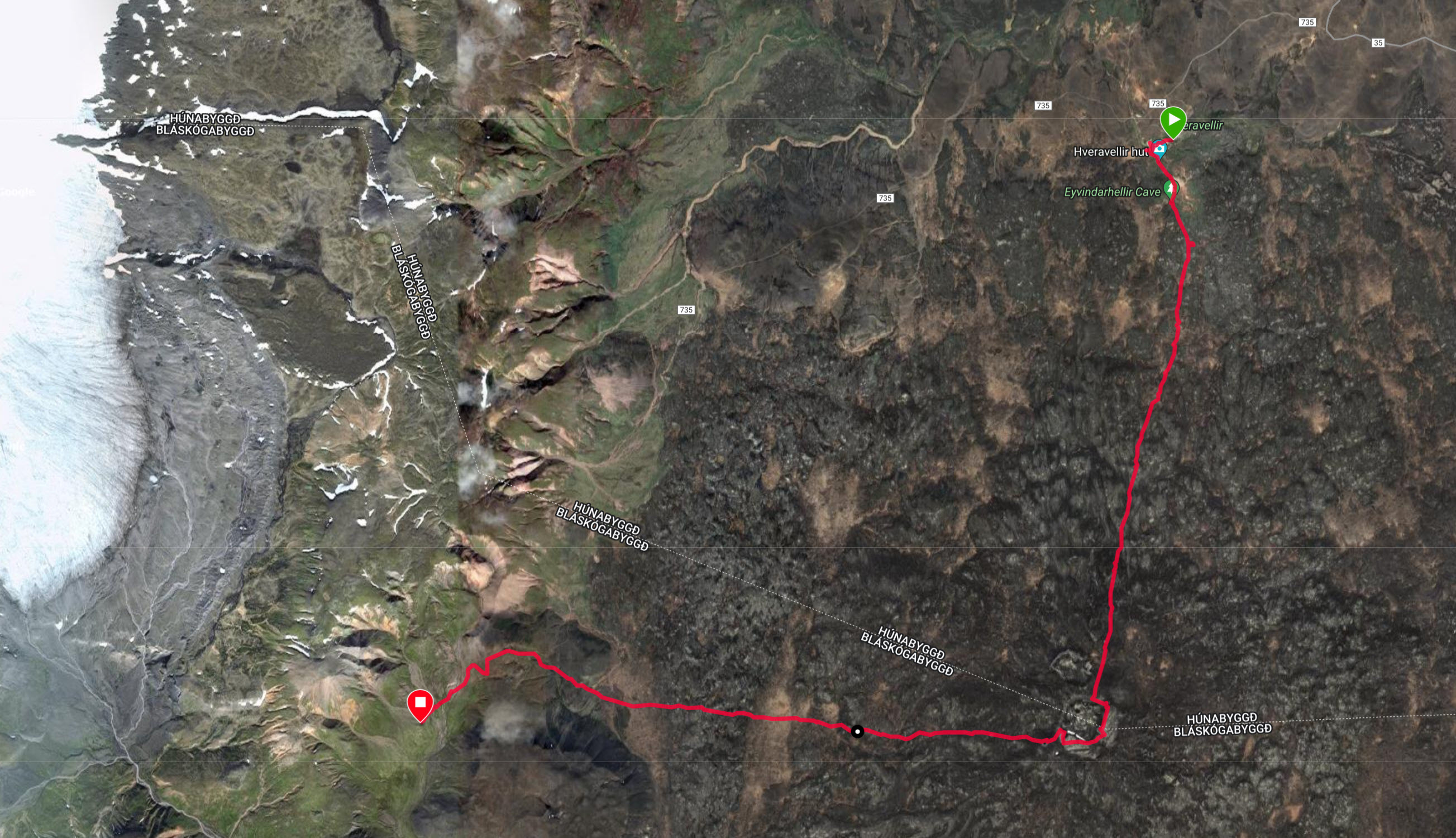
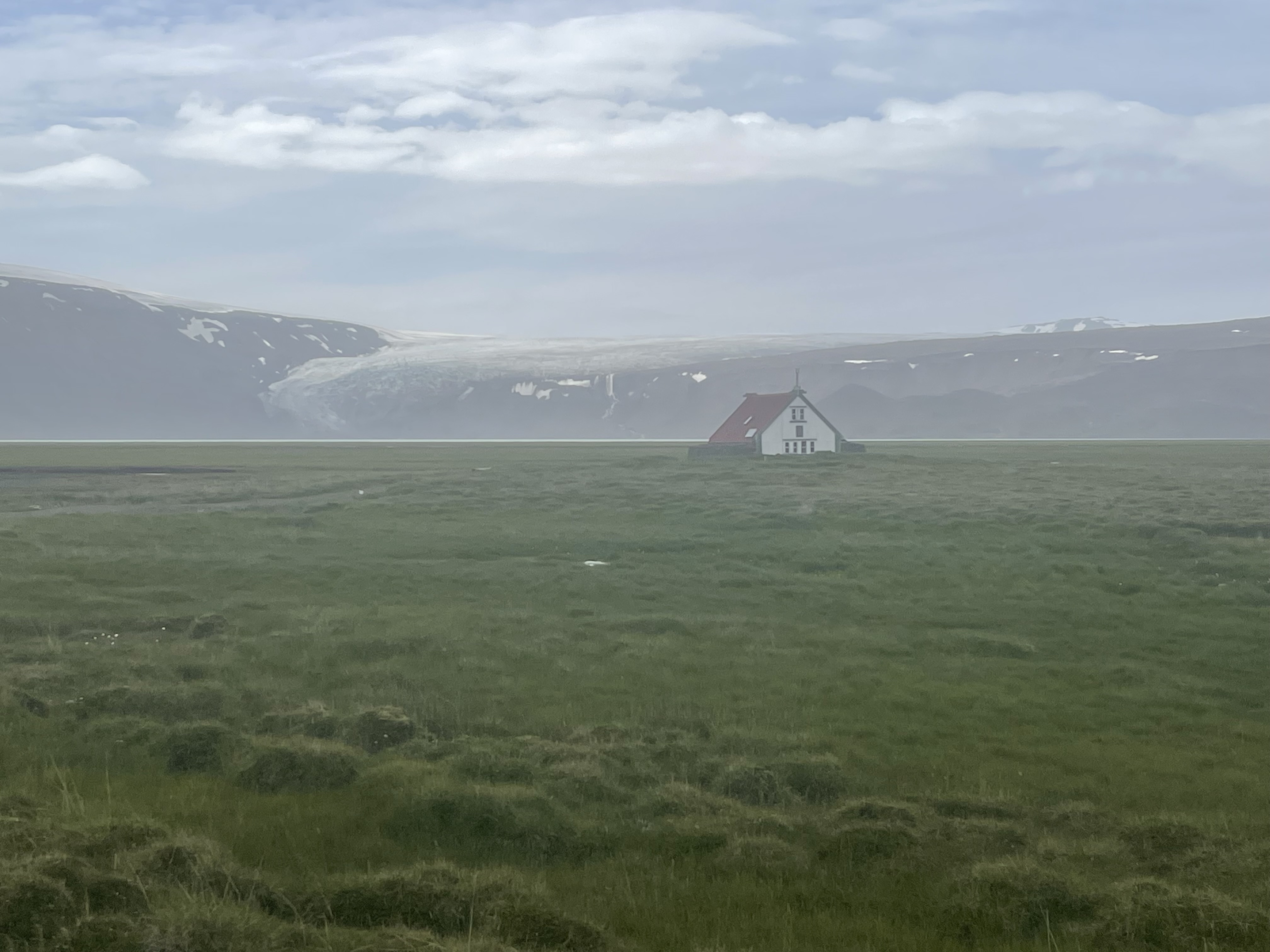
Here is the last hut, the haunted one, after a long hike. In the back, you can see the Longjökull glacier draining all the way into the lake below. You can see the lake in the left lower corner of the map above. He hut is at the red bubble.
While we were there, the sun set around 10:30pm. Here is a picture from our hotel in Reykjavik taken at 10:15pm:
The sun is setting on the other side of the hotel behind us. We only see the reflection of the sunset in the window on the buildings across the parking lot. Notice also the rainbow to the right of the building. Somewhere behind us it’s raining. While the sun goes down, it really just dips below the horizon and it never really gets fully dark, even in early August. The latitude is approximately that of Fairbanks, Alaska.
The summer season is very short in Iceland. Snow is still on the ground in the highlands in June. Sometimes it snows already again at the end of August, but definitely in September. While we were there, from end of July through beginning of August, it was as cold as the high 30ies in the mornings and it sometimes warmed up to the low 60ies. We saw the sun a few times, but it was mostly cloudy and sometimes very windy, with gusts up to 40 miles an hour.
That is enough wind to blow your hiking poles sideways when you lift them up, and a time or two it almost blew me over. The wind was most prevalent on exposed trails and ridges, of course.
In the video below you can see the wind whipping Trisha’s pants as she hikes along the ridge with the steam clouds drifting by.
Here is another one:
Here you can see the fierceness of the wind as it blows the steam plume over the trail. You might turn on the sound on your computer to hear it. The person in the picture is our guide Jonas.
A long time ago I read the biography about John Adams by David McCullough. When Adams left Boston in the deep freeze of February of 1775 on horse to get to the Congress in Philadelphia, it was a multi-month journey. Along the way, he and his fellow travelers had to stay at inns. In those days, you didn’t get hotel rooms to yourself like we do today. If there were beds, sometimes you had to share them with some other fellow traveler, and you may have had no idea who it was you slept next to.
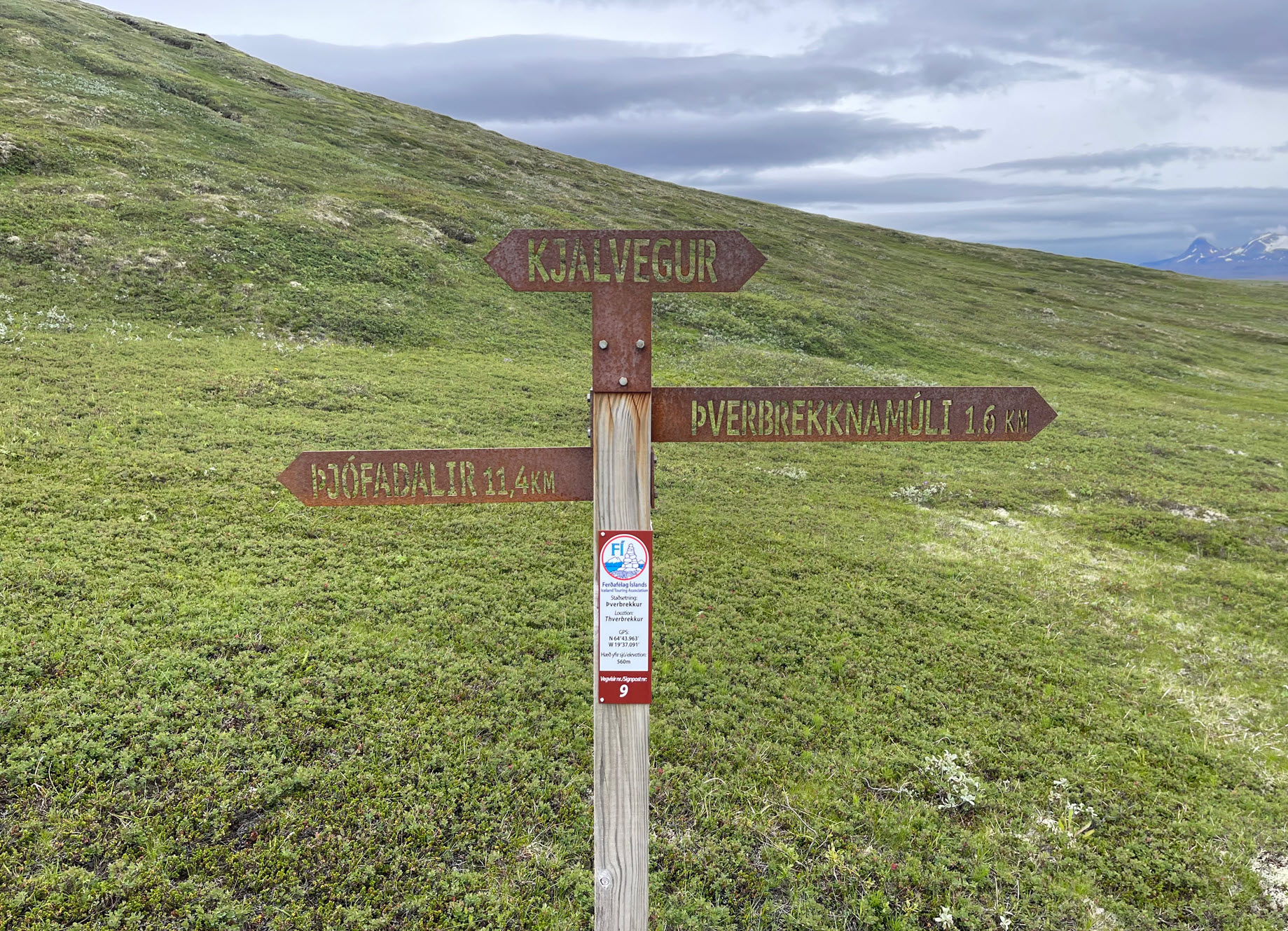
So it is in the highland huts of Iceland. You can make reservations until all the bunks are full. Just because we were a travel group, there was no guarantee that we’d have the hut to ourselves. In Hut 2 there were some teenagers who bunked in the loft upstairs. Hut 4 was called þverbrekknamúli.
Good luck pronouncing that name – I learned how to do it, but I can’t describe it here.
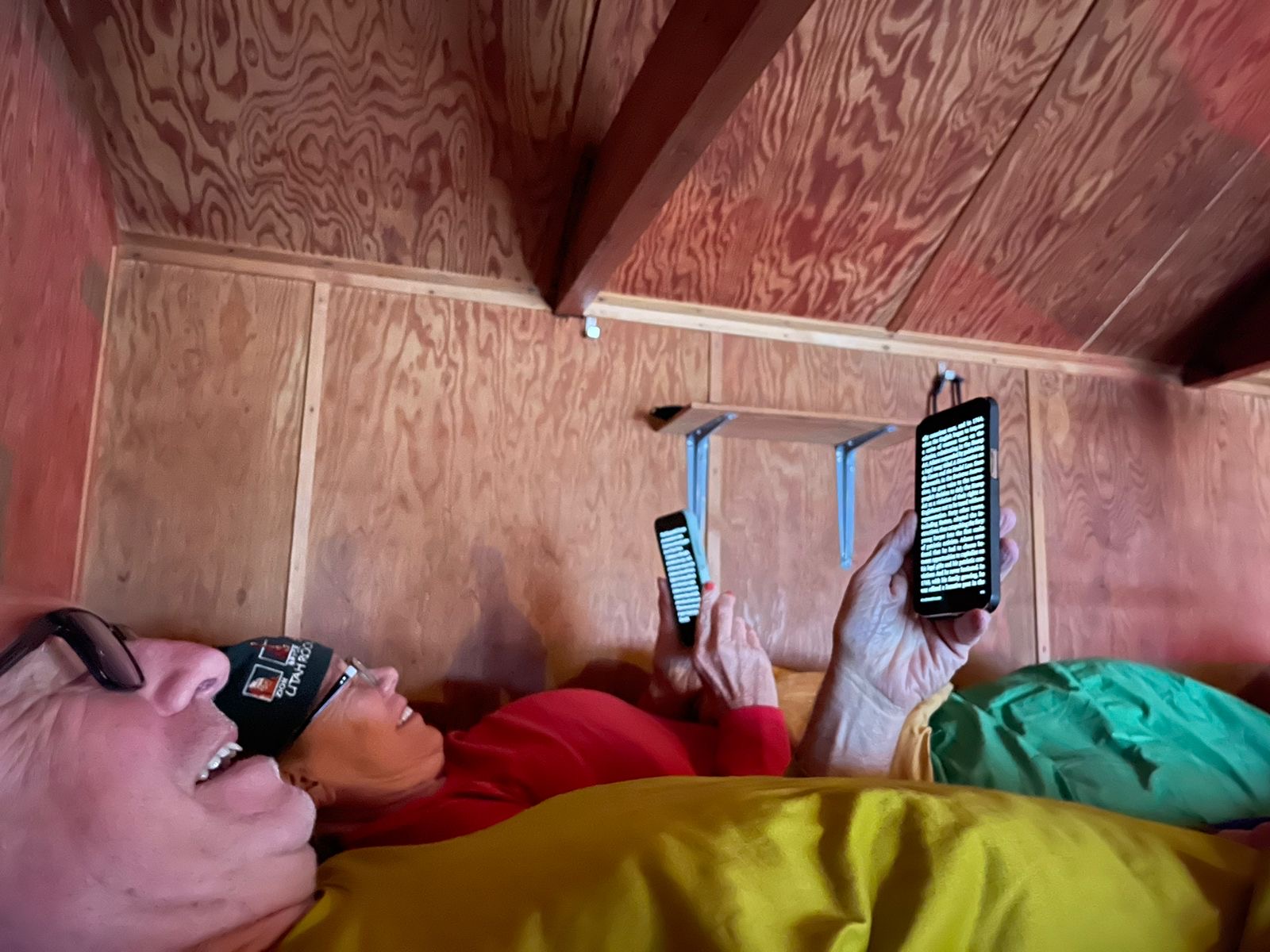
At þverbrekknamúli, as we were all getting ready to sleep, my wife and I had doubled up in one bunk. There were not enough bunks in the hut for everyone to have their own. Here we are, reading before going to sleep. Note how little head-room there is.
At about 10:00pm, there was some rumbling outside. Our guide Jonas was just getting ready to crawl into his sleeping bag when the commotion started. He got up, went outside and found out there were two men with backpacks who were also planning to stay the night – and worse – make dinner first. Since Jonas didn’t want all of us to be kept awake by cooking activities, and since we had leftover food from our meal, he offered it to the travelers. He joined them at the table and the three of them were whisper-chattering away in Icelandic until about 11. Jonas, who had the bunk next to us, gave up his for the two travelers, and pushed over our driver and double-bunked with him. I was still awake when the two newcomers climbed up into their sleeping bags next to our feet. And thus we had strange bedfellows whose heads spent the night not 8 inches away from my feet in my sleeping bag.
Morning came and we went about our routine. The visitors were friendly enough as we prepared breakfast and got ready for our departure. One of them actually took some group pictures for us, including the group shot, with Jonas in it:
We said our good-byes and went our way. Later, during a break in our hike, Jonas told us that one of the visitors was Guðmundur Ingi Guðbrandsson, the Icelandic Cabinet Minister of Social Affairs and the Labour Market and head of the Left-Green Party. Before that, he was Minister for the Environment and Natural Resources. Jonas didn’t want to reveal his identity while we were there out of respect for his privacy.
It was good that he did, since I would have loved to have a chat with him and learn about environmental policy in Iceland.
As it goes, we were just strange bedfellows.
On language:
The character ð is pronounced like a very soft “th” in English, with a lot of air flowing through your teeth, like in the word teeth.
The character þ is pronounced like a very hard “th” in English, like in the Viking name Thor.
We were driven to Hut 1 on the first day and spent our first night there. All the huts were built in the 1960ies and 1970ies. This one is the second-oldest. In hindsight, it was also the most luxurious. It had a mudroom in the front, with a spacious kitchen and dining area behind it and hot running water. Two indoor toilets. The dormitory was simple bunks. Some of us slept upstairs in the loft (attic) up a scarily steep staircase. It was freezing in the morning. You see us here with all our layers on just before departing. Trisha and I are on the left side.
Hut 2 also had one indoor toilet and a single room with bunks and a picnic table in the middle for meals with a small kitchen to the side. Right next to it was a natural hut tub. It consisted of a man-made basin fed by two water pipes. A hot one directly from one of the hot springs, running boiling water, and a cold one from the adjacent creek. The trick is to move the pipes so the water mixes in the middle making for a good temperature. We had to be careful not to slip over too close to the hot pipe. Boiling water is not good for the skin. When it got too hot, we could jump out into the creek for a dip in cold water.
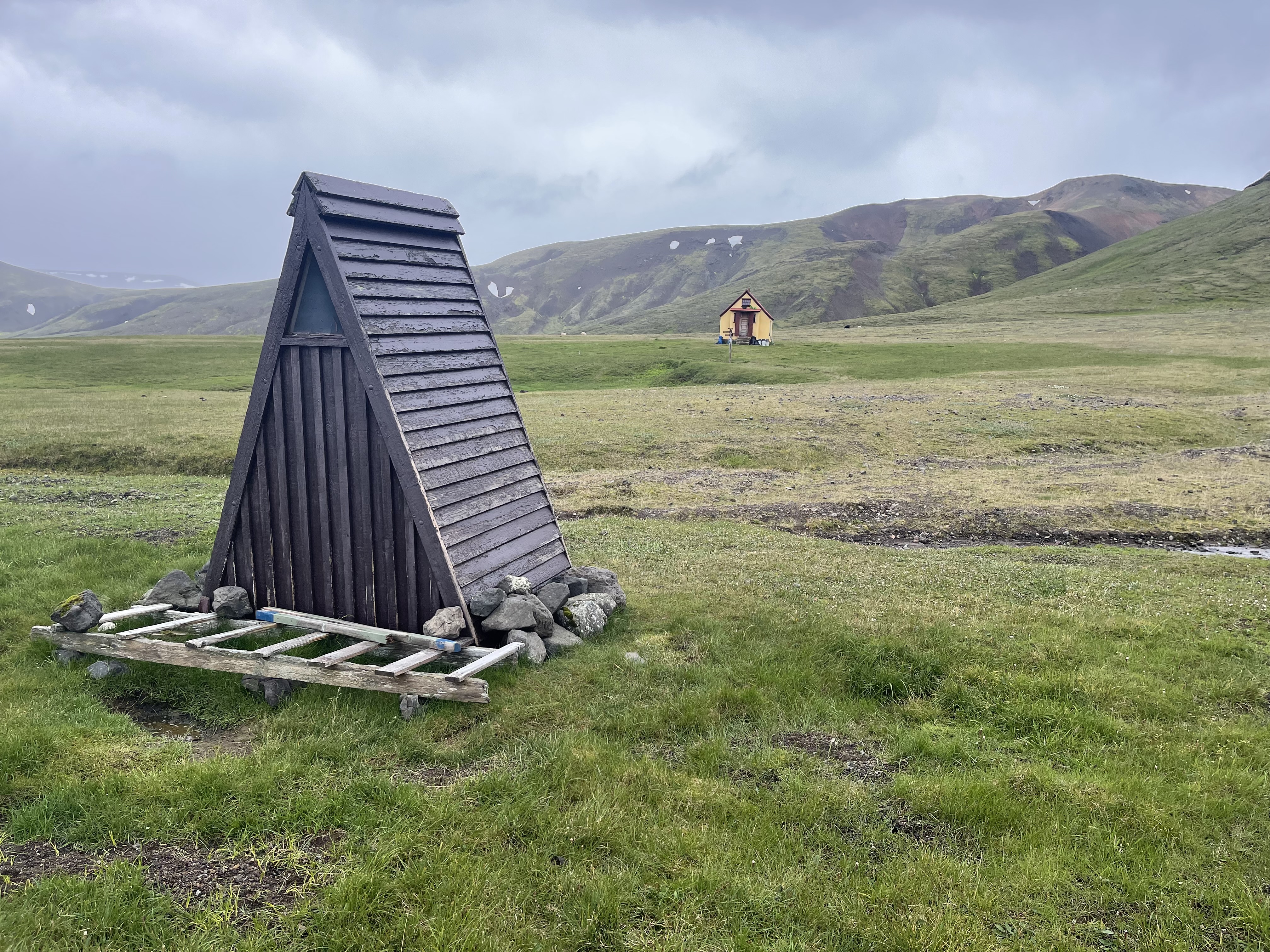
Hut 3 was a trip. It was TINY:
We arrived there after a long and strenuous hike, with about 4 miles off trail across the tundra, with occasional high winds and rain. We were wet. Check out the picture below. This is the whole hut, and twelve of us (2 guides and 10 guests) slept in this. It’s literally no bigger than my home office where I am currently typing. There are four bunks on each side, two on the bottom, two upper ones you have to climb in. The length of the hut is perhaps 12 or 13 feet. Then there were another four sleeping spots upstairs in the loft. I didn’t even look up there since I thought it would be too claustrophobic. The bunks were like coffins. Nobody slept well. If any one of us had to get up to pee in the middle of the night, I am sure everyone woke up.
There was a rickety outhouse this far away across a creek.
Here is a picture of part of our crew inside. I took this from my bunk. There was not enough room inside for everyone to be up at any time. Some of us needed to be in bunks to fit. The two ladies staring up are talking to the ladies in the loft above. They were sitting there with their feet hanging down over the table.
Here I am, refusing all my life sharing even a hotel room with a workmate all these years, with a minimum hotel grade standard, and lifetime Hilton Diamond membership. This was by far the coziest I have ever slept with twelve other people literally within an arm’s reach.
After the tiny hut, Hut 4 seemed luxurious. There were ten double bunks (about four feet wide). So most people could stretch out, but the two couples, Trisha and I being one of them, had to double-bunk, so we only had a shoulder-width for each of us.
Hut 5 is the oldest hut in the highlands and it is said to be haunted. It was the only one occupied by a caretaker, which they call warden. She told us some ghost stories before we went to sleep.
There was also an outhouse with two toilets and running water, but it was literally 200 yards away. Quite a walk in the middle of the night. At the right there is a grill table where the guides cooked a leg of lamb for dinner.
Here is a view of Hut 5 from the end of the trail where the bathroom was. You can see how long a trip it was to “go.”
In addition to bunks with mattresses, the huts have assortments of dishes, like plates, bowls and cups, knives, forks and spoons, and some pots and pans, to prepare food for as many people as there are sleeping accommodations. The dishes are in some state of disrepair. For instance, many coffee cups have handles broken off and plates and bowls are sometimes chipped.
But there was always plenty of toilet paper. There must be a Costco on the island.
From July 29 to August 4, Trisha and I went on a hut-to-hut hiking tour of Iceland’s Ancient Trails. We booked a 6-day tour with Norse Adventures. Our guide was Jonas Valdimarsson.
The Kjalvegur road crosses the Icelandic central highlands and was essential for connecting the north and the south through its long history. It was used by Viking armies, traders, shepherds and explorers despite the harsh conditions. We hiked about 50 miles from hut to hut over five days.
There were ten in our group, eight women and two men. Eight Americans and two English ladies. I was the second oldest. The oldest was a 75-year-old woman from Spokane.
Here we all are. Coincidentally, Trisha and I happen to be the two in the front and center. Yes, it’s the middle of high summer in Iceland. The temperature ranged from the 30ies in the morning to about 60 as a high during the day, when there was no wind. However, the wind often was fierce, with gusts of over 40 miles per hour along some high spots and exposed ridges.
We needed all our layers, gloves, hats, long underwear and rainproof outer shells just to be comfortable.
A support vehicle carried our gear between the huts, while we and our guide hiked. You can see me leaning on the tire for scale.
Notice the “snorkel” on the left side of the windshield. This is the air intake. Some river crossings have water come up to the windshield of the vehicle.
I will post a series of topical updates in the next few days for further reading.
Published in June 2016, when Vance was just 32 years old and about three years after he graduated from Yale Law School, Hillbilly Elegy is a remarkably good book and a must read, no matter what your political bent may be. There is also a Netflix movie that I have reviewed here.
Vance wrote the book long before he had political ambitions. It is a passionate and highly descriptive narrative of his own personal life and upbringing. He is only one year older than my daughter, so I could relate to the chronology of when and how Vance grew up and what shaped him.
The odds against such a child just simply surviving the desperate fight out of drugs, poverty and despair, let alone being successful, and achieving a stellar political career, are astronomical. In the end, I took away that the United States Marines saved the boy, made him a man, and served as his springboard. Vance tells not only his and his family’s personal story, but he shows us what social and class decline feels like in huge swaths of this nation. It helps us understand the decline of the rust belt, and the impact of manufacturing leaving our country for she shores of Asia.
It is therefore no surprise to see how some of Vance’s political views were shaped. I have a hard time understanding where some of the controversies come from that he has created since he associated himself with Trump. After reading his book, the Trump-Vance alliance seems unlikely and I can’t quite figure out how it happened. It almost does not make any sense. Perhaps it’s just the next logical step for him to ascend the ladder. While he obviously disagrees with some of Obama’s policies, views and strategies, he admired Obama and modeled some of his own life to Obama’s rise. That, I speculate, might have driven him to Trump as a stepping stone to the national stage. After the Trump era is over and Trump is gone, Vance will still be a young man and now we all know him, don’t we?
There is also nothing about any couch in this book, and nothing objectionable that might push you away from Vance as a character. On the contrary, you want to meet him and chat with him at a backyard BBQ.
I am not going to vote for Trump-Vance, but I am telling you that Hillbilly Elegy is a remarkable book. If you are at all interested in understanding the decline of America’s white middleclass, you need to read it.