
Book Review: Replay – by Ken Grimwood

Here is a unique book in a number of respects:

  1. How I came to know about it, even though it was written in 1986.
  2. How it fits into my recent readings (time travel stories).
  3. How some of the effects in the book reminded me of effects in The Accidental Time Machine.
  4. How some of the passages remind me of my own life.

Over the holidays, my friend Brian and I talked about books, and he told me about Replay. I said I’d look for it, but as it goes with such conversations, I forgot the title and never ended up following through. One Monday morning I arrived at my desk and it was in my inbox. He must have come by my office and dropped it off for me while I was out of town.

I love reading stories with time travel or similar effects and this book fits the genre perfectly. If you search this blog for books, you will find The Fermata, Time Pressure, The Time Traveler’s Wife and The Accidental Time Machine, all out of that category. I’d love to write a book like this.

Now I have to talk about the effect. First, you must note that the author published the book in 1986, smack in the middle of the Reagan administration. The protagonist is Jeff Winston, a man born in 1945 who started going to college in 1963. He became a newspaper journalist, had a mediocre life, an unsatisfying marriage, mostly due to lack of resources. He died of a massive heart attack on October 18, 1988 at 1:06pm.

Much to his surprise and causing utter disorientation, he ‘wakes up’ in his college dorm room in 1963. After some serious confusion and bewilderment, he figures out that he is simply placed back in his old life, 25 years earlier, with all the characters of his old life still there, and they don’t have a clue. To them, this is just life. He, however, remembers everything. For instance, he remembers the outcome of a horse race with very long odds. So he scrapes up all the cash he can find, a few hundred dollars, bets it all on the horse, and wins $12,000. A few more bets on horses and the World Series, and he has a few million dollars. He does not have to try hard with the stock market before he is a very wealthy young man.

Eventually he makes his way to 1988 again, leading a totally different life this time around, only to die again and to wake up in 1963 a third time. There is a minor issue: there is ‘the skew.’ Every time he goes back in time he drops forward a little bit. So when he arrived in 1963 the first time, it was May 1963. The next time it was a few days later. Then it was months later, and so on. The replays kept getting shorter on a logarithmic scale. This is an interesting effect somewhat analogous to Haldeman’s Accidental Time Machine, where the jumps are on a linear multiple factor, both spatially as well as temporally.

I don’t want to tell you more about the story or the plot in case you want to read this, so I will leave it at this. But I do want to elaborate on how there are passages that remind me of my own life.

There is a subplot that involves dolphins and dolphin research, which was of particular interest to me in the 1988 time frame, when I was seriously considering going back to college for Cognitive Science. I wanted to use computer science (the field I was in), coupled with linguistics (having studied six languages myself) and alien intelligence (dolphins) to research human / dolphin communications. I never ended up in that field, partly due to lack of resolve on my part, and excuses that I had small children at the time that needed the attention, and economics – I couldn’t afford to take time off to start another career. During that time in my life, I read Dr. Lilly’s books on dolphin intelligence and studied up on his research of dolphin linguistics.

In Replay, one of the characters creates a major popular movie, named Starsea, that centers around dolphins, which in turn inspires a young student to study Lilly’s work, linguistics and computer science and work at U.C. San Diego in Marine Biology. Reading that was eerie, this could have been myself, and to think about Grimwood writing about that at the same time I was considering such a career, but finding out now, in 2009, had me marvel about synchronicity.

Incidentally, if you are interested in fascinating science fiction involving sentient dolphins, read David Brin’s uplift series, starting with Startide Rising.

Back to Replay: This was a hugely entertaining book, well written, an inspiring story with a good message to boot.


P.S. Ken Grimwood died of an apparent heart attack  at the age of 59 on June 6, 2003 at his home in Santa Barbara.
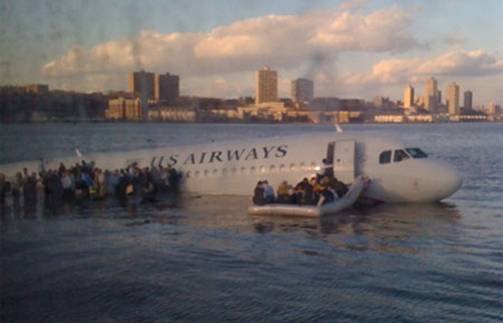
US Airways – Lost Luggage – Take Two

I have been complaining about my luggage, but it could have been worse:

This was the same airline, and the same type of airplane (Airbus 320) that had this mishap the week before:

us-airways-river-landing

So I was very lucky not to be THERE.

And about  36 hours after arrival, two full nights later, my luggage arrived at the hotel. Thank you very much.

US Airways – the worst airline in the U.S.

Traveling from San Diego to Albany, New York, I get bumped from my original flight on American Airlines to US Airways. I patiently walk across the terminal to check in.

I get to pay $15 to check luggage. I don’t have to pay at American, but so be it.

The agent can’t get rid of the American Airlines  leg on the computer, so she cannot print my luggage tags. She hand-writes one, which makes me suspicious.

When I go to my seat, there is somebody already sitting there. I get another seat.

When I get to Philadelphia, the pilot for the plane going on to Albany is not there and we sit there waiting for two hours for him to arrive. I can attribute that to the weather. So far, so good.

I finally arrive in Albany at 12:30am, three hours late. My luggage is not there. I stand in line for a half hour until  they take down my claim.

There are no taxis at the airport at that hour, so I stand in 20 degree weather with only a light coat, no car, no luggage, no taxi, stranded.

Next day: I check online based on the tracking number they gave me.

lost-luggage-us-airways

This does not look good at all.

I call the airline every two hours. The agent (in India, no doubt) confirms that they have no idea where the luggage is and they keep sending emails to Philadelphia, over and over.

The various telephone numbers all send me to the website which clearly has no record of me or my claim. The agents tell me they have no idea.

I fly very seldom on US Airways.  I do it only when I absolutely have to.

But I can honestly say that I cannot remember ever flying on US Airways and not have something go wrong.

Please,  Travel God, don’t ever let me fly on US Airways again.

The Missing – the Movie

When I started watching this, I didn’t even know it was going to be a Western.

An improbable and trite story, it starts out when a father, desperate and broken, comes back to visit his daughter, who is running a ranch in the New Mexico plains around 1880. She is has two daughters and she hates her father, so much, that she is sending him away as soon as she sees him. Presumably he abandoned her and her mother, and she has not forgiven him, and will never give him a chance.

As the story goes, her older daughter gets kidnapped and taken away to be sold into slavery in Mexico by Indian bandits. This turns her around and she recruits her father to help her chase after the Indians. Off they go. A very unlikely story, and one we never really believe as we watch it.

Cate Blanchett and Tommy Lee Jones star in this Ron Howard movie. All three of them are bigger than this movie, and they make do. You will probably watch it all the way through, even though it’s too long, and you’ll say to yourself that this is one of the weakest Ron Howard movies.

Rating: **

Movie Review: Slumdog Millionaire

After many recommendations by friends, after an avalanche of good reviews, I saw Slumdog Millionaire. I didn’t know what it was about, and I had to look it up first. This is not a Hollywood Movie. A long time ago I read somewhere that India makes more movies than Hollywood, several times over. But I can’t remember seeing a good one.

If what I saw about India in this movie is true — and it claims as much — I am not sure I am interested in ever going to India. Then, on the other hand, there is a modern India and a desperate India. Here we mostly saw the desperate side, and the modern and wealthy side was portrayed as preying on the masses of the poor in every respect, physically, emotionally, financially, morally, forcing the poor into all manner of abuse and misery.

Children, four years old, orphaned by mobs, left fending for themselves for the rest of their lives. Heaps of garbage. Open sewers. Filth and crumbling buildings everywhere. Children forced into slavery, blinded brutally by acid so they are more successful as beggars, sent off as servants (the lucky ones). We don’t see sexual abuse, but we sense it everywhere.

One in six people in the world is Indian. How can a country, portrayed as such a miserable place, be so prolific in its procreation? How can such a disastrous place even exist? I have a hard time respecting a country and a religion that  does to its people what I saw in this film. Am I being told a story to shock me? Is this the reality that I am conveniently sheltered from by never going to India? I have known people that went to India to find enlightenment. Enlightenment? So this is what an enlightened culture does to itself and its people, its children? No, thank you.

The story is about an orphan who grows up through his sheer resilience. He knows when to run, he knows when to be cunning, when to lie, steal and beg. He is smart and he lives by a set of principles, even when his friends get tortured and abused and his brother goes rogue.

Somehow he manages to get on the game show Who Wants to be a Millionaire, Indian flavor, and is lucky enough to know all the answers. They come from stories in his life, which we witness as a series of flashbacks. The story moves forward through driving music and endless imagery of one shock after another, the camera work unusual and foreign. We see the story from the sidewalk, from the level of the garbage, from the tile floor after having been beaten, from the horror of backrooms where sadists mutilate children.

And after all this, we rejoice at the end and are actually inspired and motivated. Then we leave the theater and we are astonished  that the tires are still on our cars in the  parking lot, and that we can just go home and make dinner.

Why? Because we were born in a country unlike India. Are we enlightened?

Rating: ****

Book Review: The Accidental Time Machine – by Joe Haldeman

During my last evening in Tallahassee I stopped at the local Borders and picked up a few science fiction books from authors I had never considered or read before. Of course, I can never resist a time travel story, so when I saw The Accidental Time Machine, I was committed.

I needed a book for the trip back, so I started reading that night. I was planning on working during the next morning on the plane trip back. Usually I only read during takeoff and landing, when I can’t use the computer. But that never came about.  I read the book all the way through and I was done before I got home.

The story starts around 2050, when a graduate student at MIT, named Matt Fuller, builds a minor electronic device, a calibrator for something. But as luck would have it, there is a fault in one of the electronic components of the device, as we later learn, that is only manifested in the 5th dimension, which, of course, none of us have access to. The machine moves itself, and everything metal is connected to it,  and anything in that metal it’s connected to, in the first four dimensions, when the Reset button is pushed.

But there are enormous restrictions. The distance it moves forward in time and space is linear by a factor. So it jumps about 1 second the first time, which is when Matt notices that the box disappears and then reappears after a second. He does not trust his vision. The second time it’s gone for 12 seconds. He quickly figures out that the time distance increment is linear based on a factor of about 12, and if you do the math, it does not take long before a jump is 170 years, and then the next one 2000 years, and so on.

The second restriction is that the location, the first three dimensions, of the return is not identical to the one of departure either. It moves. During the one second jump, it was not noticeable, but during  the 12 second jump, it left the screws that attached it to the wooden base. Future jumps would eventually throw him into the  middle of traffic on a highway and much worse.

As Matt figures all this out, he tests the device first in the lab with a  turtle to make sure live creatures can survive the jump.  Then he takes his shoebox sized metal device, connects it with a cable and an alligator clip to the metal frame of a car, sits down in the car in his friend’s garage, pushes the button and disappears.

Being from MIT, his professor, whom he briefed with a note before departing, figured out where Matt would eventually land 15 years in the future. He’d spend the 15 years of waiting figuring out the exact location and point in time, and leaving nothing to chance, he has a stadium-type  reception structure built with a welcome committee, bands and other trappings of glory. Not to mention that he had secured the Nobel Prize in physics for himself in Matt’s absence.

I can’t tell you the whole story. You can imagine that Matt’s experiences get increasingly wild as he travels further and further out, and I enjoyed the ride tremendously. Unlike Spider Robinson’s Time Pressure, this does not fizzle for a minute, and you keep looking forward for the next push of the Reset button

Now I need to buy more Haldeman books.

The Appeal – by John Grisham

Another legal thriller by John Grisham, The Appeal is a page turner, albeit one at a reduced pace. For a change, there is no killing by any government or industry goons. There are good lawyers and bad lawyers, and evil and selfish business  men and their trophy women.

The story leads us to get to know a few key characters, and we follow the characters in the plot until they no longer become central to the plot. Then the characters just fade away, giving focus to others. While Grisham does a good job with characterization, helping us see the folks, feel their feelings, he was sloppy on the plot, and when the book ends, we don’t have the feeling that things are tied up.

The ending is a surprise. The villians win and literally sail off into the sunset, ready to use and abuse more people, by the thousands and millions. In an age of corporate excess  and the associated failures, this book gives us a glimpse into the lives of the perpetrators. To be successful, it suggests, you have  to be ruthless, cunning, and it’s not a problem if you see others  as pawns only for your own personal benefit.

Mind you, Grisham does not try to teach, or moralize, he tries to entertain, and that he does. But the negative ending, the dropped characters, the unfinished story lines, all left me hanging. When I read the last page I had a hard time believing it was done. The good guys didn’t win, the bad guys didn’t get punished. It was as if Grisham just got tired of writing, and didn’t want to finish the last 50 pages and wrap things up so we’d feel good about the story.

So he left it hanging.

This is the weakest Grisham book I have ever read.

Below Freezing in Florida

You don’t normally pack warm clothes when you travel to Florida. So I arrived in Tallahassee last night, wearing jeans, a shirt and a sports coat. My luggage was nowhere to be found. And it was cold out. The weather report said the overnight low was 20 F. I had to go to K-Mart and buy a sweatshirt and sweatpants just to be comfortable for the night.

I seem to have a knack for finding cold spots this winter. Take me home, country road!

100 Degrees Change

Yesterday I traveled from San Diego to Des Moines, Iowa. I left 85 degree weather and arrived at 10 below, plus windchill, and snow flurries. The shock is stunning. How do people ever get used to this and deal with it on a day to day basis?

You Are Here – by Thomas Kostigen

The subtitle is:

Exposing the Vital Link Between What We Do and What That Does to Our Planet.

I learned a tremendous amount reading this book. Systematically the author walks us through exotic places and shows us the adverse effect of human activity on the planet, in areas where we’d  never expect it.

I am a skeptic. I don’t fall for fads. But let me tell you this:

  1. I am going to review my personal use of electricity.
  2. I changed my thoughts on how to do the dishes.
  3. Water use (or abuse) has a different meaning.
  4. Paper and recycling (or rather, not printing  that page of paper in the first place) has new meaning to me now.
  5. I am going to be more careful about recycling my garbage.
  6. I will watch product labels and origins more carefully.

The list goes on.

The book is very readable and written in a no nonsense style. He just makes sense.

Go the Kostigan’s Web Site and get more information and updates, and be amazed about some of the asinine negative comments.

Thank you, Chelsea, for giving me this book for Christmas. It made an impact.


A few days after I first published this post, I ran into this picture on MSN, which references one of locales a chapter of the book is dedicated to.

Frost/Nixon – the Movie

Nixon resigned the presidency on August 8, 1974, the day after my 18th birthday, and 12 days before I first arrived in the United States as a foreign exchange student. So I never experienced the Nixon hardship the country was going through, and I was not in the country in the spring of 1977 when the Front interviews took place. I had missed that.

I enjoyed watching events that occurred during my coming of age, and some of the footage provided me with flashbacks to my youth.

Clearly, some of this, albeit based on actual events in a historical context, is fictionalized. However, we get a sense of Nixon’s character, and we are in awe of his shrewdness and smooth operator mannerisms. It looked like he was just playing with Frost, that Frost was way out of his league. Only through intense pressure, focus and excellent research did Frost eventually turn things around and make history.

Nixon was a bad president, of course, history has proven that, and his legacy is unique in our history. But somehow he seems more presidential than George Bush does to me right now. I found myself comparing this guy to Bush. I questioned the soundness of our political system that creates men like these and elevates them to the pinnacle. How does this keep happening?

I learned much watching Front/Nixon, a Ron Howard movie. And I enjoyed it immensely. I think it will win awards.

Rating: ****

Criss Angel – Believe – the Las Vegas Show

Since the Mindfreak shows were aired on A&E in 2005 and 2006, I always enjoyed watching Criss Angel shows. I think he is the best in his class.

So naturally, when I found out that they built an $85 million theater in the Luxor for a Criss Angel and Cirque du Soleil collaboration, I was eager to go and see the show.

Last Sunday we drove to Las Vegas with the sole purpose of going to the 10:00pm showing of Believe.

Fortunately, I didn’t read the reviews before. Here are a few samples:

http://www.lvrj.com/news/29875759.html

http://www.yelp.com/biz/criss-angel-believe-las-vegas-2

They are absolutely AWFUL.

If I had read these reviews before booking, I would never have gone.

I actually enjoyed the show. It was an experience and adventure. Criss Angel staple tricks are appearing and disappearing, levitation and mentalism. He did some of that. He also did a few slight of hand tricks, like the classic pulling doves out of handkerchiefs. All of it done masterfully.

The Cirque du Soleil dancing and occasional acrobatics fit well within the story line and the music, as always, was superb and contributed in a large way to the experience.

One thing I found that was new was the clever way the show mixed video with reality. There were several occasions or stunts where characters walked onto the stage out of a screen, or walked or jumped from the stage into the screen. At one time, a flock of doves (lots of them) appeared to be flying out of a screen, right into the audience, to the back of the theater, where they disappeared.

There were also sequences where you could not quite tell  what was video and what was stage reality.

When you see Criss Angel critics, bloggers or commentators, they often talk about how he “fakes” things by hanging from wires, or body doubles, etc.

HELLOOOO. This is an illusionist. When he is suspended from the air, or apparently walking on water or up a wall, he is hanging from SOMETHING.  How else would this be working. When he is performing a mentalist trick, he is not reading the person’s mind. He is simply using some trickery that has not occurred to you and he has diverted your attention from the trickery sufficiently to fool you. I also got a kick out of the people commenting about being able to see the cables suspending the human angles flying. Duh! This is Cirque du Soleil. Did they really think that we were going to think the angels actually flew?

On the other hand, of course, Criss Angel should have anticipated that, and not have an act of flying angels at all — they really didn’t add to the story and we could have been fine without it.

My main criticism was  that there was not as much magic as I would have liked. I saw David Copperfield a year or two ago live, and while I thought some of his stuff was dated, he did a lot more active magic and not so much fluff.

So yes, I can see how Believe might not have the 10 year contract lifetime, and how it might eventually flop, unless he cleans  up some of the rough edges and listens to the critics.

Because, after all, the reviews are absolutely miserable. And there must be some kernel of truth.

Rating: *** (because I did enjoy the show)

We Were Soldiers – the Movie

A 2002 movie starring Mel Gibson as a colonel in the US Army, leading a battalion in 1965 in the Vietnam War. Get ready for graphic violence and horrible war scenes. This is another war movie that leaves you speechless about the futility of war. Men on both sides get mowed down. They lose their lives on the battlefield. Then they are told they are doing this for their country. What did 58,000 American soldiers lose their lives for in Vietnam? It’s easy for us to say today that the Vietnam War was a useless war. Tell that to the soldier on the battlefield.

What are we telling soldiers on the battlefield in Iraq today? And what will we say about the Iraq War 43 years hence in, dare I write it down, 2052? I will likely not be here in 2052, but my children will. What will they say then?

This is a movie about leadership. The commander of the operation is the first soldier to step onto the battle ground, and the last one to leave. This is in direct contrast to the Vietnamese colonel, who led the entire Vietnamese effort from inside an underground bunker, safe and protected, while the sent his young soldiers into ridiculous suicide missions. After it was all over, he walked the battlefield, examined the mounds of his dead comrades, neatly stacked by the Americans, and mused about the tragedy of war.

It seems every war movie has the same formula. Get to know the players,  see them crumble under pressure, or soar above everyone else and hopefully survive, coming home a reluctant hero, forever damaged. When the lights come on, we blink, we rub our eyes, we marvel how it can be possible to have stuff like this happen, and then we go about our business again in gross-national-product-land.

Rating: ***

Valkyrie – the Movie

Tom Cruise stars in this movie as a German colonel during WW II, under Hitler’s regime. Most people don’t know that Hitler had systematic internal opposition in Germany, and there were at least 15 attempted assassinations. This movie, based on actual facts, chronicles the last one, which took place on July 20, 1944, just nine months before Hitler eventually committed suicide.

We are conditioned to think of all Germans in uniform during the Nazi regime as monsters. This film helps set the record straight. There were good people and soldiers with conscience in Germany who risked their lives and the lives of their families for the good in humanity and the honor of Germany.

In this case, to no avail, as we all know from history.

Cruise does an excellent job in the portrayal of a German officer. We are riveted to our seats  as we watch  the dangerous coup unravel. And we learn some history that we likely didn’t know anything about.

Rating:  ***