Book Review: Incidents in the Life of a Slave Girl – by Harriet Jakobs

Some of the greatest novels of all time have one distinct villain who dedicates his life to making the hero miserable by pursuing him relentlessly, against all odds and reason. Examples are Javert in Les Misérables or Danglars in The Count of Monte Cristo. We draw some comfort from the knowledge that those are fictional characters, and the stories are made up. Sadly, there are many examples in real life where tormentors do target single individuals with the simple objective of hurting and breaking them. Recently I reviewed the book Unbroken by Laura Hillenbrand. She tells the story of “the Bird,” a sadistic Japanese prison guard who tortures a prisoner of war. Unfortunately, “the Bird” is a real person, and the victim could have been any one of us.

slavegirlDr. Flint was a slave owner who took a liking to his slave Linda when she was a little girl. When she didn’t respond to the sexual harassment and abuse, he made it his life’s quest to hurt her in every way he could.

The book Incidents in the Life of a Slave Girl, one of the first autobiographical stories of female American slaves, was published as a novel in 1861 under the pseudonym of Linda Brent. It was based the real story of Harriet Ann Jakobs, who was born a slave in South Carolina in 1813. After escaping slavery she became an abolitionist speaker and reformer.

Harriet educates us about aspects of slavery that we might not have thought about, particularly as it concerns women and girls. Since the slaves are the property of the master, they can do anything they want with them. That opens up obvious and unspeakable possibilities, especially concerning young and beautiful girls. Owners would abuse the girls sexually. The girls would get pregnant at a young age, and since the children follow the status of the mothers, the children, too, would be slaves. All the owner had to do is feed them to grow up, and thus they could expand their stable of “livestock.” Many of them were not morally concerned that these slaves were actually their own children. The mothers were inferior, so the children were too, no matter that they sired them themselves.

One of the most brutal practices of slavery was separation of families. Even if slaves were married and had children, the families still belonged to the owners. In times of financial distress, the owners would sell of the families, often in pieces. Fathers who were strong could be sold off for plantation work, while the mothers stayed behind. They would never see each other again. Worse, children would be sold one at a time, or as sibling packages, without the mothers. Scenes of wailing mothers begging to be bought along with their children, just so they could stay with them, were frequent at slave markets. The markets were the most dreadful experiences for slaves.

Injustice abounded. An old man, who may have worked as a family servant for generations, would simply be discarded like trash when he was old and feeble and could no longer work. Sometimes a slave might manage to get the funds to “buy himself” free. Often there was fraud, and the owners would take the money only to re-enslave the subject under some pretext or legal loophole that the hapless slave didn’t know about.

Slaves were kept ignorant. It was forbidden to teach them to read and write. An ignorant, uneducated man cannot improve his lot and certainly he can’t challenge authority.

When Linda escaped, she was hidden by her family in a little attic over a storage shed next to the porch of her grandmother’s house. The attic had a hidden trapdoor for access from the storage shed. It was nine feet long, seven feet wide and at the highest point only three feet high. It was completely dark, insect and rat-infested and not insulated. So in the summer it turned into an oven, and in the winter it was bitter cold. The roof leaked and could not be fixed without exposing the occupant.

In this hell hole Linda could not even stand up or exercise. She drilled a few small knot holes so light and air could come in. She tried to keep herself busy with sewing. Not even all the occupants in the house, like other slaves, knew about her presence there. Only her grandmother and uncle tended to her for her necessities.

She lived in this coffin for seven years.

Here I must stop, because Harriet Jakobs tells her own story in brilliant clarity herself much better than I ever could recount it.

If you are only going to read one book about slavery in your life, Incidents in the Life of a Slave Girl is the one I would recommend you read.

Rating: ****


Movie Review: 12 Years a Slave

12 Years12 Years a Slave is crushing at the deepest levels.

Masterfully done cinematography, a haunting musical score and powerful acting tell the story of Solomon Northrup (Chiwetel Ejiofor), a respectable middle-class family man who lives with his wife and two children in Saratoga, New York in 1841, when he is lured away and eventually abducted into slavery. Solomon is sold and resold, from one plantation to another. Through his eyes we see mothers separated forever from their children, women abused sexually, people whipped until the flesh peels from their backs for no reason but the egos of the owners. Ignorant, insecure and vindictive individuals in arbitrary positions of power have ultimate control over the lives, happiness and health of others – by “owning” them. Being a slave means being subject to the whims of the lowest of the low characters the human race has spawned: slavers.

This movie is based in part of the memoir of Solomon Northrup, which he wrote after he was able to escape from captivity by proving his freedom in 1853, twelve years after he was abducted. The film illustrates in brilliant colors the terrible injustice our own system of government inflicted on the slaves.

I cannot imagine how it is possible, after viewing 12 Years a Slave, to wrap yourself in the Confederate flag now and today and protest for secession of Texas, or march in front of the White House. Do these people really yearn for those conditions to return? What does the Confederate flag mean to them?

12 Years a Slave reminded me Django Unchained, another masterpiece about slavery, but it has a different, more emotionally intense approach.

Watching two hours and 15 minutes of that took a lot out me, but it is a story that must be told, over and over again.

This is particularly true in a world where human trafficking in 2013 is alive and thriving. There are slaves right now working in factories all over the world. There are slaves in Europe and the United States providing sexual services against their will. There are slaves all over the middle east working in households for no pay, 18 hours a day. We ignore this while we post cat pictures on Facebook.

12 Years a Slave brought forth all these images in me, and they are not going away. I predict there will be many awards for this movie. It is definitely one of the best, most powerful ones I have seen this year.

Rating: ****

Abuse of Afghan Wives and Young Boys

Afghan wife Sahar Gul being taken to hospital. Her in-laws tried her to force her into prostitution

This is a 15-year-old Afghan girl. She was sold as a wife when she was an illiterate 12-year-old. Her in-laws waged a campaign of unimaginable torture. They starved her, chained her in a basement bathroom, beat her, burned her with red-hot metal pipes and pulled her fingernails out, trying to force her into prostitution.

Another problem in Afghanistan and many other Muslim nations is the systematic and institutional sexual abuse of young boys, something that has been going on for thousands of years in those cultures, and something that is going on today, every day.

Remember your own childhood. Remember how vulnerable you were being in this magical world where adults were gods and omnipotent, where you didn’t know the rules and were completely dependent on your parents for nourishment, shelter and emotional well-being. Now imagine that those parents had looked the other way when you were an eight-year-old boy and some uncle came to the house and spent the night in your room, your bed.

As a girl, imagine if your father had sold you to some old guy for a few sheep or goats when you were twelve years old.

Yet, while I sit here safely in the United States, sipping my Negra Modelo beer while typing this post, this is exactly what is being done to thousands of children in the Arab world, right now, right this minute.

I know I cannot change the system of what is religiously acceptable in an Islamic country. I cannot change what other sovereign nations allow to be done to their people, and particularly the weakest members of their society: children – and unfortunately worse – female children.

But I can stand up and state that I do not agree that my country supports the regime that allows this to occur. I despise that our own young men and women are being sent to this country under the pretense of “securing our freedom” only to come back in body bags, in the worst case, or maimed physically, or permanently damaged emotionally due to having had to observe atrocities, and being asked to look the other way.

I can stand up and categorically state that I do not believe that United States taxpayer money should be sent to a country that promotes this type of atrocious abuse.

In God we trust?

What’s Your Slavery Footprint

In China, soccer ball manufacturers make their employees work 20 hour days, for a month without interruption. Have you bought a soccer ball lately? If you did, you have slaves working for you. How many leather shoes are in your closet? How many gadgets do you own? Do you use coffee? Do you have jewels? Silver or gold?

In Pakistan, boys get placed in servitude at age 13 and don’t get released until age 30. You know how long ago 17 years was? Clinton was dilly-dallying with Monica 17 years ago. That’s how long.

Take the Slavery Footprint Survey and be amazed how much your actions and your purchases contribute to slavery all around the world.

I found out that 29 slaves work for me. I think my score is low.

slavery

With Liberty and Justice For All

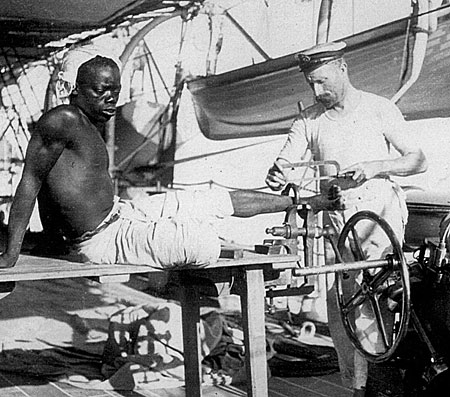
African Slave Being Shackled
African Slave Onboard Ship Being Shackled

At least eight of our 44 presidents were slave owners. Note that John Adams (2) is missing. Adams is actually famous for being against slavery when it was a mainstay institution of the American economy.

1. Washington: 316 slaves

3. Jefferson: 187 slaves

4. Madison: 106 slaves

7. Jackson: 160 slaves

10. Tyler: 70 slaves

11. Polk: unspecified number of slaves

12. Taylor: 100 slaves

18. Grant: at least 1 slave

source: U.S. Slave

As for some of the other early presidents, I speculate that they were simply not rich enough to be able to afford slaves.


Be Careful What You Post

Like saying in a comment that “slavery is not all that immoral” could end up getting you on the cover on the New York Times – or into my blog….

U.S. Population in 1776 and 1790

The first census was done in 1790. The population of the U.S. was found to be 3,929,214 people. In 1776, at the time of the Declaration of Independence, historians estimate the population to have been about 2.5 million people. That is less than the population of San Diego County today.

It’s also interesting to compare population and population growth of the white versus African-American population, including the percentage of black slaves: