
See more of their unique work here.


Sky Black is a young surrealist who lives and works in Flagstaff, Arizona. Click here to see his website and his work.


I considered making an outdoor painting (something to hang in a patio or an outdoor restaurant) the size of a door. The frame should be roughhewn facia board or barn wood. The surface could be an old door, or just a piece of plywood.
This painting was meant to be just a draft or a concept of what the big painting would be. The painting itself would be about three feet wide and six feet tall (1 : 2 ratio), so the center section of this draft is 10 inches wide and 20 inches tall. That’s why there are two green “frame bars” on both sides.
Draft or not, this little painting is a good work of art on its own. I’ll keep it.
Now – the problem is – I don’t have a big enough studio to do a painting as tall as a door.
I subscribe to American Art Collector Magazine. Being an artist, I like their pictures and the featured art work more than any other art magazine I have come across. All others, I subscribe for a year, and then I get tired of them and I let them expire. American Art Collector I always renew.
What I didn’t realize until now is how snobby a magazine it apparently is. I thought Forbes, to which I also subscribe, was an uppity rag, with its ads for Rolexes, private jets and Maserati cars. But that’s nothing compared to American Art Collector, apparently.
Check out this survey (click to enlarge):
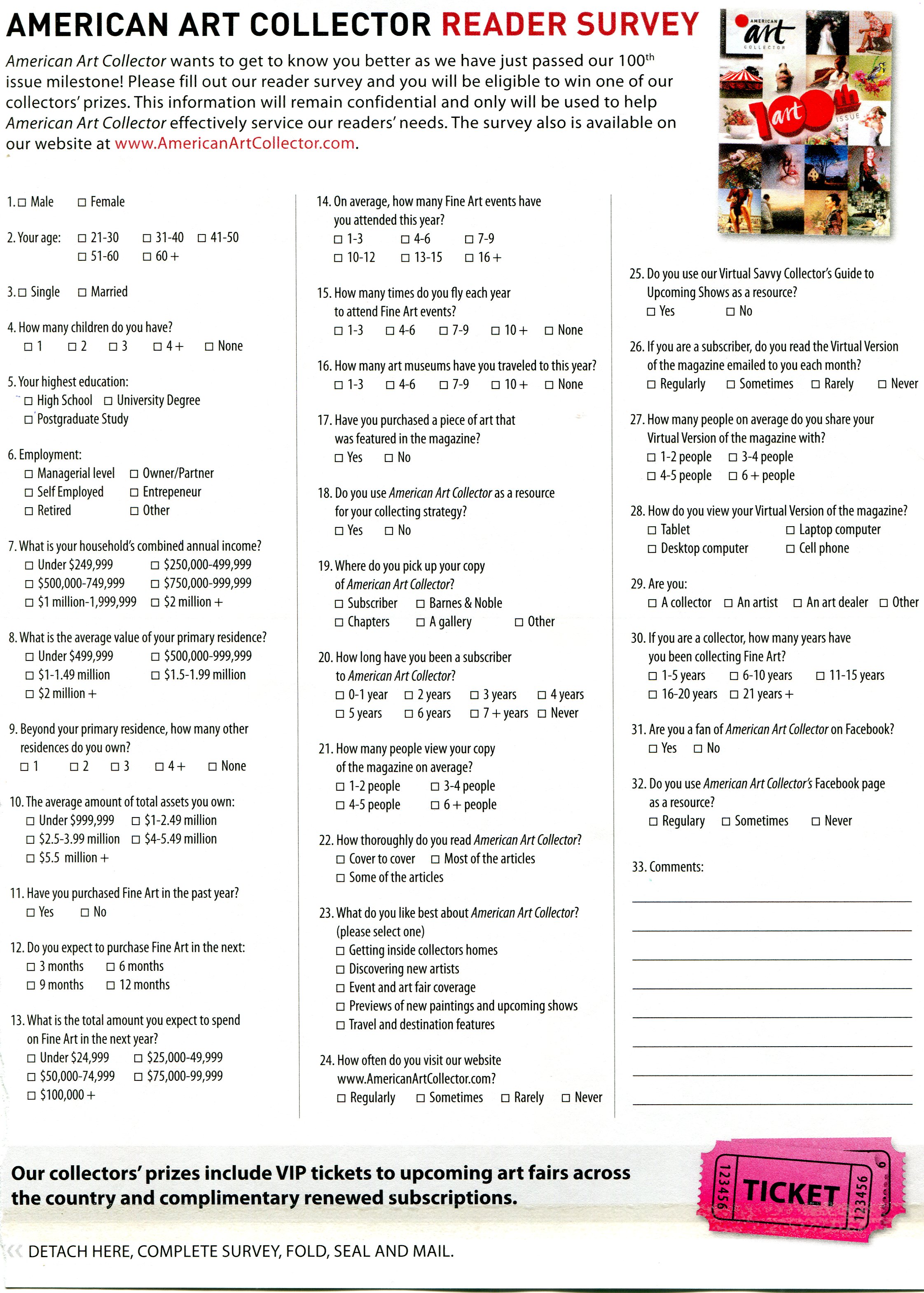
Question 7: the lowest household income listed is “Under $249,999”
Question 9: beyond your primary residence, how many other residences do you own? 1, 2, 3, 4+ or “none”
Question 10: the smallest average amount of total assets they list is “Under $999,999”
Question 13: the smallest total amount I expect to spend on fine art is “Under $24,999”
Ok, I have decided that I don’t need to fill out this survey, lest I embarrass myself. It looks like they expect that only millionaires qualify. Apparently I am not in the league of subscribers to American Art Collector Magazine.
I have to invoke the income inequality clause. I am just going to be a stealth reader.

This work of art is entirely made by a single black thread wrapped around many nails.
The creativity and the sheer tenacity and patience of some artists propels them to the top. Kumi Yamashita belongs in a category all by herself.
Check out her photography work creating shadow silhouettes created by objects and carefully placed light sources highlighted in this article.
I consider myself a polyglot, having studied six languages, being fluent in two, and marginally functional in several others. Besides the Old German and Roman alphabets, I have studied Cyrillic and there was a time when I could sound out Russian words even though I didn’t know them. I can also read Japanese Katakana and Hiragana, and some Kanji. I would guess that’s more linguistic exposure than most Americans.
Then, today, a new person followed my blog, and as I browsed back, I found the artwork in the image on the bottom of my post. However, I also found out what it must feel like to be completely illiterate. I have no idea what this is about.
 This is the Bengali language, used in Bangladesh by about 189 million people. It seems like an obscure language to the rest of the world, and particularly us Westerners. Let me put the Bengali language into perspective. The German language has about 98 million speakers, and when you include all varieties, it goes up to 120 million. While we would all agree in the modern world that German is an important world language, its native speaker population is only half of that of Bengali – a language most of us would not even recognize if we heard it, or saw it written, like in the image of a blog post below. The Bengali language, according to a chart of the most widely used languages, is solidly in slot number five.
The art work is in English, though – I am being funny here. This example shows how important art can be and how universal its language is, compared to linguistic languages. They eyes of the girl are extremely alive and serve as the focus in a tentative abstract painting. What a powerful message, with no words for me, the illiterate polyglot.

Here is a very clever artist that came up with a whole new kind of art. He is passing time on the train.

Hitler was a failed artist who had a love for art and felt, since he and his race were superior to others, that he was entitled to art, where lesser people were not. While the rest of the world considered his systematic acts of looting museums, churches and private collections as stealing at a minimum, the Nazis actually thought they were doing history and destiny a favor by collecting the art for a higher purpose. This way, millions of works of art were taken from their rightful owners. Since those owners often died in the war or in death camps, those works were never returned.
To make matters worse, Hitler issued a Scorched Earth decree. He ordered his troops to destroy everything as they retreated, homes, factories, facilities, utilities, harvests, vehicles, bridges, railways and roads. This also included the looted art. So the Nazis, if they had time, burned or blew up the art work. Hitler believed that if the superior German people couldn’t have it, the world didn’t deserve it.
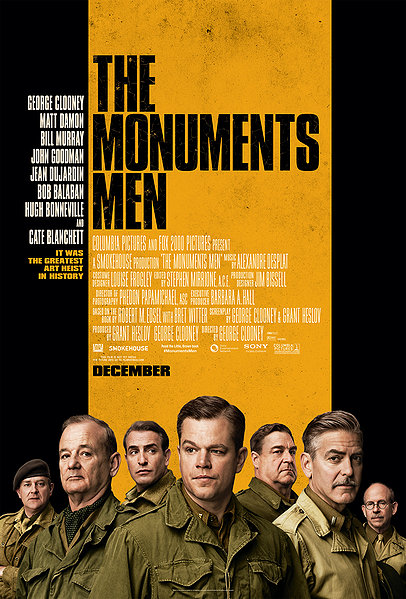
Monuments Men is a movie based on a true story about a platoon of soldiers sent by President Roosevelt, comprised of artists, art academics, architects, and curators, obviously “older” soldiers, put together as a group for the sole task of going to Europe in 1944 to save as much of Hitler’s looted art as possible and return it to the rightful owners.
Produced, directed and acted by George Clooney, supported by Matt Damon, John Goodman and Bill Murray, the movie has assembled a crew of veteran actors. They entered the war zone through Normandy Beach, after the bloody battle when it was safe, and started investigating where the Nazis had taken all the art. They encountered challenges by the military commanders who obviously were not willing to risk any men for the sake of works of art. They were held back by snipers in war-torn villages, and their efforts were blocked by the local population in France. But they made headway through sheer determination and love of their cause, recovered thousands of important works before they could be lost, and ultimately fulfilled some of their mission.
There are problems with this story, since there is not a consistent plotline that allows for a classic conflict, a climax and victory of good over evil. So the story, albeit well acted and told, is somewhat slow, and reminiscent of Oceans 11, without the drama and suspense. It flip-flops between comedy and drama, and the comedy is almost necessary to keep the movie going.
I am an artist, and I appreciate art, its value, and the impact of art on culture. Love of art comes through in this movie, and I enjoyed seeing these men light up when they saw a priceless piece of art, and I respected it when they were willing to put their lives on the line to save it.
I enjoyed the film and I liked the story. But love of art and dedication to a quest alone does not provide enough conflict to make a successful movie. As a movie, it never quite came together.
Rating: ** 1/2

Two thoughts struck me when I saw this picture, and a third was bestowed upon me later.
1. Oh how the human eye deceives. See my other post just before this one to that effect.
2. There are some man-made places in the world, that, even though I have never seen them in person, I still instantly recognize them on a picture. Those are true works of genius. Some of them include the Sydney Opera House, the Eiffel Tower, the London Tower, the Empire State Building, the list goes on.
3. Then a faithful reader pointed out to me that my second point made no sense – since the building in the picture is actually the Lotus Temple. Thanks, MB, for saving me from looking like an idiot. Now I know what the Lotus Temple looks like. Which brings me to the 4th point:
4. Even when you think you know what you’re talking about, often you don’t know what you’re talking about. As Mark Twain so aptly said: “It is better to remain silent and be thought a fool than to open one’s mouth and remove all doubt.”

If you haven’t figured out why the giant is so big, check out his shadow. That’s where the clue is.
We have all taken pictures of a glorious sunset, the best ever, only to find later that the photographs don’t quite do it justice. I have therefore often refrained from taking pictures at all at amazing places or events, like the Grand Canyon, a sunset, or a moonrise, or a concert, since the time spent fiddling with the camera just took away from my attention to the actual event and therefore the experience itself.
On a recent road trip I experienced this more than ever. I was driving across the Mojave Desert. Endless sand flats, distant mountains, grand skies dominated the landscape. Then I saw a freight train approaching. Four locomotives pulled a seemingly endless trail of wagons reaching into the distance as far as the eye could see. I saw an idea for a dramatic painting. A freight train in front of the Mojave. The train was colorful, it popped out of the desert landscape vividly and in three dimensions. My eye saw the painting forming.
Since I was driving down I-40 at 70 miles per hour on an empty freeway, I just pulled out my iPhone and snapped a few pictures of this stunning site. And here is the result:

My eyes didn’t see the glare of the windshield and bug stains and dusty wiper smears. My eyes saw the train huge and impressive, making its way down the track with powerful engines across a forbidding landscape. My eyes saw brilliant colors and stark shapes and movement of the train across magnificent desolation of the desert.
My eyes saw what they wanted to see. But the camera saw what was actually there. Reality let me down.
That’s why artists need to go out to be surrounded by nature to do their work, at least some of the time.
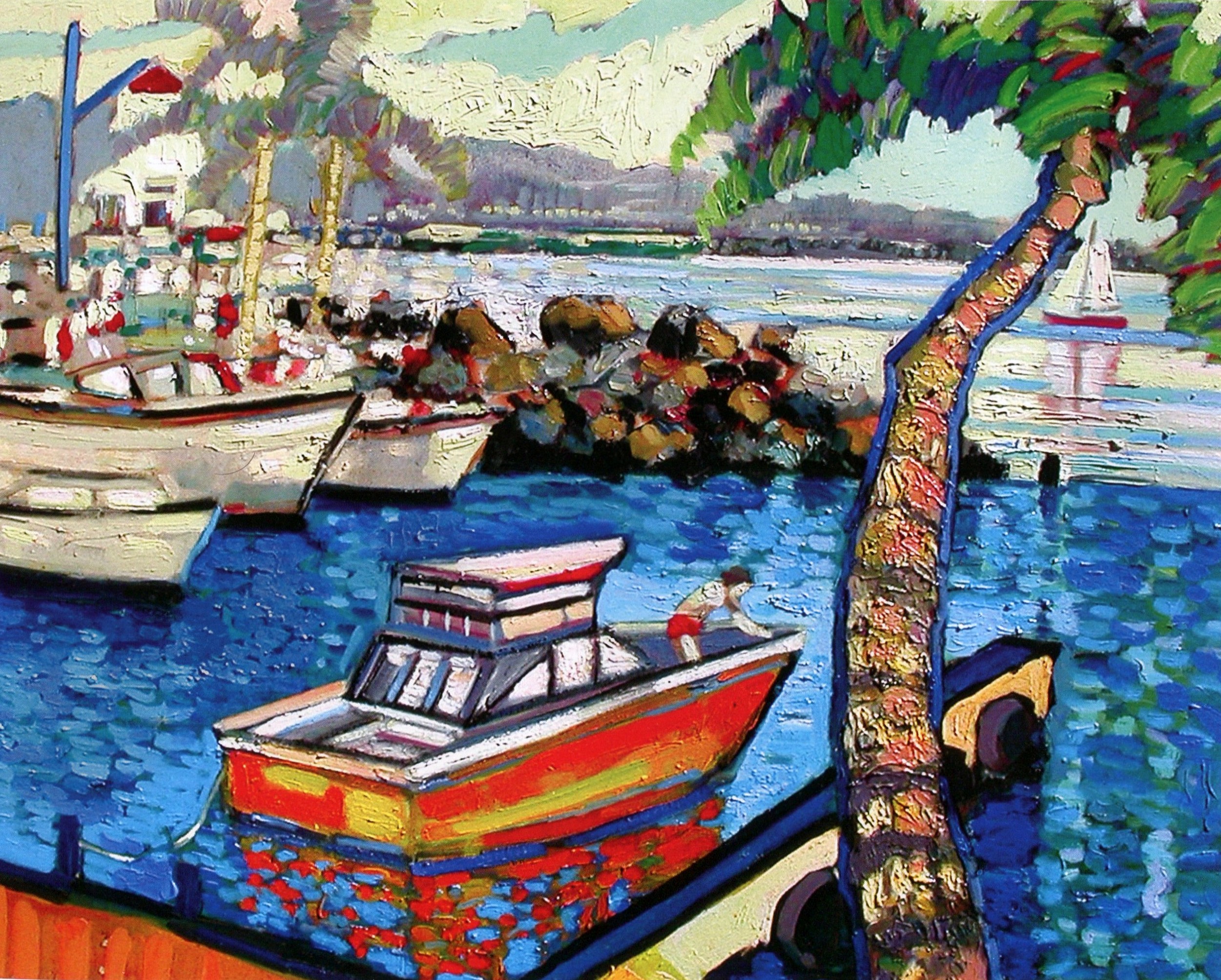
When we were last on the Big Island of Hawaii, there is a little town called Kapa’au, where I spotted an art gallery as we drove through. We met the artist and we talked for quite a while about his work. Then we exchanged addresses.
Today, this big box came in the mail. The artist has sent a signed copy of his 250 page hardcover coffee table book full of his art.

How many art galleries have you ever stopped in and then received the artist’s book with his life’s work in it in the mail? I am honored!
Make sure that if you ever go to Hawaii, drive up to Kapa’au, where you can see Maui looming in the north on a clear day, and where Ackerman’s gallery, full of bright and inspiring paintings, is open to visitors.
If you are really lucky, you might even meet the artist.