David Zach, Futurist

At the GTC East conference in New York last week, David Zach gave one of the keynote speeches. He was inspirational, funny, serious and entertaining, all at once. After he was done, I wished I could listen to him again.

If you need a speaker of an entirely different kind, David Zach would be a great choice.

Worst Genocides in the 20th Century

People usually think of Hitler as the worst mass killer. He is close to the top, but not at the top.

1. Mao Ze-Dong – 49 million to 78 million

2. Jozef Stalin – 23 million

3. Adolf Hitler – 12 million (some estimate up to 20 million indirectly)

Here is a link to Piero Scaruffi’s site. He does an excellent job summarizing genocides. Noteworthy is how far down on the list Saddam Hussein is. Also noteworthy is how many of these killers were active while we were all alive and happily going about our lives.

Finally, the most shocking of all is that Richard Nixon is on this list for the genocide of 70,000 Vietnamese and Cambodian civilians during the Vietnam war. We don’t think of our own commanders-in-chief as killers. Sort of like German SS soldiers in 1942 thought of their Führer.

Heck, Fidel Castro is only responsible for 30,000 deaths in his 40 year reign.

Book Review: The Old Man and the Wasteland – by Nick Cole

Reminiscent of The Road, by Cormac McCarthy, this story plays  after a nuclear war destroyed just about all U.S. cities, presumably through missiles launched by terrorists from the Middle East. We don’t find out if there is anything left in the rest of the world, but we do know that the United States of America no longer exists. The story starts 40 years after total nuclear destruction of civilization. Most of the country is destroyed by radiation. There are pockets of survivors hanging on in little villages they created, but most of the people left are degenerates, feral human offspring of survivors that never experienced civilization. They live under unspeakable conditions and have resorted to cannibalism for survival.

The Old Man leaves the village on a quest, just like in Hemingway’s The Old Man and the Sea. We never find out his name. Nobody has a name, just like in The Road. In addition to the point of view of the Old Man, the writer provides the viewpoint of a feral boy as well as a wolf.

Reading The Old Man and the Wasteland is both depressing and uplifting at the same time. It is frightening to contemplate how quickly humanity could deteriorate to savagery if institutions, laws, security, shelter and all infrastructure disappeared. Survival of the fittest, and this means unfortunately the strongest and often most brutal, takes over. Little of what we know as humanity would be left.

The Old Man believes it might be otherwise. Will he prevail?

I know I will need to stop at Picacho Peak between Yuma and Tucson next time I drive there and let things sink in for a while.

Rating: ***

Controltec’s Project Won “Best of New York”


Yesterday the Center for Digital Government awarded the New York Office of Children and Family Services – Child Care Time and Attendance System the “Best of New York” award.

 Read about it here. 

We done good.

Book Review: The Door into Summer – by Robert A. Heinlein

Here is a classic misleading book cover. Yes, there is a cat central to the plot in this book. There are also several women, one villain, Belle, and one heroine, Ricky. I don’t know who the woman on the cover art is supposed to be.

Heinlein lived from 1907 to 1988 and is widely recognized as the most influential science fiction writer of the 20th century. His classic Stranger in a Strange Land is probably his most famous work, but there are many others, and I have read most of them. His science fiction always focused on character development, and he is one of the few authors who, besides creating engaging and intriguing science fiction plots, also got into the human side of life. His characters kiss, get naked and have sex. There seem to be nudists in many of his plots, and there are some key nudist characters in The Door into Summer.

The story starts in 1970. Dan Davis is a genius engineer involved in robotics. He loves his cat Pete. Dan starts a successful and revolutionary robotics company named Hired Girl. The company specializes in household robots. He is vastly successful. Then he decides to take the Cold Sleep, which is a cryogenic sleep, allowing the person to arrest all body functions and wake up at some time in the future. He decides to sleep until the year 2000.  But before he does, he sets his affairs in order. What he does not realize soon enough is that his fiancée Belle and his buddy Miles are screwing him out of his company. And so the plot runs.

I don’t know how I missed reading this book during my heyday of reading Heinlein in the 1980-ies, but I did. It’s a time travel story, and a great one at that. I enjoyed it for that alone.

But more of a crack-up was the fact that Heinlein wrote The Door into Summer in 1957. So when he made it play initially in 1970, he basically put the story into the near future, assuming some improvements in science and engineering, resulting in Dan being an engineer in robotics. So we see what Heinlein thought the near future would bring by 1970.

But then, he had Dan sleep for 30 years until 2000. For Heinlein, 2000 from the perspective of 1957 was 43 years in the future – utopia for all practical purposes. To have Dan travel into the year 2000 was going into a fantastic future.

This is particularly enjoyable to watch for me from 2011 – a full eleven years after 2000, when 2000 is actually a long time ago already.

You’ll have to read The Door into Summer to find out what Heinlein thought 2000 would be like, but I’ll make a few observations that don’t spoil the story. Here is one segment in chapter IX:

I could have saved time by hiring a cab to jump me to Riverside, but I was handicapped by lack of cash. I was living in West Hollywood; the nearest twenty-four-hour bank was downtown and the Grand Circle of the Ways. So first I rode the Ways downtown and went to the bank for cash. One real improvement I had not appreciated up to then was the universal checkbook system; with a single cybernet as clearinghouse for the whole city and radioactive coding on my checkbook, I got cash laid in my palm as quickly there as I could have gotten it at my home bank across from Hired Girl, Inc.

Obviously, there were no automatic teller machines in 1957, so Heinlein could not predict them. His view of the banking system in 2000 is hilarious. In his 2000, there are still typewriters, but electric ones. He misses cell phones entirely. People still have to walk to pay phones to make calls. There is no Internet or anything like it, except perhaps the cybernet above for banks. There are no personal computers, and there are few computers at all. Research is still being done at the library and by going through archives.

Dan is inventing robots that do housework. But the robots can only understand rudimentary English in 2000, like: Go, No, Yes, Give Me, etc. They cannot understand spoken language, and when they have a problem, they hand a card with a printed error message to the user. No screens. He is also inventing a drafting machine, some mechanical apparatus that does engineering drawings. No Autocad, no screens, no mouse, no computers.

Cars have not changed that much. Clothes have. People wear synthetic material called Sticktite which appears to be some thin material that is stuck to the body. This apparently does not leave much to the imagination in terms of sexuality. But I wonder how the less attractive people deal with it.

There is a Great Los Angeles, a Great Asia Republic, and England is a province of Canada!

Finally, to make the plot work, a physicist has discovered rudimentary time travel, with some pitfalls built-in. But you have to find out for yourself how that works.

Overall, the story was pure Heinlein, the science fiction engaging, but the most fun was to see how one of our great science fiction writers saw the far distant future of 2000, from the vantage point of 1957.

Rating: ***

Ten Years Minus Two Days Ago

Ten years minus two days ago at Boston Logan airport, at 7:40am, American Airlines Flight 11 pushed back from Terminal B, Gate 32. On board was Mohamed Atta, and the rest of the flight that never landed is forever in history.

Early this morning  I left Boston Logan from Terminal B, Gate 35. I looked over the gate area of Gate 32 and I shivered. The ghosts were in the air – ten years minus two days later, today, on 9/9/11.

Book Review: Garden of Beasts – by Jeffery Deaver

The title for Jeffery Deaver’s novel Garden of Beasts comes from the central park in Berlin, called Tiergarten, meaning zoo, garden of animals, garden of game or, of course, garden of beasts. Tiergarten was where the emperor of the Second Reich, Kaiser Wilhelm, used to go hunting. The beasts reference is for the Nazi leaders. Many Germans of  the day thought of their leadership as criminals, thugs or beasts.

The entire story plays within a few days in Berlin in the summer of 1936, days before the Olympic Games started. It is a novel, all events are fictional, but the background, the historical frame and the major political figures are real. It provides excellent insight into the inner circle of the Nazi regime, including some of the thinking, attitudes and foibles of the ruling triumvirate of Hitler, Goebbels and Göring. It was an interesting read for me right after reading Every Man Dies Alone by Hans Fallada, which plays about the same time, also in Berlin. Some of the same places were referenced, like the headquarters of the Gestapo on the Alexanderplatz and Hitler’s Chancellery.

At one point, talking about cars:

The Folks-Wagon, it is to be called. A car for everybody. You can pay by installments then pick it up when you’ve paid in full. Not a bad idea. The company can make use of the money and they still keep the car in case you don’t complete the payments. Is that not brilliant?

The plot is about an intrigue of the American government to kill Colonel Reinhard Ernst (fictional), the architect of Hitler’s rearmament effort, and by killing him, preventing another war in Europe. Paul Schumann, the protagonist, is an American hit man from New York City who, due to his upbringing, speaks flawless German. Paul is sent into Berlin with the Olympic team as a journalist with a mission of an entirely different nature. As you might imagine, it’s not easy to “touch off” a crime boss in Brooklyn. Going after somebody within Hitler’s inner circle in Berlin would be a matter of an order of magnitude more difficulty.

Unlike Fallada’s book, which I read in the original German language, Garden of Beasts is written in English. The author does a pretty good job letting the characters speak German most of the time, including the American protagonists. It was a bit strange to follow at times, particularly when a character like Heinrich Himmler would use an English expressions that I knew would not translate into German. Deaver also translates German terms we all know, like Führer, which seems somewhat unnecessary.

Central to the plot is that Schumann speaks almost accent-free German. Indeed, at one time he impersonates an SS officer. Having heard many Americans over the years speak excellent German, I have not ever heard one yet where it was not obvious that he was an American. As a result, Schumann seemed somewhat unreal to me at times.

Garden of Beasts is a fairly long novel (you can never tell how long with the Kindle, unfortunately – I am looking forward to a better book sizing format in the future), and it kept me turning the pages until late into the night. Garden of Beasts is a rewarding crime and detective story with an educational historical background and some real heroes.


Apple’s Ascension

For a short time last month, Apple was the most valuable publicly traded company in the world.

Here is an insightful article on Apple and their success in the Harvard Business Review. Inspiration vs. perspiration.

Onions

We left some onions on the kitchen counter and one of them had shoots. I painted them on a 20 x 16 board – first time I tried that. The glass bowl was challenging, and so was the light. My photography skills and equipment are also not up to the job. But here you go:

All My Books

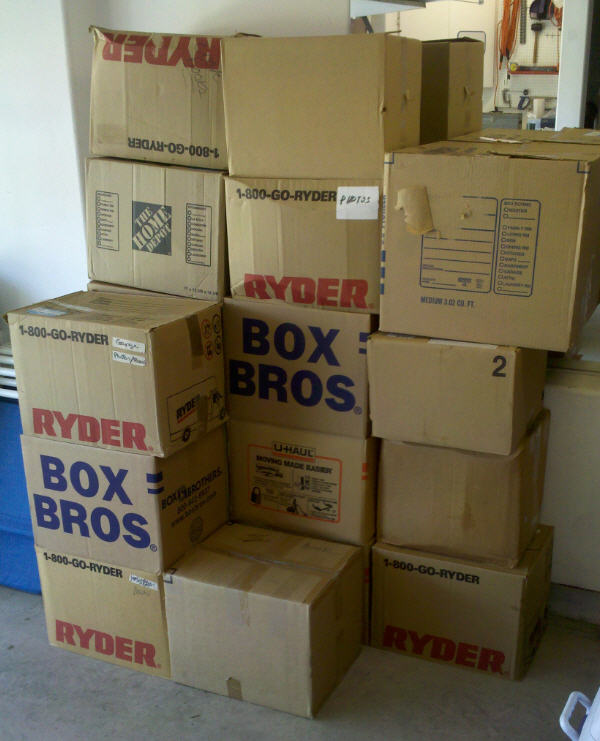
Over a lifetime, I have collected books, stored them, sold many in garage sales, given many away, donated books to libraries. Usually I have not had anywhere near enough room in the house for bookshelves to keep them all. I’d need a small library. I don’t know how many there are left. I’d have to count them. Here are the boxes in the garage that contain those books that I have considered worth keeping in 40 years of collecting and that are not on my shelves in the house now:

And here are all the 45 new books that I have bought and read since January 2010.

I have all of them with me all the time. I carried them to the bottom of the Grand Canyon, and more importantly, back up. I took them all with me on my trip into the Emigrant Wilderness.

 When we last moved, the boxes took major lifting but the books in the Kindle got moved and I didn’t even notice.

All that is good.

Except, what do I do when Amazon, one day, goes out of business?

The New Face of Spam

More and more, my Spam box at work looks like this.

I can’t read Chinese. A few years ago we never saw Chinese in email. Now it’s everywhere.

It makes me want to learn the language. My lifestyle, however, does not have another two hours a day available without giving up something else that’s important to me. And my incessant travel does not permit me to take a class.

Ah, so little time, so much to learn!

What War Does to Children

When you think about refugees, some pictures come to mind. But not one like this. We need to see much, much more.

Click Here – Iraqi Refugee