The snow-covered ground glimmers with a dull blue light, reflecting the sky and the approaching sunrise. Leading away from me the narrow dirt road, an alluring and primitive track into nowhere, meanders down the slope and toward the heart of the labyrinth of naked stone. Near the first group of arches, looming over a bend in the road, is a balanced rock about fifty feet high, mounted on a pedestal of equal height; it looks like a head from Easter Island, a stone god or a petrified ogre.
— Edward Abbey – Desert Solitaire: A Season in the Wilderness, 1968
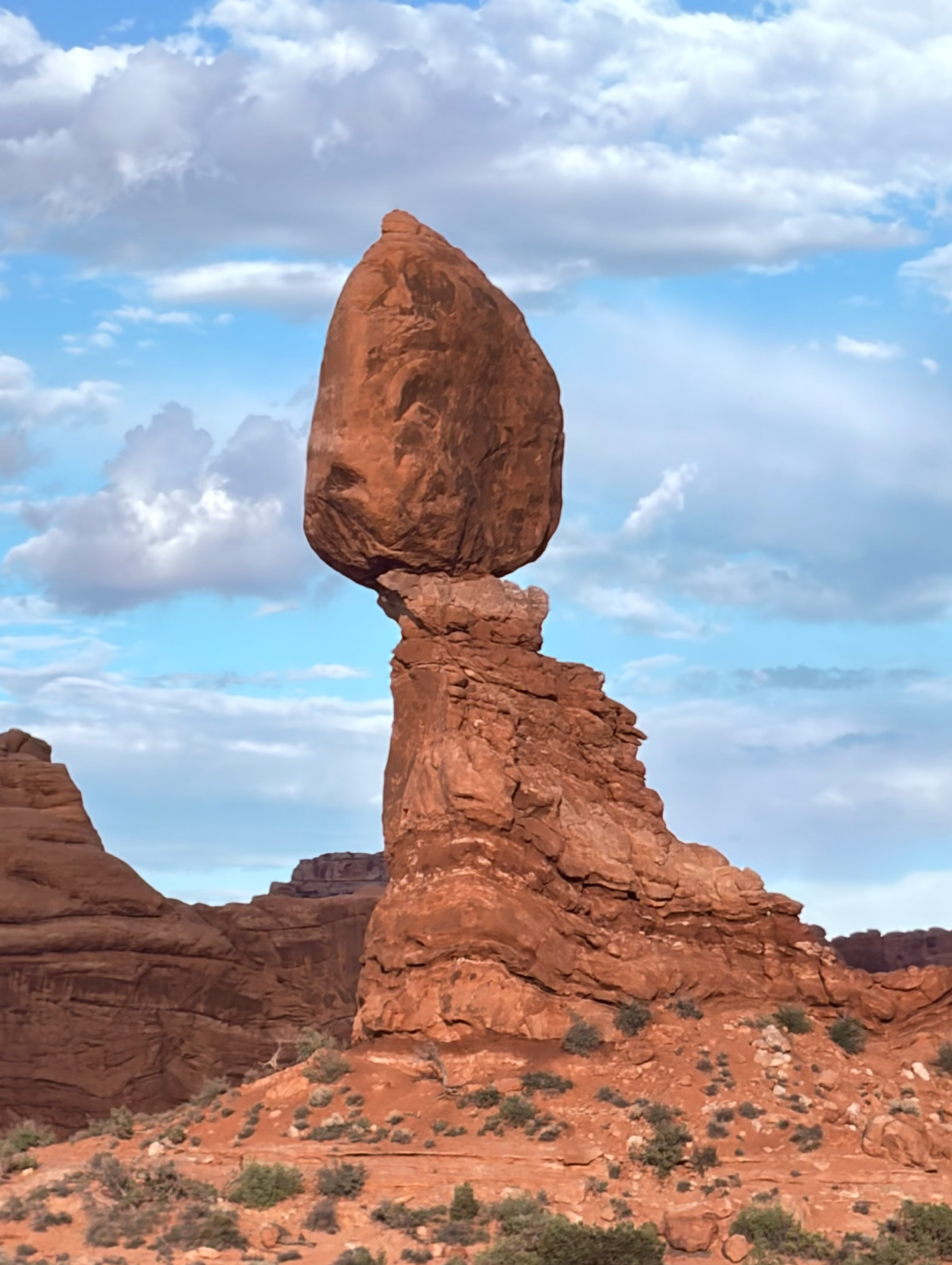
This is the Balanced Rock Edward Abbey described. He spent 1956, the year I was born, and 1957, as a park ranger in Arches National Monument, as it was called then. In 1968 he wrote Desert Solitude, which I read and reviewed in 2012, and he included the passage above. Almost 70 years after Abbey stood there, Trisha and I were there and looked at this timeless marvel in awe.
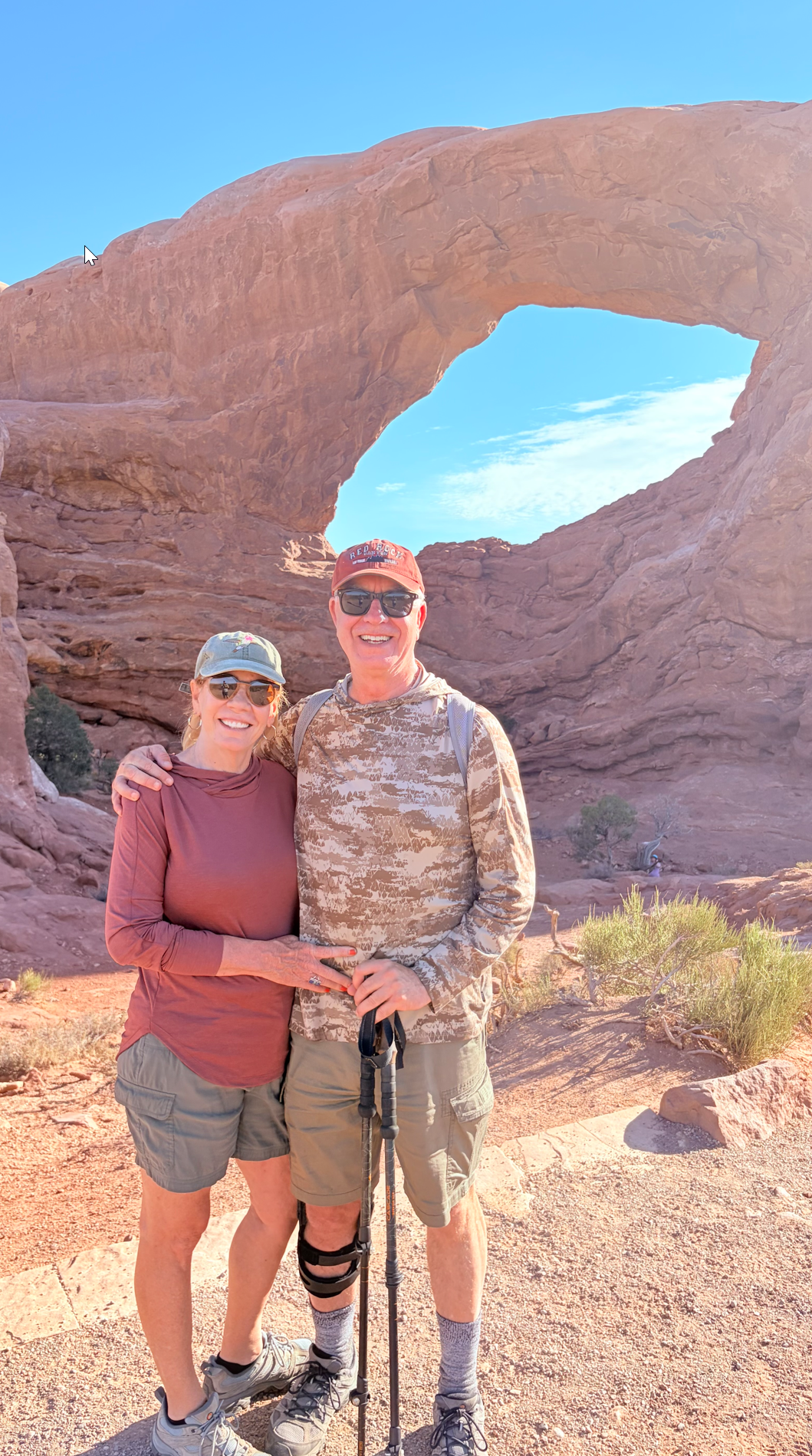
Arches is a magical place. Some of the “windows” are small(ish), and some are gigantic, seemingly big enough for an airliner to fly through. It boggles the mind that such arches can be created by just water, wind and time.

Above you can see the size of one of the arches with Trisha for scale.
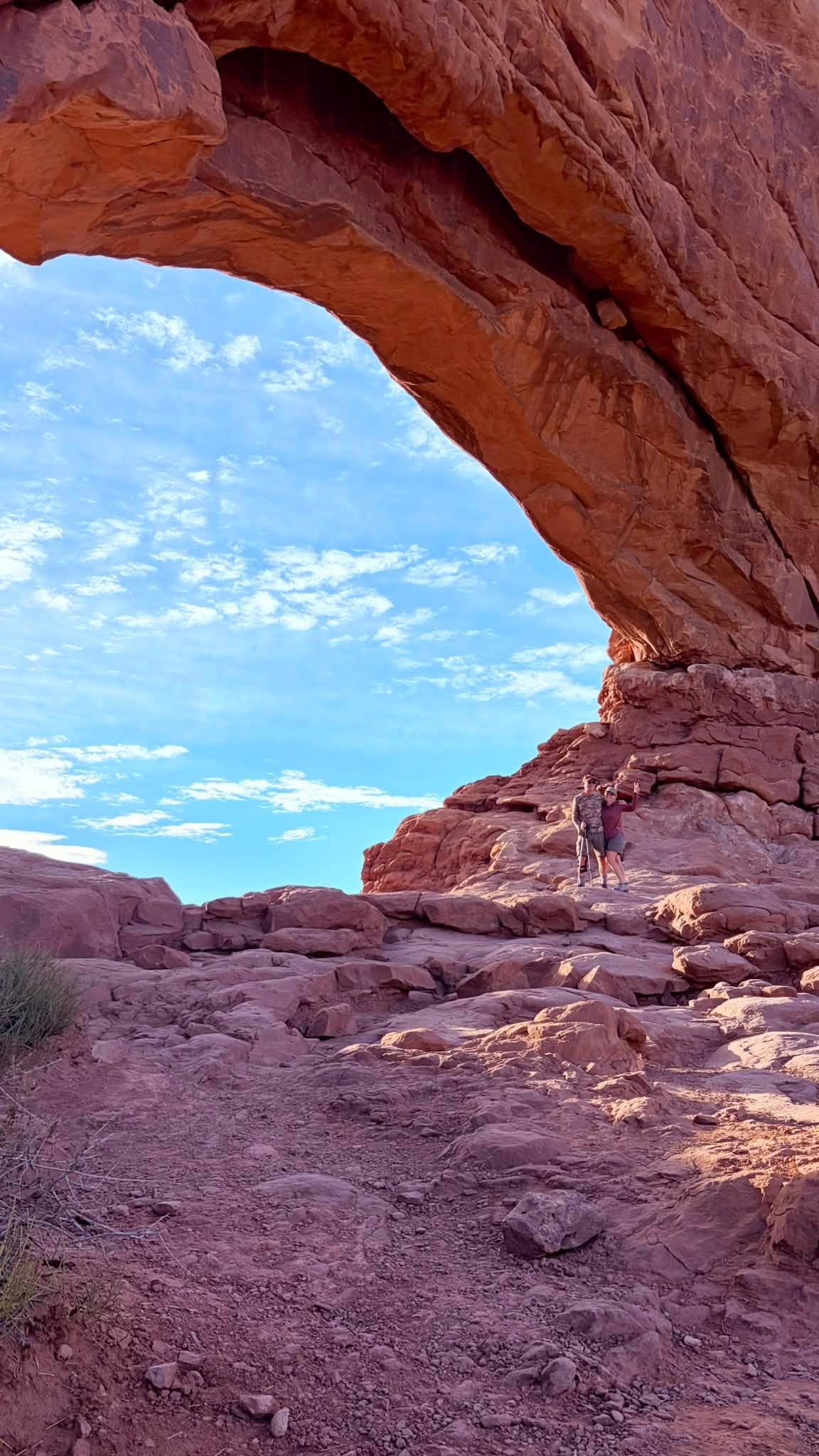
Can you see us? We wore the right camo clothes for the event, didn’t we?
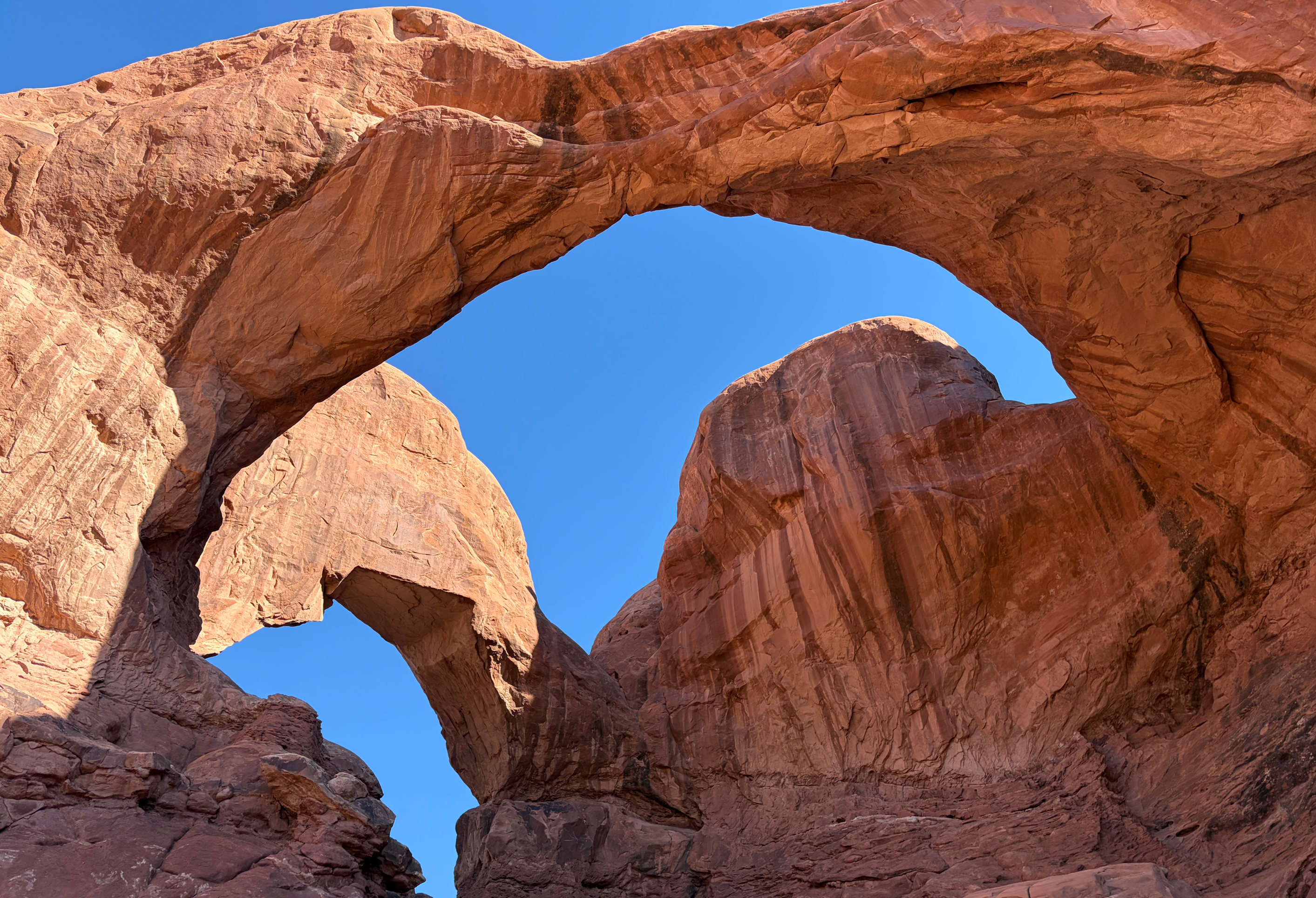
Some of the multiple arches are truly breathtaking.
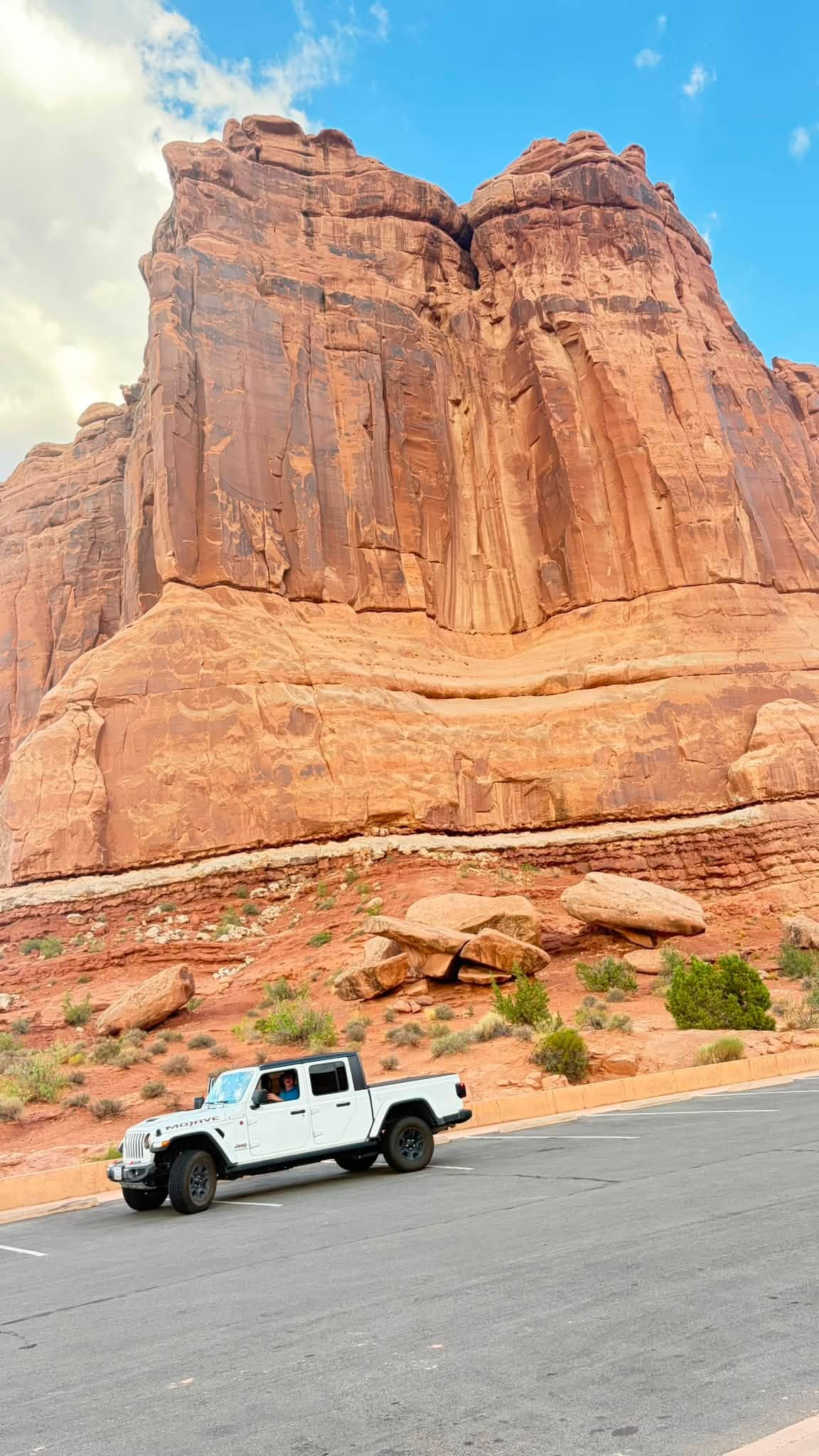
Here you can see me in the Jeep with a giant monument behind me. Notice the grey-white line running horizontally along the wall? This grey-white layer is visible throughout the park in various walls, monoliths, arches, etc. This comparatively thin gray to whitish band near the base was formed by a shallow sea. Here is the chronology:
- Under the white layer, the area was a broad, flat coastal plain. Shallow lagoons and tidal flats existed along the edge of a shallow inland sea over 165 million years ago.
- Then the sea level fluctuated repeatedly, and fine mud settled in quiet waters. During dry periods, evaporation concentrated dissolved minerals, producing carbonate and sometimes gypsum-rich sediments. The water became shallower and more saline at times, but geologists don’t think there was a sudden worldwide change in ocean chemistry.
- Then the sea retreated. Winds built hundreds of feet of sand dunes over the area, similar to what we see in modern Namibia in southwestern Africa. Those dunes became the Entrada Sandstone, which forms most of the spectacular cliffs and arches today. These dunes started accumulating about 165 million years ago.
The white layer erodes much faster because it contains much finer particles and weaker cement than the sandstone above. Once it wears away, it undercuts the massive Entrada Sandstone, leaving dramatic overhangs.
One fascinating detail is that the white layer represents perhaps just tens of thousands to a few hundred thousand years of deposition, while the thick Entrada Sandstone above it may represent millions of years of migrating sand dunes. In other words, a relatively thin layer records a very different world sandwiched between two much longer-lasting desert environments.
And here I was, sitting in my truck, watching it all, my short lifetime just like a firefly in the endless times of this ancient world. One day our civilization will just be a centimeter-thick layer of crumbled concrete, glass and plastic spoons and shopping bags in the stone, covered by more millions of years of dunes.
I see your hurt knee has not slowed you down in your adventures to exotic places. It looks surreal. and yes we humans are not even a fingernail’s thickness in the span of time, but managed to fuck up the planet. But the earth will survive us eventually.