
Here is an excerpt out of the book Blue Highways:
Even then, Vern was an anachronism. We boys who collected at his station didn’t call him that, of course. We called him, as I remember, “an old fart.” Vern, in his antique ways, believed that anyone who got behind a steering wheel could rightly be expected to operate the car rather than just steer it; that’s why you were issued an Operator’s Permit. He believed the more work a driver did, the less the car had to do; the less it had to do, the simpler and more reliable and cheaper to repair it would be. He cursed the increasing complexity of automobile mechanics. But, as I say, he was a man of the old ways. He even believed in narrow tires (cheaper and less friction), spoked wheels (less weight), and the streamlined “Airflow” designs of Chrysler Corporation cars of the mid-thirties—designs Chrysler almost immediately gave up on before proceeding to build the biggest finned hogs of all. We boys of the fifties loved their brontosaurean bulk.
— From William Least Heat-Moon – Blue Highways: A Journey into America (p. 404). Little, Brown and Company
Reading that paragraph gave me pause.
My first car in America was a 1973 Ford LTD.
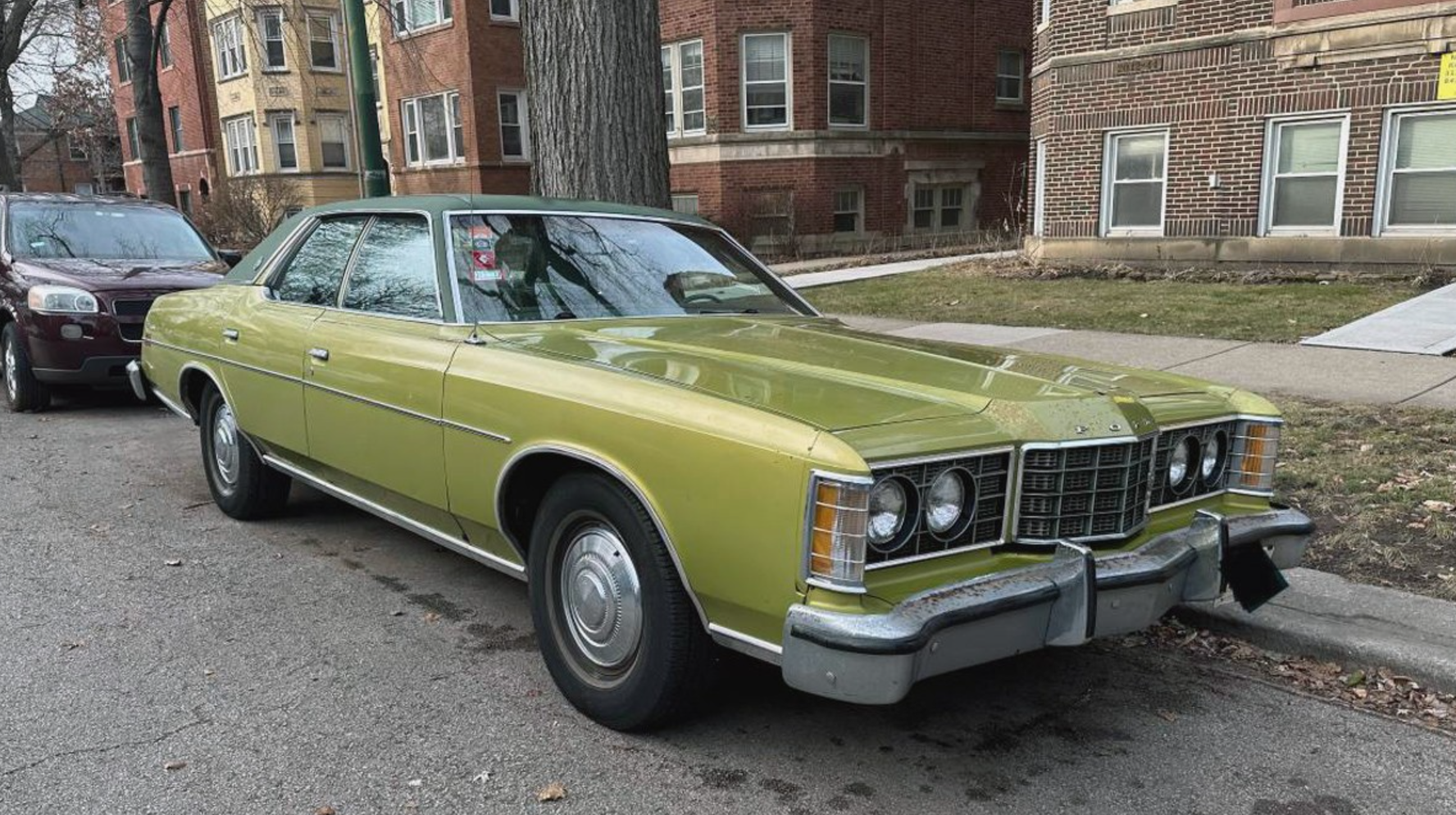
Mine looked exactly like this, same color, four doors, green vinyl top. Huge engine. In 1977, when I bought it from another soldier in Luke Air Force Base in Arizona for $1,800, it had about 54,000 miles on it. I loved that car and the power it had. It got just 10 miles to the gallon. Gas cost 57 cents per gallon then.
But let me get to my point – simple cars. This is what it looks like inside of this listing of a car over 50 years old. Mine looked pristine at the time.
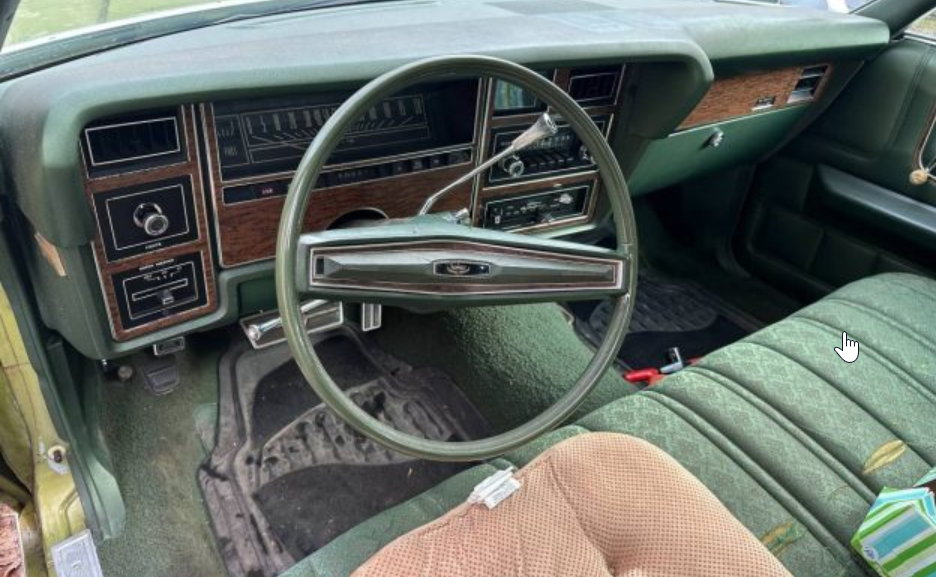
There was nothing automatic.
The doors had cranks. You turned them to lower the windows. The air conditioner was turned on with one button, in or out. When you wanted cold air, you pushed a slider switch one way, when you wanted warm air, you pushed it the other way. If you wanted the fan off, you pushed a slider switch to the left, to turn it on, you pushed it to the right, the farther to the right, the higher the fan speed. You turned on the lights by pulling that big knob on the left of the dash.
There were no screens, no setup, no menus to touch or to drill down. Other than looking out on the street, you didn’t need to see anything. You could drive this car with your hands without having to look at any controls. They were all where they should be, and they worked intuitively. You never needed to look at a manual.
In contrast, every time I get into a rental car today, I have to deal with trying to figure out how to control the climate, how to turn the thing on or off, how to make the radio not blare a channel I am not interested in, heck, how to turn the radio off altogether. I don’t use the parking brake because I can’t figure out how to use it. I am scared of the gear selector, since it’s often just a knob and to select a gear, you have to take your eyes off the road and look down, first find the little knob, and then select the right gear, Drive or Reverse.
Once I rested my arm on the middle console while driving down the freeway in a rental car and – don’t ask me how it did it – I put the car into the parking brake – and it actually let me do it. Imagine the moments of panic I went through before I got myself back out of that impossible situation!
Another time, in a different rental car in the winter, I managed to let the car run in the parking lot of a hotel, from 4:00pm in the evening to 8:00am the next morning. It burned a full half of a tank of gas idling all night. It had one of these remote control buttons that turned the car off or on. I am not sure how I did it, but the fact that I managed to do it, shows how wrong that feature is designed.
My point: I want simple cars back, with knobs and buttons and sliders that I can touch. Abolish all screens in cars. I want to drive my car with arms and legs without having to look at anything inside. And I want the controls to be intuitive.
I can wish, can’t I?
I loved that book. Want to read it again. But as for new cars, they are “designed” by people who think they are being clever but, IMO, are building-in — on purpose — Planned Irritation. It’s not just cars, it’s Everything. I hate to “UP”grade as features are changed, for no reason. Every phone call involves Menus and holding and robots (“HI! I’m your Virtual Assistant! — if you want to bypass him, just say “SUPPORT ASSISTANT”.) In the Age of Communication, that’s the last thing we have. The amount of administrivia in daily life is so enervating, I think it’s a ploy by corporations to make frustrated, drowning in details, to keep us from looking at the big picture of what is happening — the deliberate plan to make us into robots, by robots.
Thanks, Barbara, very insightful and right aligned with my own sentiments.
We still drive a 2005 Toyota Matrix. 😀
How is your knee? You hobbling around at least?
Yes, hobbling around is a good word. Surgery is scheduled for April 23. Recovery is supposed to be difficult and long. I am bracing for that right now.
Did you see my fairly recent review of Blue Highways? https://norberthaupt.com/2025/08/23/book-review-blue-highways-by-william-least-heat-moon/
You might also enjoy this set of comments about ashtrays: https://norberthaupt.com/2021/10/23/smokers-ashtrays-and-butts/
I guess self-driving cars don’t need either. If that is where we are headed, what could go wrong… So many people (even in AI tech) are waking up to the dangers of AI, I am slightly heartened. But humans are too late to fix it. Like the Lego machine: apparently nobody knows how to turn it off. If that’s not true, it feels true.
The “turn it off part” has me thinking about another blog entry…. Thanks for the incentive.
I read it when you posted it. And replied. A wonderful book — it is no longer in our Ottawa public library. I rarely buy books. (Our condo has a 800-book library and I’m working my way through it. I read 75+ books a year. Always have at least 3 on the go — BTW, I don’t comment on your movie reviews as my husband and I only watch (a lot of) movies on TV (we have many, many channels).
Oh, yes, I actually remember now that you said this. You must be a much faster reader than I am, or you have more time :).
I loved this piece and totally agree with you. I still have my mom’s 2005 Buick Century. Remember it? It’s a simple but luxurious car. Fun to drive!