

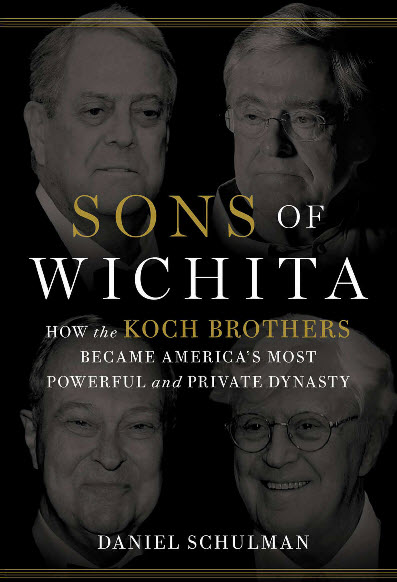
The “Koch Brothers” have been a household name in American politics over the past twenty years; since Obama, however, they have been vaulted into the spotlight. They are either revered or loathed, depending on the point of view. Sons of Wichita digs deep into the Koch family history and background, and leads us all the way to the present time. Their story starts in the earlier part of the 20th century, when Fred Koch, a young and ambitious engineer starts building a business in Wichita, Kansas.
The sad fact is that once people begin to get something for nothing then they want more and more at the same price. It destroys their independence, their self-reliance, and transforms them into dependent animal creatures without their knowing it. The end result is the human race as portrayed by Orwell— a human face ground into the earth by
— Fred Koch
Fred had four sons, not just two, as we commonly think of the “Two Koch Brothers”, David and Charles. There are also Frederick, who is the oldest, and Bill, David’s twin, who are known a “the Other Koch Brothers” in their own right and with their own legacies.
Some one-star reviewers on Amazon complain about how this is not a business book but a “soap opera” of American politics. I don’t agree at all. The author didn’t try to write a business book. It’s a biography of a remarkable family. Whether you like or dislike their politics, their characters or their deeds does not really matter. He tells the story like it was and is, and readers can make up their own minds and form their own opinions.
Fred Koch created a company out of nothing during a difficult time in America. The depression, the second World War and finally the post-war years. To make it possible, he was engaged in decades of stressful legal battles. Nevertheless, he built a company that was doing some $70 million dollars in business a year when he handed the reigns to his second-oldest son Charles, then a man in his early thirties. Charles turned that 70 million dollar business into a 90 billion dollar business, more than a thousand times as big.
Charles possessed an uncanny ability to sniff out profitable ventures, and when he occasionally mired the company in money-losing deals, he quickly cut his losses. The results of his leadership spoke for themselves. Between 1960 and 2006, the company’s revenues increased from $ 70 million to $ 90 billion. During that timeframe, an original investment of $ 1,000 in Koch Industries would have swelled to $ 2 million, a rate of growth that outperformed the S& P 500 by a factor of 16. This was not just dumb luck. Charles had a formula.
— (p. 243)
After reading the book, I have come away with several main thoughts myself:
- Fred Koch, the patriarch of the dynasty, instilled in his sons a set of values that eventually resulted in what they built. Those values are based on modesty, privacy, extremely hard work, lack of entitlement of any type, and shrewd business skills.
- A spirit of fighting for the last crumb, and litigating mercilessly, under all conditions, was etched deeply into all four brothers. That attitude resulted in a business empire unlike any other in this country.
- There were shady deals and ruthless deeds, some possibly illegal and doubtlessly immoral, that are at the foundation of the businesses of the Kochs.
- Fred fostered political activism and passed it on to his sons. A powerful belief in the destructiveness of communism and socialism, based on what father and sons learned in the Soviet Union, was the foundation of their libertarian activities, which eventually led to their current Tea Party affiliations and American conservatism.
- Before reading Sons of Wichita, what I knew about the Koch Brothers came from what I learned from their activities over the past decade in American politics, mostly from reports of the liberal media, including Rachel Maddow and Lawrence O’Donnell. That information was admittedly narrow and biased. I have gained respect for the Koch brothers as individuals, and I admire their business skills and approach.
- There are a lot of activities of the Koch empire that may not be so clean, and the term “organized white-collar crime” is not far from the surface. I am not qualified to judge what has really happened, and whether these adverse claims would stand.
- Anything the Koch Brothers are involved in must be taken seriously, very seriously.
- They are now all in their sunset years, and as the new generation takes over, things will get softer and I would expect their political activism to fade.
While the book is not an easy read, I found it a page-turner nonetheless. It provides a fascinating view into one of America’s richest and enigmatic families.
