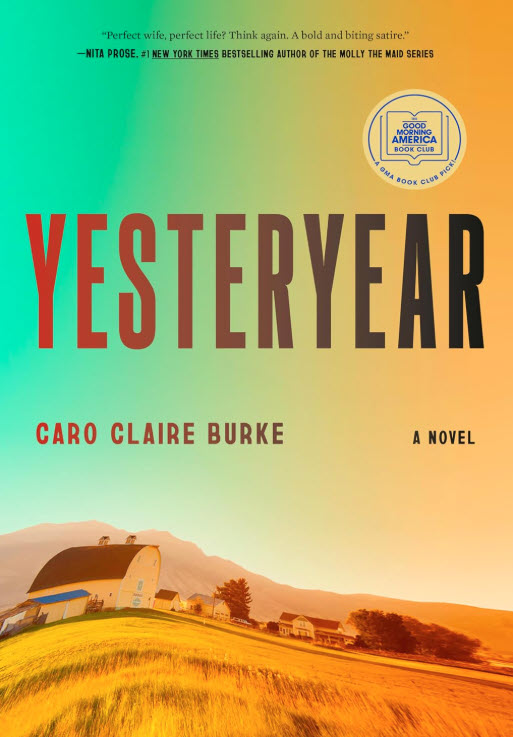
Natalie Heller Mills is a young Christian woman raised in a Christian family with typical Christian values. She marries a “rich boy” she meets in college. She becomes a “traditional wife” in a “godly” family. Her husband does not have any ambition beyond playing video games and surfing chatrooms. Their marriage is doomed from the very start. Natalie, in order to make a living, wants to become an “influencer” and tries to turn her Instagram account into a business venture. With money from her mega-rich father-in-law, also a United States senator, she buys a farm in rural Idaho where she portrays the idyllic housewife, with a cowboy husband, baking bread, milking the cow, living off the land, and producing lots of children.
One day she wakes up in an alternate reality, in the 1850 timeframe, in her farmhouse as it would have been in that era. No electricity, just an outhouse. Her family looks like her family, but things are off. Her husband seems to be her husband, but he is older. She is trying to figure out if she actually time-traveled, or if this is some elaborate hoax. Is she an unsuspecting participant in a reality show? When she tries to escape through the woods she steps into a game trap and severely injures her leg. Her husband rescues her and carries her back to the house. He beats her. Now she knows she is a prisoner in this life.
The plot of this story is well-structured, and it kept me following the book. I wanted to know how it would end. But that was the only thing that kept me going.
I listened to Yesteryear as an audio book. It was painful. There was not a single character in this story that was likable. I severely disliked all the people in the story, and most of all I disliked the protagonist. If I ran into Natalie at a social event, I would quickly turn away. I would not want anything to do with her.
Yesteryear is a book without any joy. I don’t have an Instagram account and I am now more glad than ever that I don’t. The whole influencer thing is not something I am interested in. I am not a Christian, and now I am more glad than ever that I am not. The stuff that Natalie constantly spews about “the Lord” just makes me roll my eyes.
Yesteryear is a book about a severely dysfunctional family, all the way from the grandparents on. The victims of that dysfunction are her brood of children. And that’s where the plot hits the hardest.
This is a book that I would normally have abandoned listening to about 20% in, just because it was so distasteful. But the suspense of how this mess could possibly end kept me going and I eventually finished it.
Very distasteful.