Book Review: A Prayer for Owen Meany – by John Irving

After trying to read The Last Chairlift and getting through about half of the way, I remembered that I had read A Prayer for Owen Meany a long time ago, probably when it first came out in 1989. I remembered that I thought it was a remarkable book, I remembered it was about a boy, and that’s about it.

A Prayer for Owen Meany has a print length of 1,115 pages. This explains why I have seemingly not been reading lately, or at least publishing book reviews. The fact is, it takes forever to read Owen Meany.

The story is about two best childhood friends, and it starts in a small town in New Hampshire in 1953, when the boys are 11 years old. John Wheelwright is the narrator, but his best friend, Owen Meany, is the protagonist. Owen, in a stroke of terrible bad luck, hits a foul ball in a Little League game and kills John’s mother who is among the spectators. Owen does not think this was an accident. He thinks he is God’s instrument.

The story follows the two boys and their friends and family through their coming of age and into adulthood. It weaves a rich tapestry of characters, and when the book finally ends, you will miss them all and the world in which they have been living. After all, you’ll have been spending a lot of time with them.

A Prayer for Owen Meany is a treatise about religion in American society. But it is also about the Vietnam war and the plight that generation of young men went through to deal with the draft and what it did to their lives and American society.

Irving likes to portray unique characters, and there are some similarities across his books. For instance, the protagonist in The Last Chairlift was “very small” as was his mother. Irving has something about small people. Owen Meany is also very small, very light. As an adult, he is just under five feet tall. Also, due to some congenital defect in his larynx, he has a very gravelly, out of this world sounding voice. His voice is so unique, that throughout the entire book, all direct quotes spoken by Owen are done in capitals. “YOUR MOM HAS THE BEST BREASTS OF ALL THE MOMS,” Owen would say to his friend John when they were 11 years old and analyzing — well — what boys that age are interested in. You will get used to Owen’s capitalized voice quickly and it works well in this book.

Besides his highly unusual voice, and his extreme smallness, Owen is brilliant. He gains the respect of the adults around him through his actions and statements, and he tends to command the attention wherever he is present. He is slated to be the valedictorian in his class but gets expelled before the graduation. He eventually joins the U.S. Army through the ROTC program.

Owen, who thinks he is an instrument of God, believes he has a mission in Vietnam, and all his actions and decisions throughout his life seem to point to a single day in Vietnam – where his purpose lies.

Visiting Hemingway’s House in Key West

Last week we visited Key West, Florida, for a few days. There are two very famous Key West citizens whose presence is felt all over the island. One is Jimmy Buffett, the American singer and songwriter, author, actor and businessman, who is best known for his music, which often portrays an “island escapism” lifestyle. He started his career partly in Key West, and “Buffett-stuff” is all over the island. The other famous Key West citizen is Ernest Hemingway, who lived there in the 1930ies.

We visited Hemingway’s house, which is now a well-preserved museum dedicated to his life and legacy. Here is a view of the house.

I found it riveting to be walking through the rooms where he lived, including his bedroom and the master bathroom, the sleeping quarters for the nanny, and the room where his kids slept.

But most inspiring was seeing his writing studio. Here I am at the foot of the stairs. The studio door is at the top of the stairs above my head:

Here is another view of the building from the other side:

I was able to enter the studio. I was alone while there, behind a fence to keep out tourists, of course. I had plenty of time to just reflect.

This room, museum staff told us, is largely untouched as it was when Hemingway wrote there in the 1930ies. This is his actual chair and table. You can see one of the 54 cats on the property under the chair on the left. It is said that all the cats are descendants of Hemingway’s cats. He went up into that studio before breakfast every day to write at least 700 words. 70 percent of Hemingway’s work was written in this room, including the following novels:

  • A Farewell to Arms
  • Death in the Afternoon
  • Green Hills of Africa
  • To Have and Have Not
  • The Fifth Column
  • For Whom the Bell Tolls
  • Snows of Kilimanjaro

It turns out, I have only read one Hemingway book: The Old Man and the Sea, and I have read that several times. I have no review of it published here, since the readings were all before 2007 when I started this blog.  I once tried to read The Sun Also Rises, but could not finish it. Here is my short review.

Being in that studio inspired me, and I decided to give it another shot and read some Hemingway.

After the visit to the Hemingway house, we went across the street to climb the historic lighthouse:

Here is a look back to Hemingway’s property from the top of the lighthouse:

If you find yourself visiting Key West, I strongly recommend you visit this museum. The entry fee is $18 per person – cash only – yes, but it’s well worth it.

The Special Hell of Flying American Airlines

My wife and I attended a wedding in Key West, Florida, this past weekend. We flew from San Diego to Miami on a non-stop red-eye flight on Wednesday night and arrived there first thing Thursday morning. Then we rented a car and drove down all the way along the Florida Keys, since we had never done that before and wanted to see what that was like. No regrets.

Our return trip was also a non-stop, leaving at 9:20pm Sunday night, scheduled to arrive just before midnight in San Diego. Enough time to go home, get a good (short) night’s sleep to be ready for work on Monday morning.

At about 5:00pm when we got to the airport, the airline alerted us that the flight was delayed to leave at 11:11pm. Ok, not too bad. We checked our luggage and went to the Admirals Club to relax while we waited. When we showed up at the gate at about 10:30, the airline posted that the flight would now depart at 12:18am. The incoming flight was late due to mechanical problems. Then the flight was delayed again to 2:30am, because one of the pilots had timed out of his 12-hour window and they had to find a new reserve pilot. They soon told us they had found one, but it would take time for him to dress, drive to the airport, park, take the shuttle and get to the gate. At 2:30, they finally boarded us, even though there was no captain or pilot on board yet. When we were ready at about 3:00am, I saw a pilot, but no captain. They then told us that we would have to get off the plane, and we would leave at 6:30am, but this time “for real.”

So rather than telling us at 5:00 that there’d be trouble, giving us a chance to rebook another way home, they kept stringing all 200 of us in the gate area along one hour at a time.

If I had known that the plane would not leave until 6:30am, I would have found a nearby hotel and got a good night’s sleep and showed up at 6:30 for the flight. Did they know? I cannot tell. It’s now 4:04am in the Miami airport as I am typing this and I really don’t know if we’re really leaving at 6:30.

This kind of stuff happens too often these days. Weather, mechanical issues, labor regulations, and sheer apparent planning incompetence get in the way, and air travel is no longer reliable.

If this country had a decent high-speed rail system, I would have booked a ticket for the 12-hour ride from Miami to San Diego, I would have slept the night, and arrived on time without stress.

Instead, we are literally trying to sleep on the hard carpet at gate D16 in the Miami airport.

And this is the special hell of flying American Airlines today.

Hiking to the Hollywood Sign

For the over 45 years that I have visited Los Angeles, I have told myself that one day I’ll be hiking up to the Hollywood sign. It was one of those things that just never happened, because it requires planning, preparation and then following through.

Well, yesterday was finally the day. A great help was that an associate from work I recently got to know lives in the neighborhood right below the sign, and he was gracious enough to give us the guided tour.

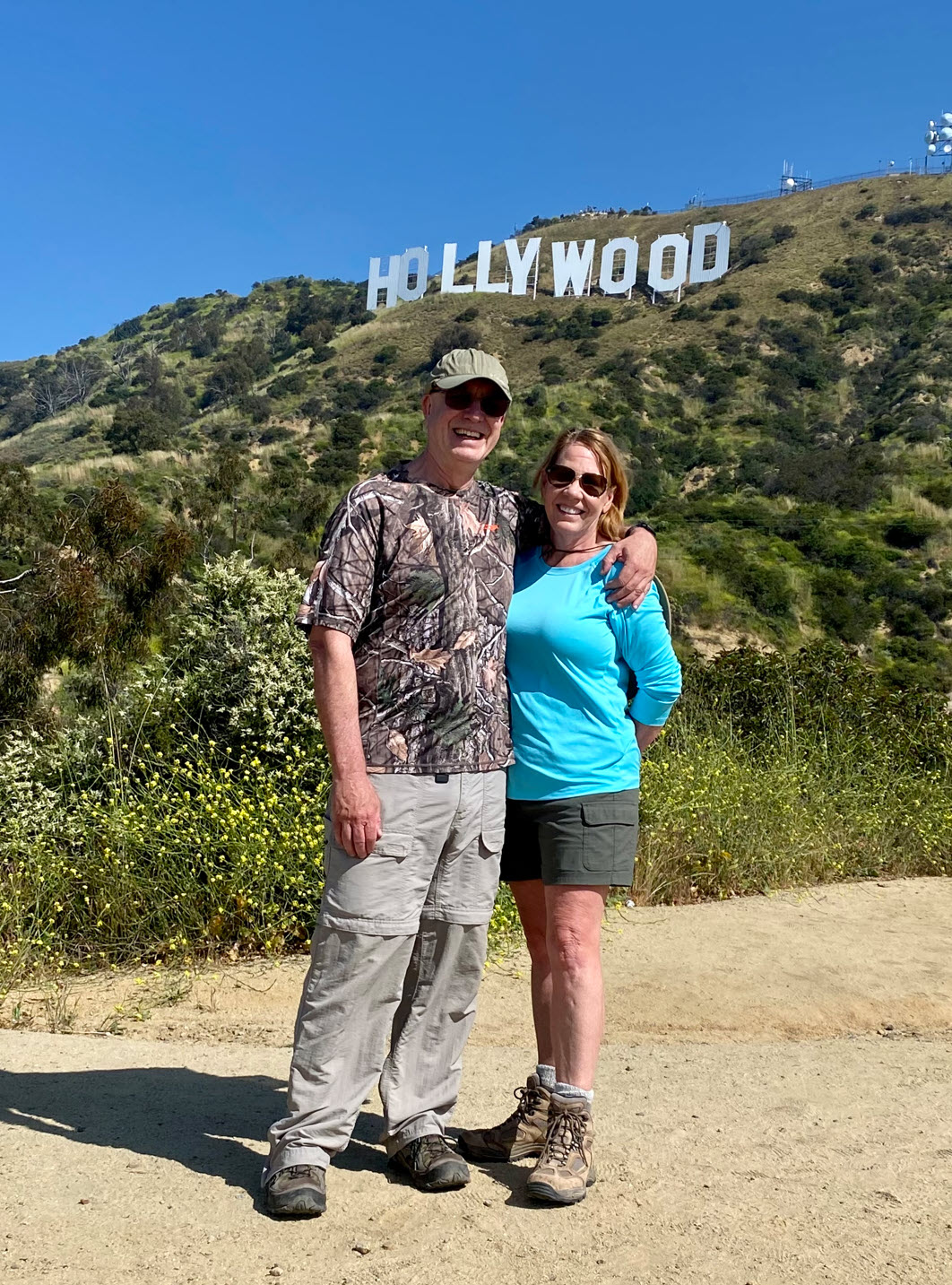
The photo below shows the sign from a neighborhood street were we walked up.

The entire hike round trip was about 4.5 miles with an elevation change of 900 feet. It’s all paved road, so no hiking poles are needed, and a quart of water should be plenty. It took us about an hour going up, and as much coming down.

About halfway up there is a good spot for a picture. Just above the W you can see a ridge and you can make out people on top of it. That’s where the next few shots are made from.

Finally at the top, the sign is all fenced in to protect it from vandalism, which was rampant in the early years. The sign was first put up in 1923 by a real estate company by the name of Hollywoodland. It was lit up at night and must have been a gaudy site. The intent was to keep it there for only a couple of years, but it “grew roots” and it’s become an iconic landmark recognized around the world, of course.

In the picture above you see the letters from behind. This is how close you can get. There are actually police up there that prevent any trespassing. Each letter is 46 feet tall. From right to left you see “LYWOOD.”

Looking down into the valley, the entire Los Angeles basin was shrouded in smog. On a clear day, one could see all the way to the ocean, and the entire panorama would stretch from downtown Los Angeles in on the left side to Hollywood and Century City on the right, with the Pacific Ocean in the background. Yesterday, all we could see was murky skylines that didn’t even show up in these photos.

Our friend took a panoramic of us at the top with all the letters visible.

On the way back, I looked up to the ridge from where we took the panoramic shot just a few minutes before. You get a sense of how many tourists there are. We must have walked past hundreds on our way up and down. It’s a very popular destination, of course, with the mountain being in the middle of the Los Angeles sprawl with more than 10 million population within a couple of hours of driving.

We finally hiked the Hollywood sign. Check!