
 Excerpt from page 52:
I pose a hypothetical question. As a man of some fifty-seven years of age, I am discovered sucking the penis of a baby boy. I ask you to picture your own outrage and revulsion. Ah, but I have my explanation all ready. I am a mohel: an appointed circumciser and foreskin remover. My authority comes from an ancient text, which commands me to take a baby boy’s penis in my hand, cut around the prepuce, and complete the action by taking his penis in my mouth, sucking off the foreskin, and spitting out the amputated flap along with a mouthful of blood and saliva. This practice as been abandoned by most Jews, either because of its unhygienic nature or its disturbing associations, but it still persists among the sort of Hasidic fundamentalists who hope for the Second Temple to be rebuilt in Jerusalem. To them, the primitive rite of the peri’ah metsitsah is part of the original and unbreakable covenant with god. In New York City in the year 2005, the ritual, as performed by a fifty-seven-year-old mohel, was found to have given genital herpes to several small boys, and to have caused the deaths of at least two of them. In normal circumstances, the disclosure would have led the public health department to forbid the practice and the mayor to denounce it. But in the capital of the modern world, in the first decade of the twenty-first century, such was not the case. Instead, Mayor Bloomberg overrode the reports by distinguished Jewish physicians who had warned of the danger of the custom, and told his health care bureaucracy to postpone any verdict. The crucial thing, he said, was to be sure that the free exercise of religion was not being infringed.
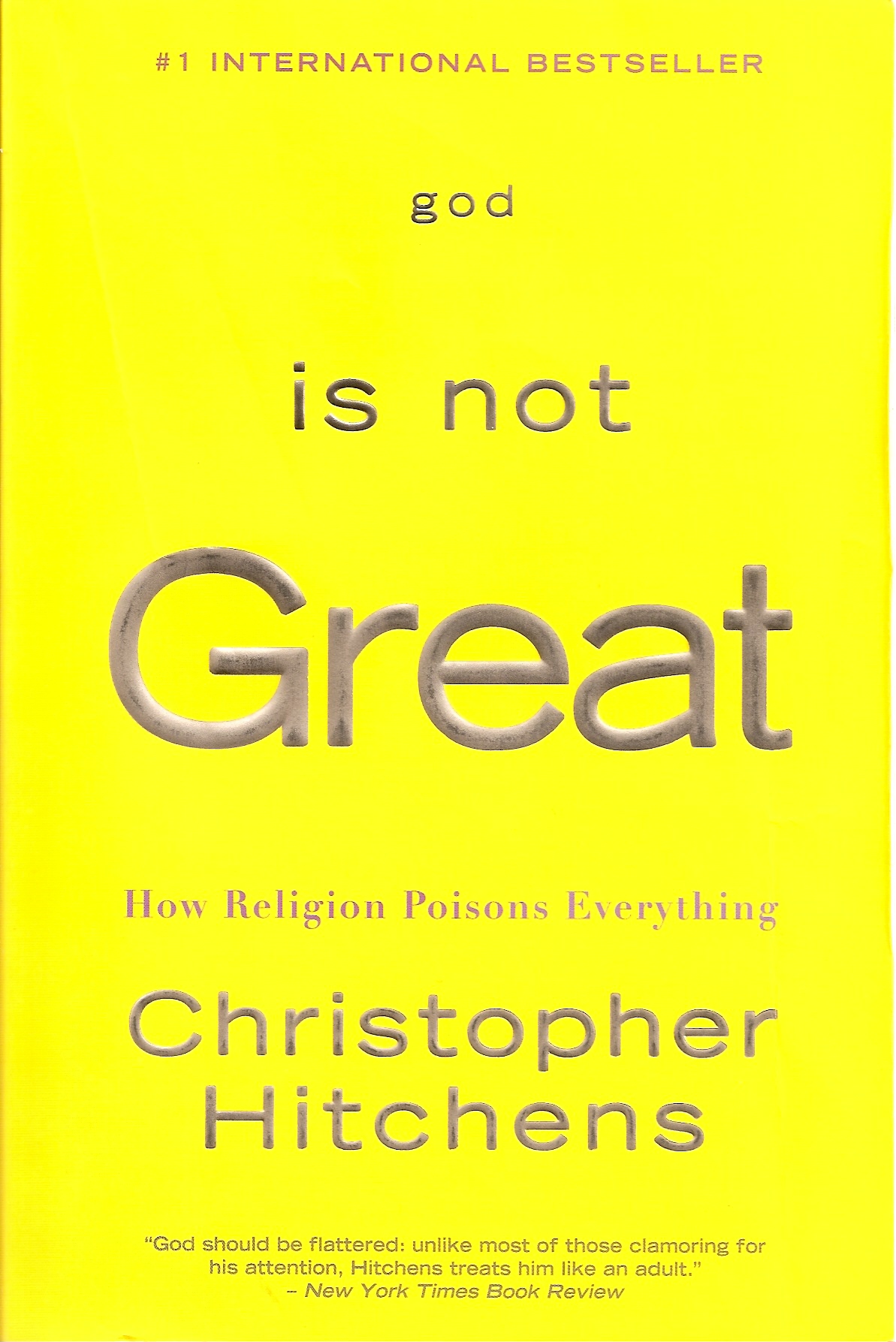
In his book, God is not Great – How Religion Poisons Everything, Hitchens points out example after example of ludicrous religious practices that are anchored in murky texts sometime thousands of years old that are practiced today to the detriment of people. He argues that we are doing injustice to our young by subjecting them mutilation (male circumcision, female circumcision, female sewing up of vaginas), by loading them down with immense guilt for completely natural phenomena or needs (masturbation, sexuality of any type, procreative desires) at a minimum.
But if it was “only” guilt! In the name of religions, still today, in some societies young girls are punished if they are raped. Girls as young as eight years old are married to old men and flogged if their dowries are too small.
In page, after page, after page, Hitchens indicts the major religions of Judaism, Christianity of all flavors, Islam, up to the “modern” religions of Mormons, the Moonies and many others, with brutal exposition of simple examples.
Here from page 199:
Pascal reminds me of the hypocrites and frauds who abound in Talmudic Jewish rationalization. Don’t do any work on the Sabbath yourself, buy pay someone else to do it. You obeyed the letter of the law: who’s counting? The Dalai Lama tells us that you can visit a prostitute as long as someone else pays her. Shia Muslims offer “temporary marriage,” selling men the permission to take a wife for an hour or two with the usual vows and then divorce her when they are done. Half of the splendid buildings in Rome would never have been raised if the sale of indulgences had not been so profitable: St. Peter’s itself was financed by a special one-time offer of that kind. The newest pope, the former Joseph Ratzinger, recently attracted Catholic youths to a festival by offering a certain “remission of sin” to those who attended.
On page 173, talking about Ghandi’s India: Cows were
cleverly denominated by the priests as “sacred” so that the poor ignorant people would not kill and eat their only capital during times of drought and famine.
As you can see, I am letting the book describe itself.
Its pages are full of vivid, appalling, grotesque and disgusting examples showing how the organized religions are designed to give a few individuals immense power over masses of people, make the leaders extremely wealthy, and keep the average person in fear of eternal pain and damnation, fueled by ignorance, outright falsehoods, covered up by pseudo science, and all attributed to a form of supreme being, obviously invented by each religion to suit its needs of the time.
God is not Great will not be easy to read for a “believer” of any religion and it will no doubt be banned by most as heresy, the work of the devil and thus evil and anti-social.
I wish I could remember the endless references and examples, as it would arm me as a more effective debater. As it is, it’s a powerful work of reference, and it is an eye-opener about religions, much like Sam Harris’ The End of Faith.
Rating: ***