
I grew up with the SETI generation. SETI stands for Search for Extraterrestrial Intelligence. The 1997 movie Contact with Jodie Foster was about this topic.
I remember marveling about the Drake Equation back in the 1960s, when I was a kid. Drake is Emeritus Professor of Astronomy and Astrophysics at the University of California, Santa Cruz. He attempted to estimate the number of extraterrestrial civilizations in the Milky Way galaxy that were advanced enough to communicate via technology outside of their planets. Based on a number of assumptions, Drake came to the conclusion that there were “probably between 1,000 and 100,000,000 civilizations in the Milky Way galaxy.”
Recently I waxed in this blog about Counting Stars and at that time I stated, based on best estimates, that there were about 100 billion stars in our (and the average) galaxy, and there were about 100 billion galaxies in the universe.
Recently, science has jumped way, way ahead, thanks to the successes of the Hubble and Kepler space telescopes. The numbers have been upgraded. Our own galaxy may contain as many as 200 billion stars, and there are probably hundreds of billions of galaxies in the universe. This multiplies those original numbers by a healthy factor of 2 to 5.
USA Today of November 5, 2013, reported on page 5A that there are likely “tens of billions” of Earth-like planets in our Milky Way galaxy alone, according to a study by astronomers from the University of California-Berkeley and the University of Hawaii. They stated that “planets like our Earth are relatively common throughout the Milky Way galaxy.” They estimate there are about 40 billion of them. The closest so far identified is only 12 light years away.
The image below is an artist’s rendering by NASA of all 3,638 planets and their suns so far discovered by the Kepler telescope. The stars and planets are shown in their relative sizes.
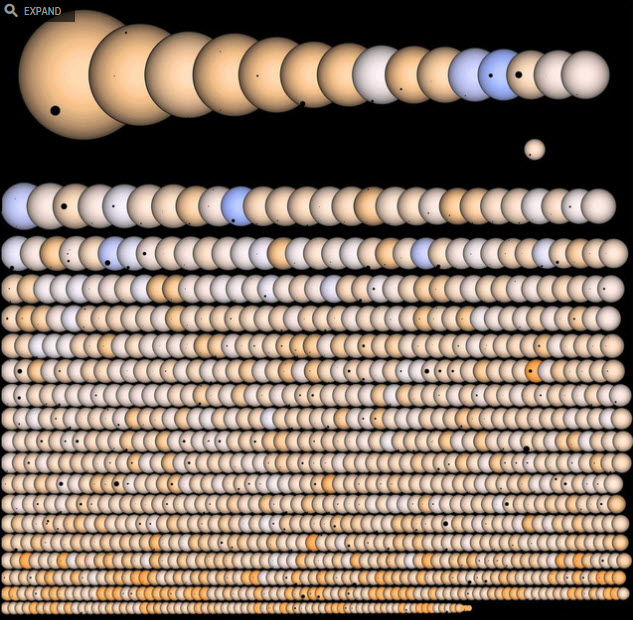
Of all the planets found, the fourth planet of the Gliese 581 star system may be the most like Earth ever found, so far.

Of course, the galaxy is old, and sentient civilizations can have developed 100 million years ago and vanished 99 million years ago, and we would never know. But these extremely pessimistic estimates I posed here still give us 10 advanced civilizations in our own galaxy that are alive right now, with intelligent beings looking up at the stars and wondering if they are alone.
If there are at least 10 civilizations in our galaxy, and there are more than 100 billion galaxies, there are one trillion civilizations in the universe. That’s a million million civilizations. A trillion.
Now we just have to keep looking and listening. SETI needs more funding. We need to find ONE of these one trillion. Once that happens, it will change our philosophical outlook profoundly.
This is the most exciting time to be alive – ever. I wish Carl Sagan were still with us to experience this.
Dr. Sagan is still with us , he never left . He just has a much better view than the one he had here .
He would have disagreed with that comment…
Pingback: Why extraterrestrial civilizations may be exceedingly rare | SelfAwarePatterns