Warren Buffett owns Geico, the auto insurance company with the infamous Gecko ads. At a recent company annual meeting, Buffet said that self-driving cars are a threat to the auto insurance industry. Buffet said: If self-driving cars prove successful, and reduce accidents dramatically, it will be very good for society and very bad for auto insurers.”
I am a computer programmer. Early in my career, 30 years ago, I specialized in embedded systems and systems automation. Part of my job was to make sure my “robots” didn’t collide with their own parts as they did their jobs, or worse, run into external obstacles, or worse yet, hurt humans. This requires complex algorithms and a large array of sensors, so the machine can “see” any obstructions in its way. In short, I know a bit about autonomous motion of machines.
A self-driving car is nothing but a complex robot. As it drives down the street, it applies a host of inputs, including radar, vision, and of course location signals from GPS to determine where it is, where it needs to go, and how to avoid any obstacles, like traffic, children running into roads, or ladders fallen off trucks. As I drive down the road today, I often think in terms of being a self-driving car. How would my car handle THIS situation right now? And I shudder.
But then, let’s think back to about 100 years ago, when cars first started taking over.
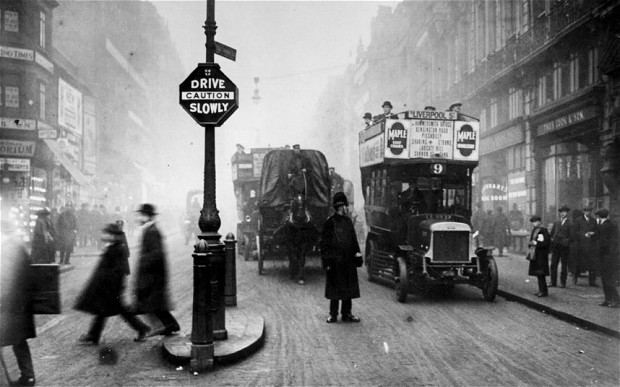
I imagine walking those streets, a jumble of activity, with teams of horses and loud, smoke-belching automobiles and trucks, all vying for their space, all trying to cross intersections full of people. If I had been there I would never have predicted that this automobile invasion would ever work. I would have thought that the cars would never be able to go much faster than the horses blocking their way, and that pedestrians would be killed by the hundreds every day.
The first traffic light was actually installed in London in 1868 to control traffic in Bridge Street, Great George Street and Parliament Street. The light was gas-powered, and operated by a policeman with a lever. Within a few weeks, the thing exploded, killing its operator.
The first electric traffic light was installed on 5 August 1914, almost exactly 100 years ago, on the corner of East 105th Street and Euclid Avenue in Cleveland, Ohio. If we had asked someone then whether they believed that such traffic lights would eventually be installed practically in all intersections in the world, they would have thought we were insane. Just like when the telephone was first invented. Critics ridiculed it. After all, you’d have to run a wire to every house for it to work!
Our infrastructure for automobiles is currently still designed for human drivers. Traffic lights are often in weird places, obstructed by trees or bushes, or too high to see above windshields. We’re now where we were in 1914 in the picture above, where horses got in the way of smooth traffic.
Once human drivers are the oddity, things can get smoother for self-driving cars. Eventually roads and freeways will be marked not with colored stripes but with radio frequency tags or other devices that cars can sense, so they know where the lanes and the exits are.
Have you ever entered a freeway where the exit follows the entrance closely and a whole line of cars tries to exit while another line of cars tries to enter, all within a few hundred feet of interchange? In places like that, cars will communicate with each other and the flow of traffic in and out will be smooth and swift. It will be scary to watch sitting inside the cars, but it will be smooth and accident free. The same will happen with traffic jams. Rubberneck jams on the opposite side of a freeway from an accident will be totally eliminated. Traffic jams will still move at 65 miles an hour with proper spacing between cars. Any sudden braking by a car 15 cars ahead will be communicated back to those following and every car will decelerate smoothly.
We’ll have way less accidents, and we’ll burn much less gas. Cars will monitor their own gas levels or remaining electric charges and schedule in stops at gas or charging stations.
And yes, I think Warren Buffett is right, self-driving cars will result in far fewer accidents and far fewer traffic deaths, causing real disruption to the auto insurance business. Driving while drinking or texting won’t be a problem anymore, and people will be able to start their workday as soon as they leave the garage.
And this is not very far in the future.