
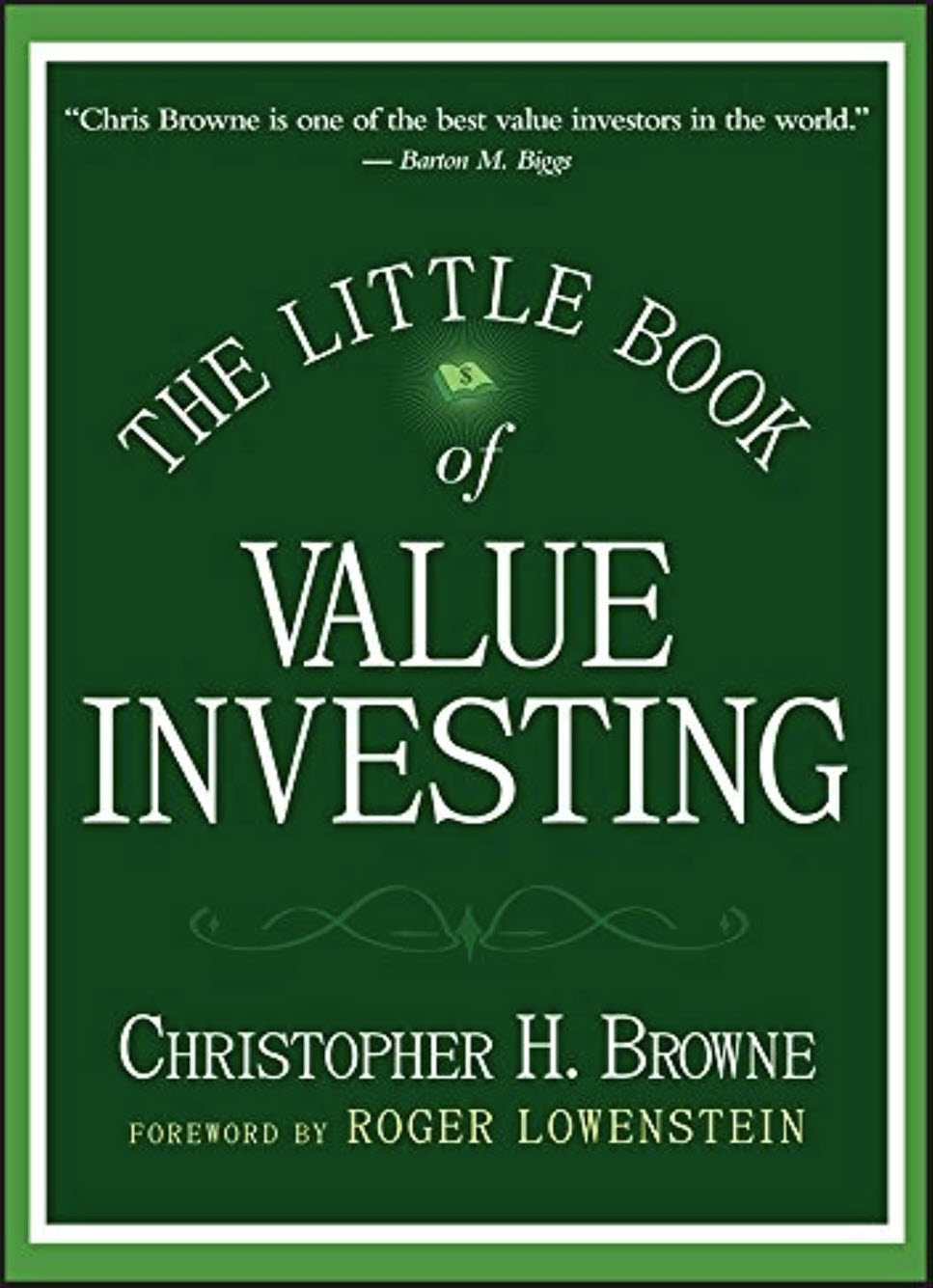
After I read The Little Book of Robo Investing a couple of weeks ago, I immediately opened an account on Wealthfront and starting taking it for a spin. After a few days of watching it work, I thought it’d be a great give for my (adult) son for Christmas. I went on Amazon and bought another hardcopy version to give to him. When it arrived a day later, it was this book instead: The Little Book of Value Investing. Apparently I had clicked on the book adjacent to the one I intended to order. While Amazon is very good about returns of erroneously bought merchandise, I thought the $22 would not matter and I might as well read it to broaden my outlook. What did they mean by “Value Investing?”
Browne is a seasoned investor who has been in the business himself since 1969. The premise of the book is that you buy cheap stocks with good potential and hold on to them for the long term. Investors who try to time the market and buy stocks when they are low and cash out when they are high are statistically not very successful, compared to the – well – Robo Investors. In the process of making his case, the author teaches us about stocks, how they work, how to read reports, how to evaluate balance sheets, all the traditional metrics that we learn in business school. Warren Buffett is brought up as an example numerous times, but then, Warren Buffett is quoted in every investment book of the last 30 years, so that might not mean too much. The story is the same one I learned in my recent readings of Robo Investing and also Tony Robbins’ Unshakable that I read just six weeks ago: Don’t day trade, don’t trade for the short term, don’t trade emotionally, but invest based on research and formulas proven by decades of research. If you want to learn about stock investing, this is a good book and a quick read.
There are some negatives, however: The book was first published in 2007. Here is a table included on page 42 showing the 20 largest corporations in the world, ranked by sales revenue.
I highlighted those four companies that are still on the list today in the last week of 2024. Just for comparison, I have created the equivalent table, just so you can see how the world has changed in the last 18 years:
| Company | Sales ($ billions) | County |
|---|---|---|
| Walmart | 673 | United States |
| Amazon | 620 | United States |
| Saudi Aramco | 488 | Saudi Arabia |
| Berkshire Hathaway | 452 | United States |
| Sinopec | 435 | China |
| PetroChina | 417 | China |
| Apple | 391 | United States |
| United Health | 389 | United States |
| CVS Health | 368 | United States |
| Volkswagen | 354 | Germany |
| Exxon Mobil | 339 | United States |
| Alphabet (Google) | 339 | United States |
| McKesson | 330 | United States |
| Toyota | 312 | Japan |
| China State Construction | 310 | China |
| Shell | 296 | United Kingdom |
| Cencora | 293 | United States |
| Costoco | 258 | United States |
| Glencore | 255 | Switzerland |
| Microsoft | 254 | United States |
Note that many of today’s most iconic companies, including Amazon, Microsoft, Alphabet and Apple were not even close then. The world has changed since 2007.
As a result, you can use this book as a textbook on investing and evaluation of companies, but I would not recommend it as an investment guide for 2025. If I had picked it up in 2007, I would have given it 3 stars. Today, simply for the brutal fact that it is dated, 1.5 is all I can do.
